
Adam Blake, Nick Poradek and Seth Cohen founded Mavria this spring. Photo courtesy of Mavria

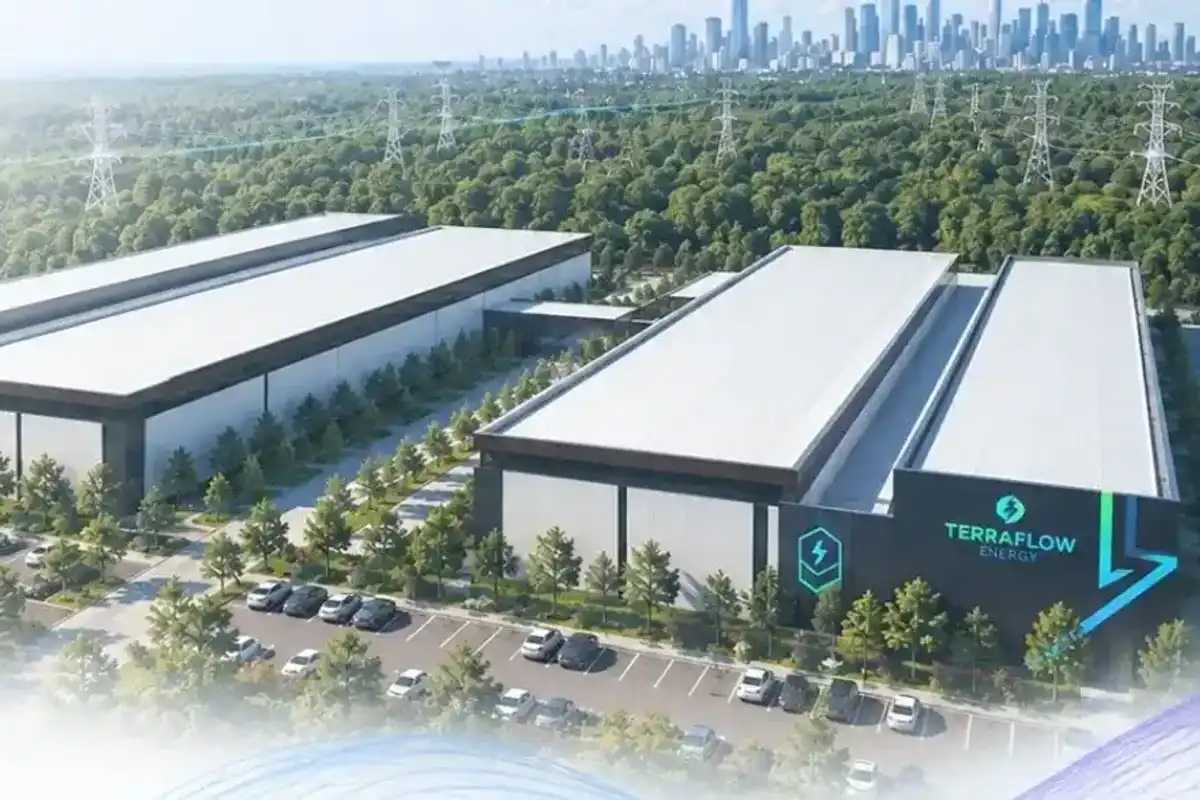
The Woodlands-based Mavria, which mass-produces factory-built modular AI data centers, just emerged from stealth mode with $130 million in funding at a $1 billion valuation.

Mavria raised the money in pre-seed and seed rounds led by Paradigm, an investment firm that concentrates on early-stage startups developing “pioneer” technology. Participants in the funding rounds include AMP PBC, Critical Frontier, Dream Ventures and Liquid 2 Ventures, co-founded by former NFL quarterback Joe Montana.

The company’s inaugural product, Terrain, is a prefabricated data center designed for AI labs, cloud computing providers and data center developers. Mavria says its platform avoids ground-up construction, delivering infrastructure more quickly and at a lower cost.

Mavria tells the Wall Street Journal that the first Terrain unit is being built at a Houston-area factory. The 5-megawatt Terrain system features power distribution, direct liquid cooling, controls and server racks.

“America sets the pace at the intelligence frontier. But the race is moving from the lab into the physical world,” Adam Blake, co-founder and CEO of Mavria, wrote in a blog post.

“Intelligence needs data centers. Data centers need power. Power needs factories, equipment, supply chains, and skilled workers, but much of that infrastructure is still built one custom project at a time, on timelines measured in years.”

Blake and Mavria’s two other co-founders, Nick Poradek and Seth Cohen, most recently worked at the U.S. Department of Energy. There, they focused on reforming the nuclear power sector.

From start to finish, it can take roughly three to six years to build a data center at an estimated cost of $10 million to $37 million per megawatt. Based on those figures, a 100-megawatt data center might cost as much as $3.7 billion.

Here are brief bios of Blake, Poradek and Cohen, who co-founded Mavria in May.

Adam Blake

Blake most recently was a senior advisor to U.S. Energy Secretary Chris Wright. He is co-founder and former CEO of Zego, a provider of energy management technology for property managers. Zego spun out from Brightergy, a commercial solar company. Blake is founder and former CEO of Brightergy.

Nick Poradek

Poradek, chief operating officer at Mavria, was also an advisor to the U.S. energy secretary. He is founder and former CEO of Spring-based Edera Energy, co-founder of The Woodlands-based craft-ice brand Clarity Ice, and founder and former CEO of The Woodlands-based Edera Capital. Poradek sold Edera Energy, a manufacturer of oilfield equipment, to Liberty Energy, a fracking company. Wright is Liberty’s founder and former chairman and CEO.

Seth Cohen

Cohen, chief strategy officer and chief legal officer at Mavria, was head of nuclear law and policy at the Department of Energy. He is also a former NASA advisor and a former attorney at Kirkland & Ellis.

“We believe in rapidly deploying infrastructure as a product, rather than custom-building every project,” Blake said. “We’re bringing together engineering, manufacturing, supply chains and capital so that every project makes us better at delivering the next.”


Ad Placement 300x100
Ad Placement 300x600

CultureMap Emails are Awesome

Meet the 40+ finalists for the 2026 Houston Innovation Awards

The Top Startups

Editor's note: We are just days away from unveiling the winners of the 2026 Houston Innovation Awards. Before the big reveal, we've compiled all of the coverage of this year's finalists. Get to know the 40+ finalists for nine awards categories below, then stay tuned to InnovationMap.com, where we'll announce the winners on Wednesday, November 18.

Minority-founded Business Finalists 

Our Minority-founded Businesses category honors innovative Houston startups founded or co-founded by BIPOC or LGBTQ+ representation. Five minority-founded businesses have been named finalists for the 2026 award. The finalists range from an AI edtech startup to a company operating in the floating offshore energy infrastructure sector.

They are: AI Made Fun, Deep Anchor Solutions, HEXASpec, Prana Surgical, and Torres Orbital Mining Inc. Read more.

Female-founded Business Finalists

Houston is home to many standout female founders, making inroads and breakthroughs in every industry. Our Female-founded Business category honors women-led startups that are shaping Houston innovation. Five female-founded businesses have been named finalists for the 2026 award. The finalists range from an AI startup for C-Suite execs to a company developing semi-autonomous crawler robots for corrosion detection.

They are: Adair, ARIX Technologies, Bairitone Health, FlowCellutions, and ParaDocs Health. Read more.

Health Tech Business Finalists

Houston has been driving medical innovation for decades and the local healthcare ecosystem continues to improve how patients are diagnosed, treated and cared for. The Health Tech Business category in our 2026 Houston Innovation Awards honors innovative startups within the health and medical technology sectors. Four forward-thinking businesses have been named finalists for the 2026 award. This year's finalists range from a startup developing miniaturized medical technologies for space to a company using AI to help develop cancer treatment plans.

They are: Bairitone Health, InformAI Inc., Prana Surgical, and Skybound MedTech. Read more.

Deep Tech Business Finalists

Houston has long been at the forefront of innovation, from NASA’s Johnson Space Center to its startup ecosystem using technology to disrupt industries. Our Deep Tech Business category honors innovative startups providing technology solutions based on substantial scientific or engineering challenges, including those in the AI, robotics and space sectors. Five deep tech companies have been named finalists for the 2026 award.

They are: Casimir, FocisAI, Machine Saver Inc., Square Robot, and Venus Aerospace. Read more.

Energy Transition Business Finalists

Houston is home to a growing number of startups reshaping what it means to be called the "Energy Capital of the World." Our Energy Transition Business category honors those innovative startups that are providing solutions within renewables, climatetech, clean energy, alternative materials, circular economy, and more. Five clean energy startups have been named finalists for the 2026 award. The finalists range from a lower-emission steel producer to a diagnostics platform developer working to support batteries used in data centers.

They are: Capwell Services, FlowCellutions, Hertha Metals, Mars Materials, and Solidec. Read more.

Scaleup of the Year Finalists

From IPOs to groundbreakings, some of Houston's most innovative companies reached major milestones this year. Our Scaleup of the Year category honors innovative later-stage startups that have recently reached a significant milestone in company growth. Three scaleups have been named finalists for the 2026 award.

They are: Erock, Hertha Metals, and Venus Aerospace. Read more.

Incubator/Accelerator of the Year Finalists

It takes a village to launch a business. That's where Houston's network of incubators and accelerators can step in, providing the resources, mentorship and community needed to push a fledgling company forward. Our Incubator/Accelerator of the Year category honors local organizations that are championing and fueling the growth of Houston startups. Three incubators and accelerators have been named finalists for the 2026 award. They support startups ranging from hard-tech companies to food and youth concepts.

They are: Activate, Impact Hub Houston, and MarMo Innovation. Read more.

Startup of the Year Finalists

Seven exceptional finalists are in the running for the title of Startup of the Year, which is our people's choice award in the annual Houston Innovation Awards. From innovative platforms benefiting the education, commerce, health, investment and IT sectors to next-gen memory technology and improvements for robotic supply chains, these startups are making an impact in Houston and beyond.

The finalists are: Fluxworks, IronLattice, Lumino, Progress Report, Rosarium Health, TokenRoster, and Thread. Read more.

Mentor of the Year Finalists

Houston’s thriving startup ecosystem is supported by a network of experienced leaders who work behind the scenes, investing their time and knowledge to help the next generation of entrepreneurs succeed. Our Mentor of the Year category honors those who dedicate their time and expertise to guide and support budding entrepreneurs. Six individuals have been named finalists for the 2026 award. They support promising startups in the medical tech, digital health, clean energy, hardware sectors and more.

They are: Al Danto, Rice University; Eric Rubenstein, New Climate Ventures; Jeremy Pitts, Activate; Joe Alapat, Liongard; Kyle Judah, Rice University's Liu Idea Lab for Innovation & Entrepreneurship; Rachel Bickham, Bickham Services Unlimited LLC. Read more.

Houston's new state-of-the-art academy FLAMA breaks ground at historic site

Groundbreaking Education

Houston’s newest school for arts and music broke ground in October in the city’s historic East End. The Frank Liu Jr. Academy for Music and Arts (FLAMA), a tuition-free charter school, will welcome students in pre-K through 8th grade next August.

Members of the Liu family, the school’s founding board members, elected officials, and East End community partners gathered at Buffalo Bayou Partnership’s historic Turkey Bend development for the official groundbreaking ceremony on October 8, which kicked off with a performance by the Kinder High School for the Performing and Visual Arts’ Mariachi group.

The new school is on a portion of the former Folgers Coffee Plant, located at 235 N. Norwood St. OMA, an international architectural firm known for its approach to urbanism, cultural projects, and adaptive reuse, is transforming the 1930s plant into a state-of-the-art educational facility.

“We’re excited to celebrate this milestone for FLAMA and look forward to seeing the transformation of the historic Folgers plant into a new home for music and arts education,” said Jason Long, one of the firm’s partners. “Like fine-tuning an instrument, our design recalibrates the existing industrial structure into an open, connected, and expressive environment for learning. FLAMA will be a new learning environment that builds on the character of the existing building while giving it new life for the community.”

Flama academy Courtesy rendering

Unfolding across three stories, the school draws inspiration from Montessori education principles, which prioritize openness, independence, and collective learning through shared “neighborhoods.”

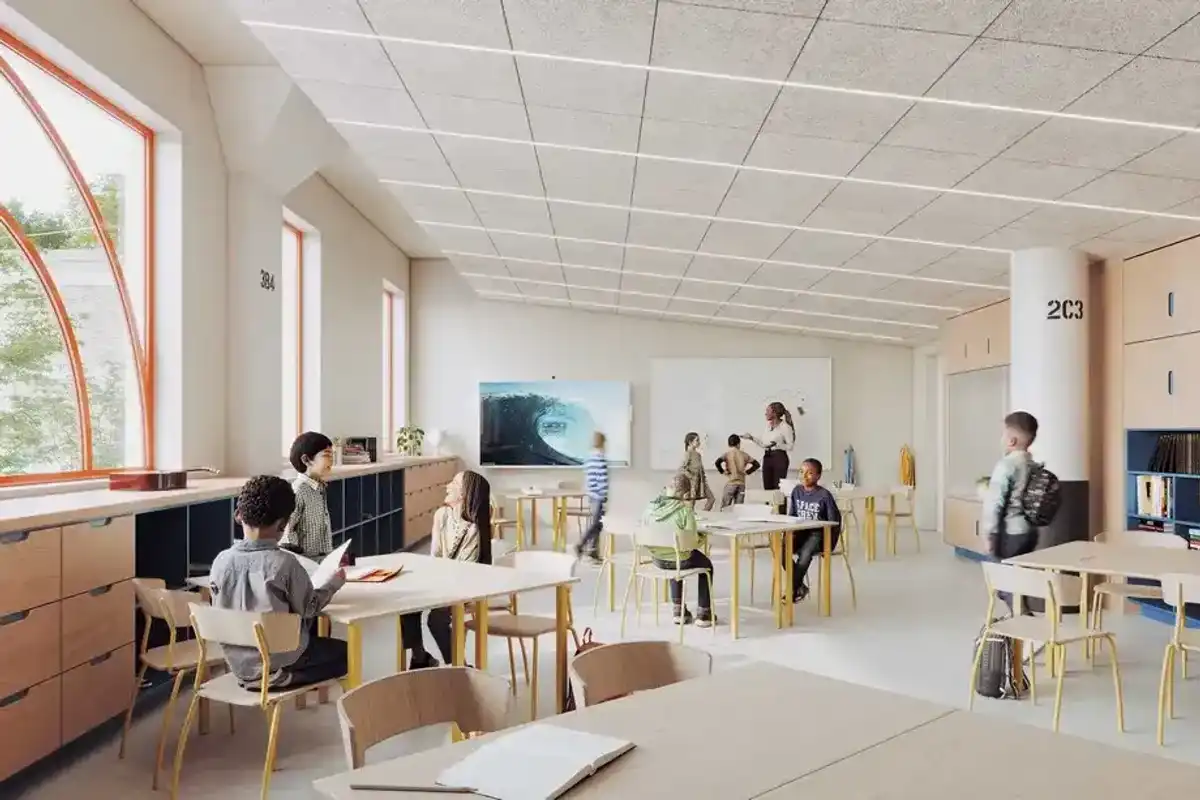
It all begins when students, families and guests enter through a private courtyard. The welcoming space will change the building’s original industrial facade into a brightly colored, kid-friendly spot, complete with yellow and green blocks spelling out the school’s name. The original windows will be restored to preserve the building’s historic character and upgraded to meet contemporary energy standards. Similarly, all of the school’s classrooms are located around the building’s perimeter, providing an abundance of natural light.

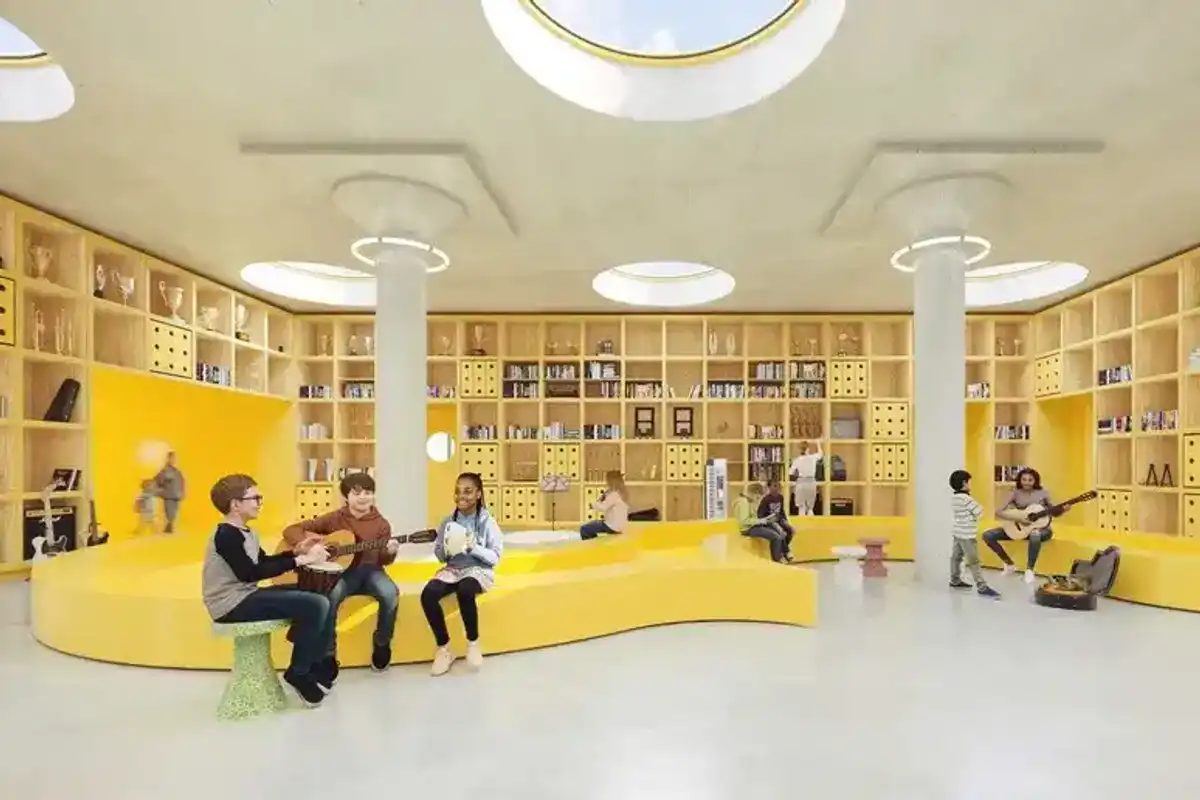
Inside, FLAMA’s three stories are divided so that younger students will find their classrooms at the school’s base, and they will move upward through the school as they progress through grade levels. The ground level has a common area for younger kids that could host drum circles, movement classes, or “breakout play.”

Children in first and second grade have their own larger open space, with an eye-catching staircase, that's inspired by the curve of a French horn. The space lends itself to everything from small gatherings to performances by the school’s early musicians.

As students progress through third grade and up, they’ll find FLAMA’s upper floors created to meet their growing artistic and intellectual needs. One example is the open library, a shared spot for students in third through fifth grades. It has flexible furniture that can transform the space into a place for group study and project work, as well as one that can host after-school activities. Directly above this library is a second common room for middle schoolers where students in sixth, seventh, and eighth grades can study.

FLAMA academy Courtesy rendering

These two libraries are connected by an F-shaped floor opening that references both the F-hole of a string instrument and the forte symbol. Musicians know this curly f as a note indicating them to play a passage with strength. That could easily be a metaphor for the school itself, which will combine high-quality education with rigorous academics. This visual cue emphasizes FLAMA’s desire for music and art instruction to amplify learning across reading, writing, math, and science.

“This will be a place where children can discover their talents, families can find opportunities close to home, and music and art can open the doors to a stronger education,” said Congresswoman Sylvia Garcia, who attended the groundbreaking. “I know how much it matters when someone brings opportunity within the reach of a child.”

Dr. R. Scott Allen, FLAMA’s founding superintendent and former principal of Kinder HSPVA, spoke about the school’s vision to pair a rigorous, engaging academic opportunity with deep immersion in music and visual arts.

Congressman Christian Menefee, State Senator Carol Alvarado, and Houston City Councilmember Mario Castillo also delivered remarks at the ceremony, speaking about the school’s power to not only transform Houston’s Second, Third, and Fifth Ward communities, but also bring incredible education opportunities to students. Former Mayor Annise Parker, former State Board of Education Member Staci Childs, State Representative Christina Morales, and Houston City Councilmembers Joaquin Martinez and Sallie Alcorn also attended the event.

“In this city, known for our undeniable contributions to music and arts, the gap has never been ability or talent; it has always been opportunity, and opportunity can be built,” said Kirby Liu, who spoke at the groundbreaking, memorializing his late brother’s vision of arts education for the youngest Houstonians. “When it comes to opportunity being foreclosed on our children, we will try like hell to bust those damned doors down.”

The Frank Liu Jr. Foundation has pledged $20 million in financial support during FLAMA’s first years of operation. Applications are now open for kindergarten and first grade for the 2027-2028 school year.

---

This article first appeared on CultureMap.com.