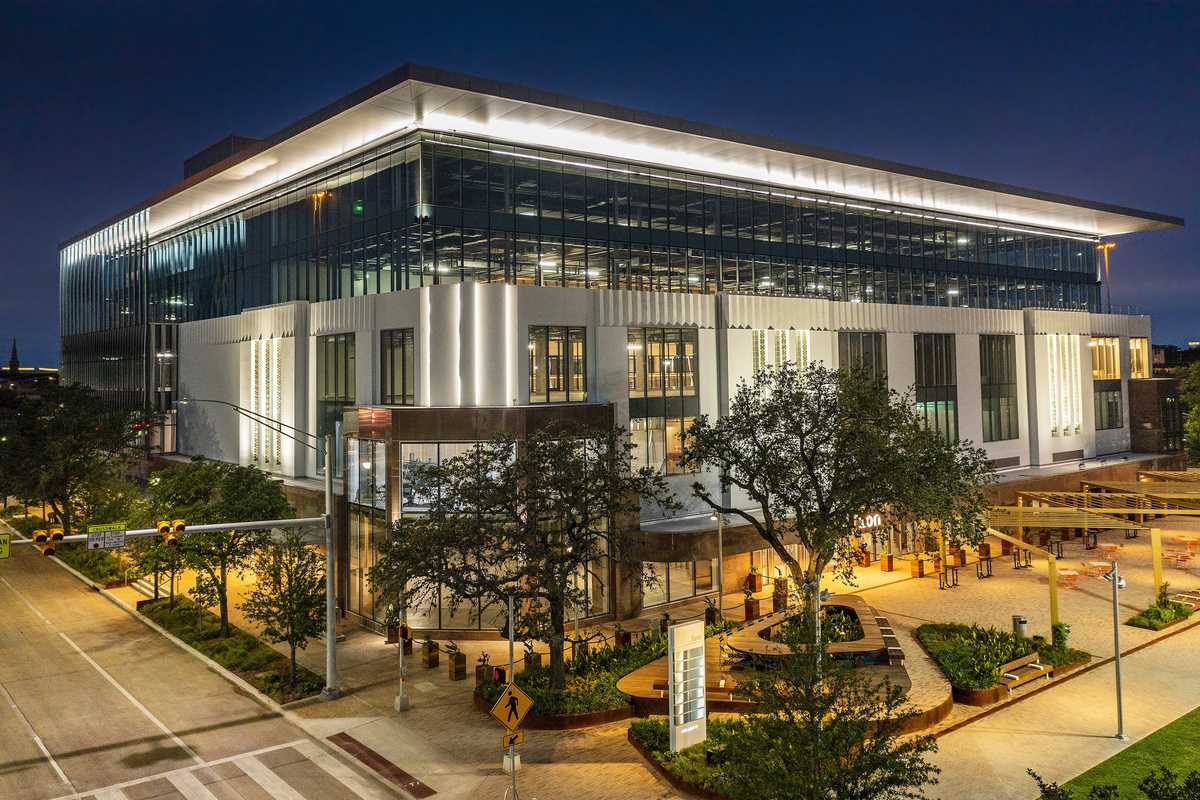
After a successful overseas festival in Sydney, Australia, SXSW will head to London in 2025. Photo courtesy of SXSW

Get ready to see triple in 2025: South by Southwest (SXSW) is heading across the pond for its first-ever conference in London in June 2025.

According to a press release, the new European festival and conference will aim to showcase London's "status as a global meeting place." Much like the original Austin festival, SXW London will occupy dozens of galleries, clubs, and other event venues throughout Shoreditch – located in east London – for its conference sessions, exhibitions, film screenings, activations, music showcases, and much more.

"SXSW London will build on Austin's incredible legacy, presenting an event that underpins why SXSW is the go-to destination for professionals and creatives seeking meaningful connections, unexpected experiences and ideas that can help shape the world," said SXSW London managing director Randel Bryan in the release.

SXSW held its first overseas festival in Sydney, Australia in 2023; The festival counted more than 287,000 attendees, encouraging leadership and organizers to expand further outside of the U.S.

London was a clear-cut choice thanks to the city's diversity, economy, and innovation. The release said the United Kingdom's cultural and creative industries alone generate £125 billion (over $156 billion), with more than half of that revenue coming from London.

Sadiq Kha, the mayor of London, said in a statement that he was inspired to facilitate a partnership with SXSW after visiting Austin during the 2018 festival.

"This is a historic opportunity for London to once again bring the world’s most exciting talent together as part of our mission to build a better and more prosperous London for everyone," Kha said.

While official festival dates are still under wraps, the release says badges are expected to go on sale in October 2024. More information about SXSW London 2025 can be found on sxswlondon.com.

------

This article originally ran on CultureMap.

Ad Placement 300x100
Ad Placement 300x600

CultureMap Emails are Awesome

Houston-based HPE wins $931M contract to upgrade military data centers

defense data centers

Hewlett Packard Enterprise (HPE), based in Spring, Texas, which provides AI, cloud, and networking products and services, has received a $931 million contract to modernize data centers run by the federal Defense Information Systems Agency.

HPE says it will supply distributed hybrid multicloud technology to the federal agency, which provides combat support for U.S. troops. The project will feature HPE’s Private Cloud Enterprise and GreenLake offerings. It will allow DISA to scale and accelerate communications, improve AI and data analytics, boost IT efficiencies, reduce costs and more, according to a news release from HPE.

The contract comes after the completion of HPE’s test of distributed hybrid multicloud technology at Defense Information Systems Agency (DISA) data centers in Mechanicsburg, Pennsylvania, and Ogden, Utah. This technology is aimed at managing DISA’s IT infrastructure and resources across public and private clouds through one hybrid multicloud platform, according to Data Center Dynamics.

Fidelma Russo, executive vice president and general manager of hybrid cloud at HPE, said in a news release that the project will enable DISA to “deliver innovative, future-ready managed services to the agencies it supports that are operating across the globe.”

The platform being developed for DISA “is designed to mirror the look and feel of a public cloud, replicating many of the key features” offered by cloud computing businesses such as Amazon Web Services (AWS), Microsoft Azure and Google Cloud Platform, according to The Register.

In the 1990s, DISA consolidated 194 data centers into 16. According to The Register, these are the U.S. military’s most sensitive data centers.

More recently, in 2024, the Fort Meade, Maryland-based agency laid out a five-year strategy to “simplify the network globally with large-scale adoption of command IT environments,” according to Data Center Dynamics.

Astros and Rockets launch new streaming service for Houston sports fans

Sports Talk

Houston sports fans now have a way to watch their favorite teams without a cable or satellite subscription. Launched December 3, the Space City Home Network’s SCHN+ service allows consumers to watch the Houston Astros and Houston Rockets via iOS, Apple TV, Android, Amazon Fire TV, or web browser.

A subscription to SCHN+ allows sports fans to watch all Astros and Rockets games, as well as behind-the-scenes features and other on-demand content. It’s priced at $19.99 per month or $199.99 annually (plus tax). People who watch Space City Network Network via their existing cable or satellite service will be able to access SCHN+ at no additional charge.

As the Houston Chronicle notes, the Astros and Rockets were the only MLB and NBA teams not to offer a direct-to-consumer streaming option.

“We’re thrilled to offer another great option to ensure fans have access to watch games, and the SCHN+ streaming app makes it easier than ever to cheer on the Rockets,” Rockets alternate governor Patrick Fertitta said in a statement.

“Providing fans with a convenient way to watch their favorite teams, along with our network’s award-winning programming, was an essential addition. This season feels special, and we’re committed to exploring new ways to elevate our broadcasts for Rockets fans to enjoy.”

Astros owner Jim Crane echoed Feritta’s comments, adding, “Providing fans options on how they view our games is important as we continue to grow the game – we want to make it accessible to as large an audience as possible. We are looking forward to the 2026 season and more Astros fans watching our players compete for another championship.”

SCHN+ is available to customers in Texas; Louisiana; Arkansas; Oklahoma; and the following counties in New Mexico: Dona Ana, Eddy, Lea, Chaves, Roosevelt, Curry, Quay, Union, and Debaca. Fans outside these areas will need to subscribe to the NBA and MLB out-of-market services.

---

This article originally appeared on CultureMap.com.

Rice University researchers unveil new model that could sharpen MRI scans

MRI innovation

Researchers at Rice University, in collaboration with Oak Ridge National Laboratory, have developed a new model that could lead to sharper imaging and safer diagnostics using magnetic resonance imaging, or MRI.

In a study recently published in The Journal of Chemical Physics, the team of researchers showed how they used the Fokker-Planck equation to better understand how water molecules respond to contrast agents in a process known as “relaxation.” Previous models only approximated how water molecules relaxed around contrasting agents. However, through this new model, known as the NMR eigenmodes framework, the research team has uncovered the “full physical equations” to explain the process.

“The concept is similar to how a musical chord consists of many notes,” Thiago Pinheiro, the study’s first author, a Rice doctoral graduate in chemical and biomolecular engineering and postdoctoral researcher in the chemical sciences division at Oak Ridge National Laboratory, said in a news release. “Previous models only captured one or two notes, while ours picks up the full harmony.”

According to Rice, the findings could lead to the development and application of new contrast agents for clearer MRIs in medicine and materials science. Beyond MRIs, the NMR relaxation method could also be applied to other areas like battery design and subsurface fluid flow.

“In the present paper, we developed a comprehensive theory to interpret those previous molecular dynamics simulations and experimental findings,” Dilipkumar Asthagiri, a senior computational biomedical scientist in the National Center for Computational Sciences at Oak Ridge National Laboratory, said in the release. ”The theory, however, is general and can be used to understand NMR relaxation in liquids broadly.”

The team has also made its code available as open source to encourage its adoption and further development by the broader scientific community.

“By better modeling the physics of nuclear magnetic resonance relaxation in liquids, we gain a tool that doesn’t just predict but also explains the phenomenon,” Walter Chapman, a professor of chemical and biomolecular engineering at Rice, added in the release. “That is crucial when lives and technologies depend on accurate scientific understanding.”

The study was backed by The Ken Kennedy Institute, Rice Creative Ventures Fund, Robert A. Welch Foundation and Oak Ridge Leadership Computing Facility at Oak Ridge National Laboratory.