CodeLaunch, which pairs startups with software consultants, is returning to Houston this spring. Photo via codelaunch.com

A traveling seed-stage accelerator has announced its return to Houston and named its second cohort.

CodeLaunch, produced by Dallas-based constant and software development company Improving and presented by Ohio-based VC network Cyrannus, is returning to Houston. The company's second Houston accelerator event will be held on March 2.

Putting a fresh spin on the seed accelerator model, CodeLaunch combines a startup competition with a tech tradeshow, as well as allows for networking among attendees. Since its inception ten years ago, the touring competition has doled out over $1.4 million in services to its finalists and overall winners.

"CodeLaunch is a startup and rock-n-roll show like nothing you've ever seen before," says CodeLaunch President and Founder Jason W. Taylor in a news release.

The competition pairs six startups with six startup consulting companies. This year's finalists and mentor pairings are as follows:

  • Lake Charles, Louisiana-based GOPHR's consultant mentor is Softeq
  • Port Arthur, Texas-based DrinKicks is paired with BJSS
  • Energy360, based in Houston, has been matched with Honeycomb Software
  • Inpathy, based in Detroit and Tyler, Texas, will work with Contollo
  • Drivingo, led by a student founder from Virginia Tech, is selected to collaborate with Blue People
  • Houston-based AnyShift's consultant mentor is Improving

Houston-based Softeq is returning to the event after working with software startup Codiac.

“CodeLaunch was great. We gained customers, investors, and a lot of local notoriety. It was the best event we had all last year," says Ben Ghazi, founder of Codiac about the event.

ResQ TRX, a Houston startup that provides solutions for the logistics industry, won CodeLaunch HOU 2022. Houston-based Clutch won Judges' Choice in last year's competition.

This year, investment is also on the line. Presenting partner Cyrannus announced that all startup founders who advance to the semifinal round of CodeLaunch will be competing in a $100,000 investment challenge, as well as the $50,000 challenge for impact startups. There would be one or two winners — either a winner for each award or, if a company scores top marks in both categories, one company can take home the entire $150,000.

“Not only will (a winner) get the cash, but also be introduced to a network that will help them refine their idea and get ready for their first big fundraiser," says Lee Mosbacker, founder of Cyrannus, in a news release.

This year's CodeLaunch event will be a part of Houston Tech Rodeo, which is taking place February 27 to March 2 this year. Tech Rodeo, which announced its schedule this week, will conclude its programming with the CodeLaunch event.

"Houston Exponential could not be more excited about our partnership with CodeLaunch Houston," says Houston Exponential CEO Natara Branch in the release. "They are a fantastic ally in Houston’s efforts to serve its growing startup community and CodeLaunch is an incredible fit for the capstone of the 2022 Tech Rodeo. Finishing off Tech Rodeo with CodeLaunch's exciting atmosphere will be a highly anticipated event for the Houston innovation ecosystem after an engaging week of programming."

Ad Placement 300x100
Ad Placement 300x600

CultureMap Emails are Awesome

Houston researchers develop breakthrough device that could bypass spinal injuries

breakthrough research

Scientists at Houston Methodist have announced a significant leap forward for spinal cord injury recovery.

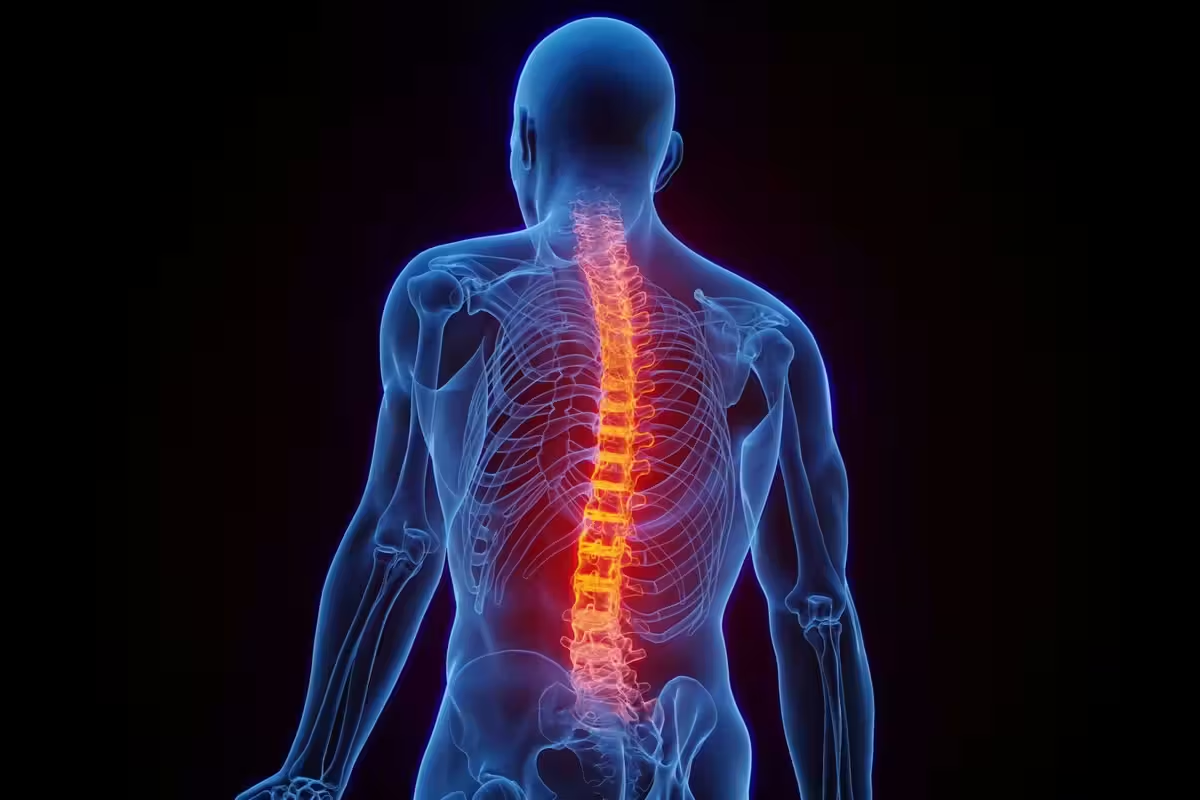
The researchers have developed a device that essentially bypasses spinal injuries, allowing signals from previously “lost” functions to reach the brain, a new study published in Nature Communications shows.

“Most current technologies try to improve whatever function remains after a spinal cord injury,” Dr. Damiano Barone, assistant professor of neurosurgery in the Department of Neurosurgery at Houston Methodist and co-lead on the study, said in a news release. “Our goal is different. Rather than fixing the injury itself, we want to bypass it completely and create an alternative route for signals to travel.”

The study involved a single ultrathin circumferential electrode array made to conform around the spinal cord without penetrating neural tissue, which was implanted into rodent and pig models with spinal injuries. The electrode array was able to interpret motor, sensory and autonomic signals around the injury. Think of it as a set of detours that restore road access to isolated towns after a disaster destroys the highway instead of just rebuilding the highway.

Over the course of three days, the arrays detected signals of intended movement from low-frequency spinal oscillations with more than 94 percent accuracy. This worked across species and was replicated in feasibility studies on human cadavers.

This research could serve as a new foundation for neuroprosthetic implants that could restore connectivity to the 2.5 million people worldwide suffering from spinal injuries that result in loss of ability. Future development could result in everything from restored organ function to mobility, according to Houston Methodist.

George Malliaras, the Prince Professor of Technology in the Department of Engineering at the University of Cambridge, who co-led the study, sees it as a fundamental restructuring of the science of spinal trauma.

“This could represent a paradigm change in how we think about spinal cord injuries,” Malliaras said. “Instead of starting from the idea that what is lost is gone forever, this approach asks whether we can restore function by carrying the signal around the injury.”

Further work involving laboratory models will need to be completed before launching human trials.

Grants from the National Institutes of Health, Houston Methodist Katz Investigator Award, Helaers Research Award and the Engineering and Physical Sciences Research Council helped support the study. Other collaborators on the study include Salim Hadwe, Ruben Serrano, George Psaltakis, Margaux Forner, Chaeyeon Lee, Sydney Swedick, Moleca Ghnnam, Tawfique Hasan and Alejandro Carnicer-Lombarte from the University of Cambridge; and Anton Banta and Xueer Zhang from Houston Methodist.

Abbott assembles expert team to help lure U.S. Space Academy to Texas

space race

State Rep. Greg Bonnen of Friendswood has been tapped to lead a new team that will promote Texas as the future home of the U.S. Space Academy.

Bonnen, a neurosurgeon, chairs Houston Physicians’ Hospital and the powerful Texas House Appropriations Committee. His House district is close to NASA’s Johnson Space Center.

Gov. Greg Abbott appointed the seven-member team. Last month, President Trump signed an executive order establishing the Presidential Commission on the U.S. Space Academy. Commission members, who held their first meeting this month, will recommend a permanent location for the academy.

Texas officials are pushing a site near Johnson Space Center to host the academy. Alabama, Colorado and Florida are among Texas’ competitors.

In a joint statement, U.S. Sen. Ted Cruz and U.S. Rep. Brian Babin, both of Texas, issued a statement backing the state’s bid for the academy. Cruz lives in Houston. Babbin lives in Woodville, about 55 miles south of Beaumont.

“America’s space program is built across the country, but Texas is where the pieces come together,” the lawmakers said. “We are ready to lead the next generation of space pioneers and look forward to showing why Texas is the right home for the U.S. Space Academy.”

The academy’s curriculum will include technical education, leadership development and public service components. Graduates will be set up for careers in the U.S. military, civil service, and aerospace sectors.

The Abbott-appointed team will work with the Texas Space Commission to prepare the state’s proposal for the academy.

In addition to Bonnen, team members with ties to Houston include:

  • Robert Ambrose, who grew up in Houston. He worked at Johnson Space Center before becoming associate director of the Texas A&M Space Institute.
  • Former NASA astronaut Nancy Curry-Gregg, director of the Texas A&M Space Institute. She earned a doctoral degree from the University of Houston and previously worked at Johnson Space Center.
  • Former NASA astronaut Jack Fischer, senior vice president of Houston-based Intuitive Machines. The company builds spacecraft, delivers payloads to the moon and launches satellites.

“Texas is the home of America’s human spaceflight program,” Abbott said in a release. “No state can match what Texas brings to this mission.”

“NASA’s Johnson Space Center, world-class universities, a premier commercial space industry, major military installations, and an unmatched aerospace workforce give Texas every asset the United States Space Academy requires,” the governor added.