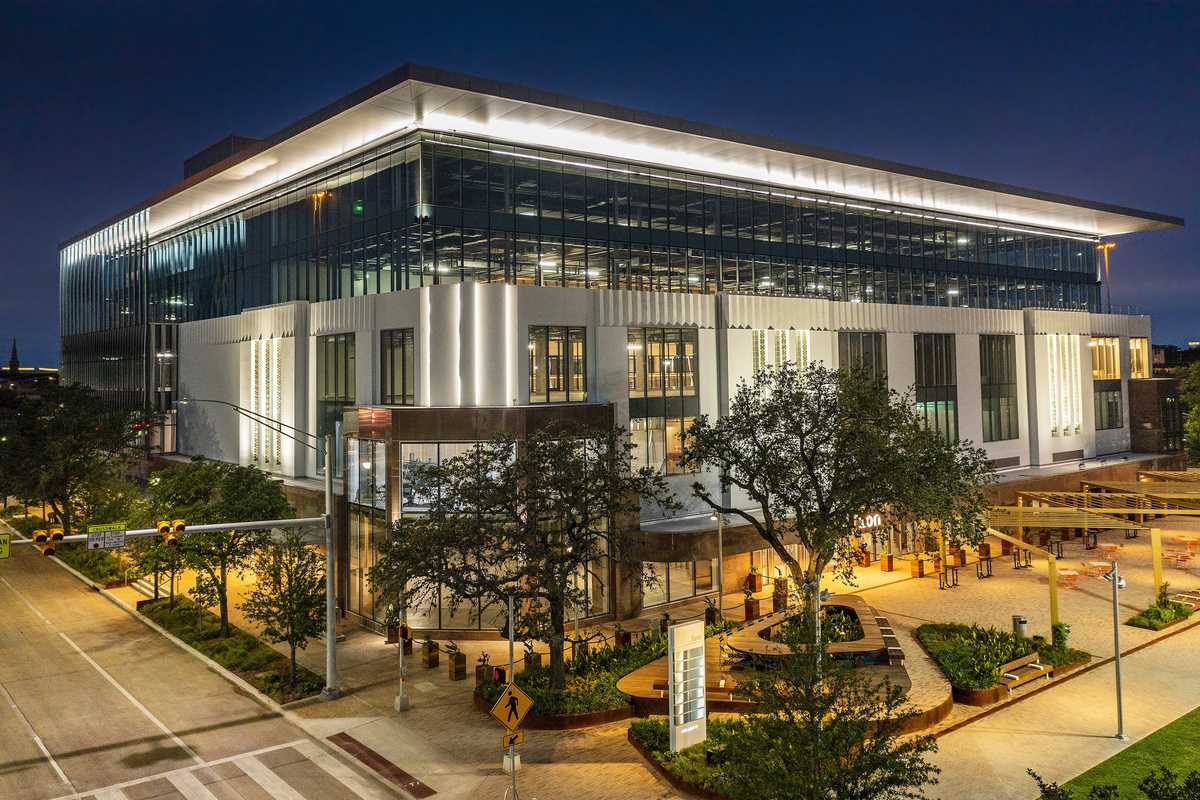
Rice University will lead a new U.S. Space Force-backed consortium to fast-track breakthrough remote sensing technologies. Photo via Getty Images

Rice University has signed an $8.1 million cooperative agreement to lead the U.S. Space Force University Consortium/Space Strategic Technology Institute 4 (SSTI).

The new entity will be known as the Center for Advanced Space Sensing Technologies (CASST) at Rice and will focus on developing innovative remote sensing technologies.

“This investment positions Rice at the forefront of the technologies that will define how we see, understand and operate in space,” Amy Dittmar, Howard R. Hughes Provost and executive vice president for academic affairs, said in a news release. “By bringing together advanced remote sensing, AI-driven analysis and cross-institutional expertise, CASST will help transform raw space data into real-time insight and expand the frontiers of scientific discovery.

The news comes shortly after the Texas Space Commission approved a nearly $14.2 million grant for the newly created Center for Space Technologies at Rice.

David Alexander, director of the Rice Space Institute, will lead CASST. Alexander is also an inaugural member of the Texas Aerospace Research and Space Economy Consortium and he serves on the boards of the Houston Spaceport Development Corporation, SpaceCom and the Sasakawa International Center for Space Architecture. The team also includes Rice professors and staff Kevin Kelly, Tomasz Tkaczyk, Kenny Evans, Kaden Hazzard, Mark Jernigan and Vinod Veedu, and collaborators from Houston-based Aegis Aerospace, University of California, Los Angeles, University of California, Santa Barbara and Georgia Institute of Technology.

In addition to bringing new space sensor innovation, the team will also work to miniaturize sensors while developing and implementing low-resource fabrication techniques, according to Rice. The researchers will also utilize AI and machine learning to analyze sensor data.

The U.S. Space Force uses space sensors to provide real-time information about space environments and assess potential threats. CASST is the fourth Space Strategic Technology Institute established by the USSF.

“Rice has helped shape the modern era of space research, and CASST marks a bold step into what comes next,” David Sholl, executive vice president for research at Rice, said in a news release. “As space becomes more contested and more essential to daily life, the ability to rapidly sense, interpret and act on what’s happening beyond Earth is critical. This center brings together the materials, engineering and data science innovations needed to deliver that capability."

The USSF University Consortium works with academic teams to develop breakthrough technologies and speed their transition into real-world applications for the U.S. Space Force.

The recent Rice award is part of $16 million over about three years. The USSF also signed a cooperative agreement with the University of Arizona in February.

The consortium has also helped facilitate several technological and commercial transitions over the last two years, including a $36 million commercial contract awarded to Axiom by Texas A&M University's in-space operations team and a follow-on $6 million contract to Axiom to build on technology developed by the University of Texas.


Ad Placement 300x100
Ad Placement 300x600

CultureMap Emails are Awesome

Houston legacy planning platform secures $2.5M investment, adds to board

fresh funding

Houston-based Paige, a comprehensive life planning and succession software company, has secured a $2.5 million investment to expand the AI-driven tools on its platform.

The funding comes from Alabama-based 22nd State Banking Company, according to a news release. Paige says it will use the funding to expand automation, AI-driven onboarding and self-service tools, as well as add to its sales and customer success teams.

The company was originally founded by CEO Emily Cisek in 2020 as The Postage and rebranded to Paige last year. It helps users navigate and organize end-of-life planning with features like document storage and organization, password management, and funeral and last wishes planning.

“Too many families are left trying to piece together important information during some of the hardest moments of their lives,” Cisek said in the news release. “This investment allows us to accelerate the next phase of growth for Paige by improving the product and expanding support for our members, our financial institution partners and the communities they serve,”

In addition to the funding news, the company also announced that 22nd State Banking CEO and President Steve Smith will join Paige's board of directors.

“We believe banking should be grounded in relationships and built around the real needs of the people and communities we serve. Paige brings something deeply relevant to that mission," Smith added in the release. "It helps families prepare for the future in a practical and meaningful way, and it gives the banking community new pathways to support customers through important life transitions.”

Paige estimates that $124 trillion in assets will change hands through 2048. Yet about 56 percent of Americans do not have an estate plan.

Read more on the topic from Cisek in a recent op-ed here; or listen to InnovationMap's 2021 interview with her here.

Houston digital health platform Koda lands strategic investment

money moves

Houston-based advance care planning platform Koda Health has added another investor to the lineup.

The company secured a strategic investment for an undisclosed amount from UPMC Enterprises, the commercialization arm of the University of Pittsburgh Medical Center. The funding is part of Koda's oversubscribed series A funding round that closed in October, according to a release.

"UPMC Enterprises’ investment is a meaningful signal, not just to Koda, but to the broader market," Dr. Desh Mohan, chief medical officer and co-founder of Koda Health, said in the news release. "It validates that health systems are ready to invest in infrastructure that makes advance care planning work the way it should: proactively, at scale, and with the human support that these conversations require. Having UPMC Enterprises as a strategic investor puts us in a unique position to prove what's possible."

Koda has raised $14 million to date, according to a representative from the company. Its series A round was led by Evidenced, with participation from Mudita Venture Partners, Techstars and the Texas Medical Center last year. At the time, the company said the funding would allow it to scale operations and expand engineering, clinical strategy and customer success. The company described the round as a "pivotal moment," as it had secured investments from influential leaders in the healthcare and venture capital space.

Koda Health, which was born out of the TMC's Biodesign Fellowship in 2020, saw major growth last year, as well, and now supports more than 1 million patients nationwide through partnerships with Cigna Healthcare, Privia Health, Guidehealth, Sentara, UPMC and Memorial Hermann Health System.

The company integrated its end-of-life care planning platform with Dallas-based Guidehealth in April 2025 and with Epic Systems in July 2025. It also won the 2025 Houston Innovation Award in the Health Tech Business category. Read more here.