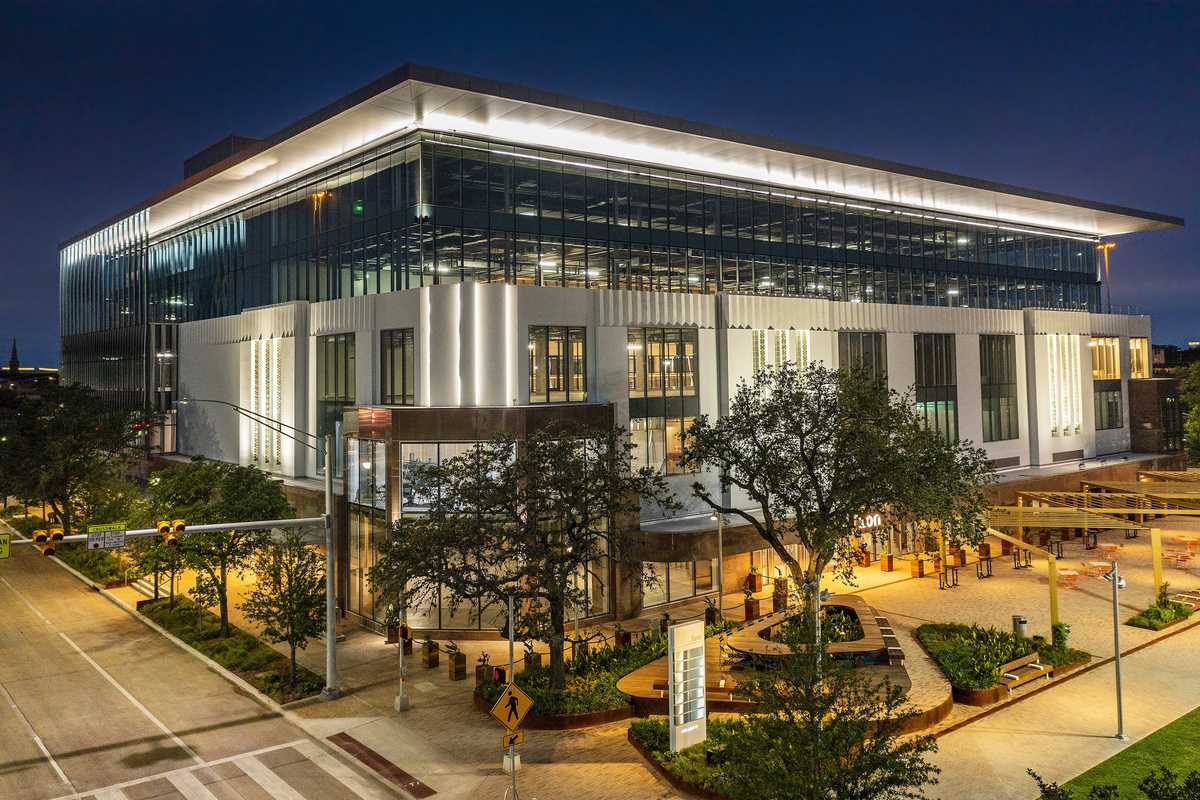
Texas has claimed a top spot on Wallethub's Best & Worst States for Jobs report. Photo via Unsplash.

If you’re hunting for a job in Texas amid a tough employment market, you stand a better chance of landing it here than you might in other states.

A new ranking by personal finance website WalletHub of the best states for jobs puts Texas at No. 7. The Lone Star State lands at No. 2 in the economic environment category and No. 18 in the job market category.

Massachusetts tops the list, and West Virginia appears at the bottom.

To determine the most attractive states for employment, WalletHub compared the 50 states across 34 key indicators of economic health and job market strength. Ranking factors included employment growth, median annual income, and average commute time.

“Living in one of the best states for jobs can provide stable conditions for the long term, helping you ride out the fluctuations that the economy will experience in the future,” WalletHub analyst Chip Lupo says.

In September, Gov. Greg Abbott announced Texas led the U.S. in job creation with the addition of 195,600 jobs over the past 12 months.

“Texas is America’s jobs leader,” Abbott says. “With the best business climate in the nation and a skilled and growing labor force, Texas is where businesses invest, jobs grow, and families thrive. Texas will continue to cut red tape and invest in businesses large and small to spur the economic growth of communities across our great state.”

While Abbott proclaims Texas is “America’s jobs leader,” the state’s level of job creation has recently slowed. In June, the Federal Reserve Bank of Dallas noted that the state’s year-to-date job growth rate had dipped to 1.8 percent, and that even slower job growth was expected in the second half of this year.

The August unemployment rate in Texas stood at 4.1 percent, according to the Texas Workforce Commission. Throughout 2025, the monthly rate in Texas has been either four percent or 4.1 percent.

By comparison, the U.S. unemployment rate in August was 4.3 percent, according to the U.S. Bureau of Labor Statistics. In 2025, the monthly rate for the U.S. has ranged from 4 percent to 4.3 percent.

Here’s a rundown of the August unemployment rates in Texas’ four biggest metro areas:

  • Austin — 3.9 percent
  • Dallas-Fort Worth — 4.4 percent
  • Houston — 5 percent
  • San Antonio — 4.4 percent

Unemployment rates have remained steady this year despite layoffs and hiring freezes driven by economic uncertainty. However, the number of U.S. workers who’ve been without a job for at least 27 weeks has risen by 385,000 this year, the Bureau of Labor Statistics reported in August. That month, long-term unemployed workers accounted for about one-fourth of all unemployed workers.

An August survey by the Federal Reserve Bank of New York showed a record-low 44.9 percent of Americans were confident about finding a job if they lost their current one.
Ad Placement 300x100
Ad Placement 300x600

CultureMap Emails are Awesome

Houston digital health platform Koda lands strategic investment

money moves

Houston-based advance care planning platform Koda Health has added another investor to the lineup.

The company secured a strategic investment for an undisclosed amount from UPMC Enterprises, the commercialization arm of the University of Pittsburgh Medical Center. The funding is part of Koda's oversubscribed series A funding round that closed in October, according to a release.

"UPMC Enterprises’ investment is a meaningful signal, not just to Koda, but to the broader market," Dr. Desh Mohan, chief medical officer and co-founder of Koda Health, said in the news release. "It validates that health systems are ready to invest in infrastructure that makes advance care planning work the way it should: proactively, at scale, and with the human support that these conversations require. Having UPMC Enterprises as a strategic investor puts us in a unique position to prove what's possible."

Koda has raised $14 million to date, according to a representative from the company. Its series A round was led by Evidenced, with participation from Mudita Venture Partners, Techstars and the Texas Medical Center last year. At the time, the company said the funding would allow it to scale operations and expand engineering, clinical strategy and customer success. The company described the round as a "pivotal moment," as it had secured investments from influential leaders in the healthcare and venture capital space.

Koda Health, which was born out of the TMC's Biodesign Fellowship in 2020, saw major growth last year, as well, and now supports more than 1 million patients nationwide through partnerships with Cigna Healthcare, Privia Health, Guidehealth, Sentara, UPMC and Memorial Hermann Health System.

The company integrated its end-of-life care planning platform with Dallas-based Guidehealth in April 2025 and with Epic Systems in July 2025. It also won the 2025 Houston Innovation Award in the Health Tech Business category. Read more here.

New 'living pharmacy' biotech company launches out of Rice venture studio

fighting cancer

Rice University’s biotech venture studio RBL LLC has launched a new “living pharmacy” company, Duracyte, designed to make cancer treatment easier on patients.

Backed by an up to $45 million Advanced Research Projects Agency for Health (ARPA-H) award, Duracyte aims to commercialize implantable biohybrid pharmacy devices that are designed to produce therapeutic proteins inside the human body around the clock, replacing the need for regular injections and infusions for some cancer patients.

The company’s main platform is its Hybrid Advanced Molecular Manufacturing Regulator (HAMMR), a rechargeable, implantable device that can sense biological signals, monitor tumor environments and adjust therapeutic output in real time. HAMMR has wireless communication capabilities, which allow patients and clinicians to remotely monitor results through an app every five minutes and make changes to treatment plans without a hosptial visit. Additionally, the device can generate its own oxygen supply, which is key for the therapeutic cells’ survival.

“Biologic medicines such as monoclonal antibodies, cytokines and metabolic regulators already account for a significant share of modern therapeutics, but the way we deliver them today often requires frequent injections or infusions that can be demanding for patients and lead to inconsistent drug levels,” Daniel Anderson, MIT professor and co-founder of Duracyte, said in a news release. “Our vision is to enable a continuous, stable therapy by producing these medicines directly inside the body, which could improve treatment consistency, reduce side effects and ultimately transform how biologic therapies are delivered across many diseases.”

Duracyte’s first clinical trial is slated to begin by the end of 2026 and will focus on recurrent ovarian cancer. The Phase I study will build upon existing work on encapsulated cytokine pharmacy technology, and the company hopes that within a few years this treatment can reach clinical application.

The development of Duracyte is supported by ARPA-H's Targeted Hybrid Oncotherapeutic Regulation (THOR) project, which supports a multidisciplinary research consortium co-led by Omid Veiseh, a professor of bioengineering at Rice. The consortium also includes others at Rice, The University of Texas MD Anderson Cancer Center, Stanford University, Carnegie Mellon University, Northwestern University and the University of Houston, plus industry collaborators like Chicago-based CellTrans.

“What we are building is the culmination of years of progress in cell engineering, biomaterials and implantable device technology,” Veiseh added in the release. “By combining these advances with real-time sensing and adaptive drug delivery, we are working with the support of RBL to create a true ‘living pharmacy’ that can deliver continuous, precisely controlled biologic therapies and fundamentally change how these treatments reach patients.”

RBL launched in 2024 and is based out of Houston’s Texas Medical Center Helix Park. Duracyte is the third company launched by RBL, including Sentinel BioTherapeutics, a clinical-stage immunotherapy company developing localized cytokine therapies for solid tumors, and SteerBio, a regenerative medicine company targeting lymphedema.

“Duracyte exemplifies the kind of breakthrough that Houston’s ecosystem is built to produce,” Paul Wotton, managing partner of RBL LLC and co-founder of Duracyte, added in the release. “With world-class clinical infrastructure, exceptional engineering talent and initiatives like the Texas Biotech Task Force driving alignment across industry, investment and talent, this region is uniquely positioned to move the most ambitious ideas in medicine from concept to patient, faster than anywhere else.”