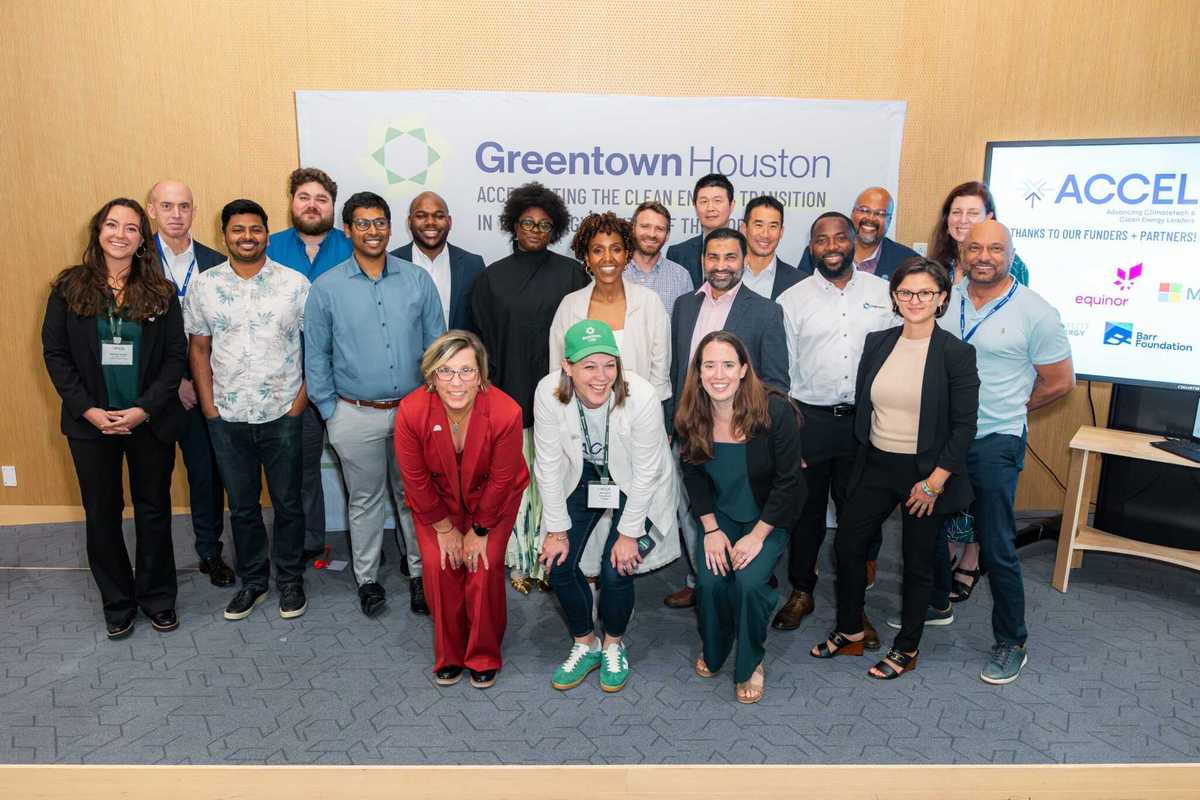
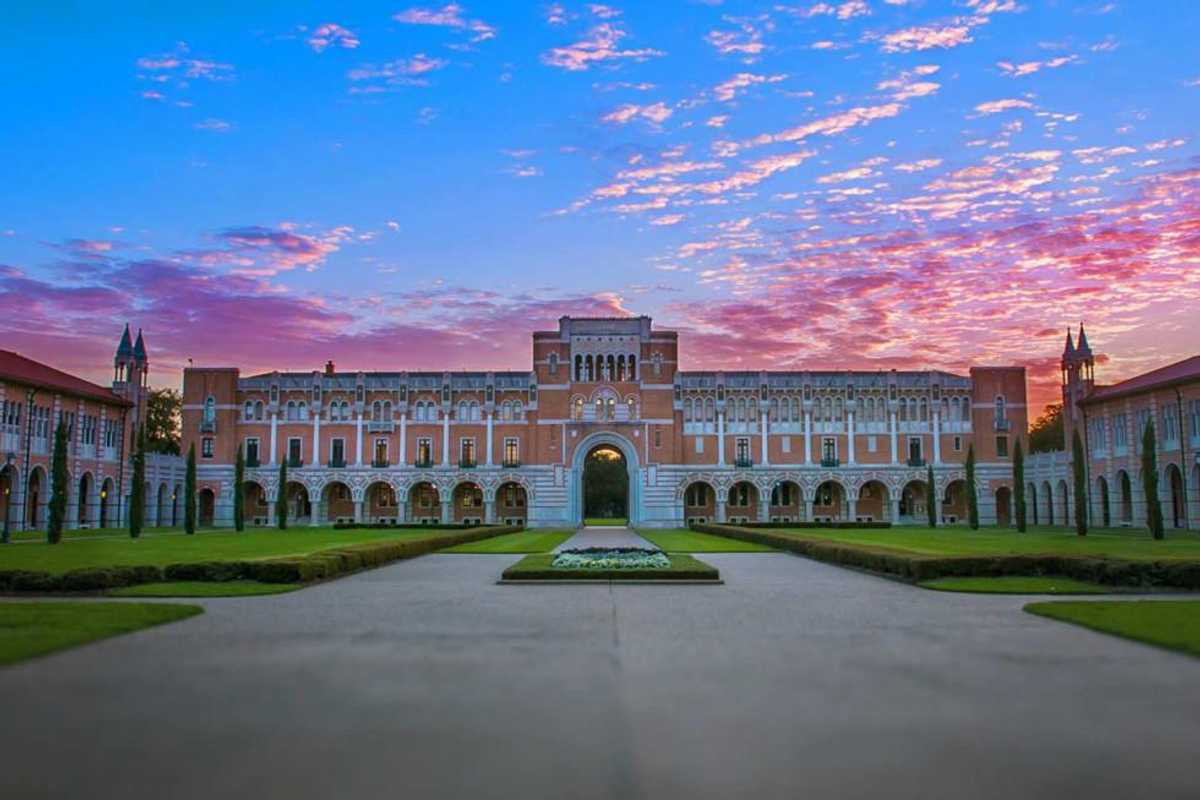
Here's who won big at the annual Rice Business Plan Competition. Photo courtesy Rice Alliance

Editor's note: This article has been updated to correct the total amount of investment and cash prizes awarded at the RBPC and with additional information from Rice.

Another team from the Great Lakes State took home top honors and investments at this year's Rice Business Plan Competition.

BRCĒ, a material-tech startup from Michigan State University, took home the top-place finish and the largest investment total at the annual Houston event. It has developed Lattice-Grip technology to create utility-based polymers that can replace traditional fabric. The materials are stronger, fire-resistant and more stable than traditional textiles, according to the company. Last year, the University of Michigan's Intero Biosystems won first-place finish and the largest investment total of $902,000.

In total, the RBPC doled out more than $1.4 million in investment and cash prizes, according to Rice. Over the three-day event, held April 9-11, the 42 competing startups presented their business plans to 300 angel, venture capital and corporate investors. Seven finalists were selected.

Three Texas teams, including one from Houston, were named among the finalists. Here's who won big this year, with their investment totals and some of their awards listed below.

BRCĒ, Michigan State University — $611,500

The recent Shark Tank alum finished in first place for its utility-based polymers technology.

  • $200,000 Goose Capital Investment Grand Prize
  • $100,000 The OWL Investment Prize
  • $100,000 Houston Angel Network Investment Prize
  • $75,000 The Indus Entrepreneurs (TiE) Texas Angels Investment Prize
  • $50,000 nCourage Investment Network’s Courageous Women Entrepreneur Investment Prize
  • $25,000 New Climate Ventures Sustainable Investment Prize
  • $20,000 Aramco Innovator Cash Prize
  • $1,000 Anbarci Family Company Showcase Prize
  • $500 Mercury Fund Elevator Pitch Competition Prize – Consumer Hard Tech

Legion Platforms, Arizona State University — $535,500

The startup won second place for its multiplayer gaming platform that can be accessed with slow internet speeds.

  • $100,000 Anderson Family Fund & Finger Interests Second Place Investment Prize
  • $200,000 Goose Capital Investment Prize
  • $100,000 The OWL Investment Prize
  • $25,000 Pearland EDC Spirit of Entrepreneurship Cash Prize
  • $500 Mercury Fund Elevator Pitch Competition Prize – Consumer

Imagine Devices, University of Texas at Austin — $111,000

The pediatric medical device company won third place for its multifunction neonatal feeding tube, known as Trinity Tube

  • $50,000 Anderson Family Fund & Finger Interests Third Place Investment Prize
  • $25,000 Pearland EDC Spirit of Entrepreneurship Cash Prize
  • $25,000 The Eagle Investors Investment Prize
  • $1,000 Anbarci Family Company Showcase Prize

Altaris MedTech, University of Arkansas – $16,000

The startup won fourth place for its pain-free strep test.

  • $5,000 Norton Rose Fulbright Fourth Place Prize
  • $1,000 Mercury Fund Elevator Pitch Competition Prize — Overall Winner

Routora, University of Notre Dame & University of Texas at Austin – $15,500

The team won fifth place for its route optimization app that works to reduce fuel costs, travel time and carbon emissions

  • $5,000 Chevron Fifth Place Prize
  • $500 Mercury Fund Elevator Pitch Competition Prizes — Digital

DialySafe, Rice University — $15,500

The startup won sixth place for its technology that aims to make at-home peritoneal dialysis simpler and safer.

  • $5,000 ExxonMobil Sixth Place Prize
  • $500 Mercury Fund Elevator Pitch Competition Prizes — Life Science

Arrow Analytics, Texas A&M University – $16,000

The startup won seventh place for its AI-powered sizing system for carry-on baggage.

  • $5,000 Shell Ventures Seventh Place Prize
  • $1,000 Anbarci Family Company Showcase Prizes


Other significant prizes included:

BiliRoo, University of Michigan – $26,000

  • $25,000 Southwest National Pediatric Device Consortium Pediatric Device Cash Prize
  • $1,000 Anbarci Family Company Showcase Prizes

BeamFeed, City University of New York – $25,000

  • $25,000 Amentum and WRX Companies Rising Stars Space Technology and Commercial Aerospace Cash Prize

Grapheon, University of Pittsburgh — $20,000

  • $20,000 Aramco Innovator Cash Prize

A total of $75,000 in in-kind legal services was awarded to all finalists. The grand prize winner, BRCĒ, also received a chief financial officer consulting prize worth $40,000. Each competing startup received at least $950 in prizes for placement in the competition.

“The Rice Business Plan Competition has grown into far more than a competition—it’s a proving ground for founders and a catalyst for real company formation, as well as a catalyst for building the Houston entrepreneurial ecosystem,” Brad Burke, associate vice president of Rice Innovation and executive director of Rice Alliance, said in a news release. This year's event was Burke’s final RBPC after nearly 25 years of leadership.

Last year, the Rice Business Plan Competition facilitated over $2 million in investment and cash prizes. According to Rice, more than 910 startups have raised more than $6.9 billion in capital through the competition over the last 25 years.

See a full list of this year's winners and stream rounds from the competition here.
Ad Placement 300x100
Ad Placement 300x600

CultureMap Emails are Awesome

Houston researchers develop breakthrough device that could bypass spinal injuries

breakthrough research

Scientists at Houston Methodist have announced a significant leap forward for spinal cord injury recovery.

The researchers have developed a device that essentially bypasses spinal injuries, allowing signals from previously “lost” functions to reach the brain, a new study published in Nature Communications shows.

“Most current technologies try to improve whatever function remains after a spinal cord injury,” Dr. Damiano Barone, assistant professor of neurosurgery in the Department of Neurosurgery at Houston Methodist and co-lead on the study, said in a news release. “Our goal is different. Rather than fixing the injury itself, we want to bypass it completely and create an alternative route for signals to travel.”

The study involved a single ultrathin circumferential electrode array made to conform around the spinal cord without penetrating neural tissue, which was implanted into rodent and pig models with spinal injuries. The electrode array was able to interpret motor, sensory and autonomic signals around the injury. Think of it as a set of detours that restore road access to isolated towns after a disaster destroys the highway instead of just rebuilding the highway.

Over the course of three days, the arrays detected signals of intended movement from low-frequency spinal oscillations with more than 94 percent accuracy. This worked across species and was replicated in feasibility studies on human cadavers.

This research could serve as a new foundation for neuroprosthetic implants that could restore connectivity to the 2.5 million people worldwide suffering from spinal injuries that result in loss of ability. Future development could result in everything from restored organ function to mobility, according to Houston Methodist.

George Malliaras, the Prince Professor of Technology in the Department of Engineering at the University of Cambridge, who co-led the study, sees it as a fundamental restructuring of the science of spinal trauma.

“This could represent a paradigm change in how we think about spinal cord injuries,” Malliaras said. “Instead of starting from the idea that what is lost is gone forever, this approach asks whether we can restore function by carrying the signal around the injury.”

Further work involving laboratory models will need to be completed before launching human trials.

Grants from the National Institutes of Health, Houston Methodist Katz Investigator Award, Helaers Research Award and the Engineering and Physical Sciences Research Council helped support the study. Other collaborators on the study include Salim Hadwe, Ruben Serrano, George Psaltakis, Margaux Forner, Chaeyeon Lee, Sydney Swedick, Moleca Ghnnam, Tawfique Hasan and Alejandro Carnicer-Lombarte from the University of Cambridge; and Anton Banta and Xueer Zhang from Houston Methodist.

Abbott assembles expert team to help lure U.S. Space Academy to Texas

space race

State Rep. Greg Bonnen of Friendswood has been tapped to lead a new team that will promote Texas as the future home of the U.S. Space Academy.

Bonnen, a neurosurgeon, chairs Houston Physicians’ Hospital and the powerful Texas House Appropriations Committee. His House district is close to NASA’s Johnson Space Center.

Gov. Greg Abbott appointed the seven-member team. Last month, President Trump signed an executive order establishing the Presidential Commission on the U.S. Space Academy. Commission members, who held their first meeting this month, will recommend a permanent location for the academy.

Texas officials are pushing a site near Johnson Space Center to host the academy. Alabama, Colorado and Florida are among Texas’ competitors.

In a joint statement, U.S. Sen. Ted Cruz and U.S. Rep. Brian Babin, both of Texas, issued a statement backing the state’s bid for the academy. Cruz lives in Houston. Babbin lives in Woodville, about 55 miles south of Beaumont.

“America’s space program is built across the country, but Texas is where the pieces come together,” the lawmakers said. “We are ready to lead the next generation of space pioneers and look forward to showing why Texas is the right home for the U.S. Space Academy.”

The academy’s curriculum will include technical education, leadership development and public service components. Graduates will be set up for careers in the U.S. military, civil service, and aerospace sectors.

The Abbott-appointed team will work with the Texas Space Commission to prepare the state’s proposal for the academy.

In addition to Bonnen, team members with ties to Houston include:

  • Robert Ambrose, who grew up in Houston. He worked at Johnson Space Center before becoming associate director of the Texas A&M Space Institute.
  • Former NASA astronaut Nancy Curry-Gregg, director of the Texas A&M Space Institute. She earned a doctoral degree from the University of Houston and previously worked at Johnson Space Center.
  • Former NASA astronaut Jack Fischer, senior vice president of Houston-based Intuitive Machines. The company builds spacecraft, delivers payloads to the moon and launches satellites.

“Texas is the home of America’s human spaceflight program,” Abbott said in a release. “No state can match what Texas brings to this mission.”

“NASA’s Johnson Space Center, world-class universities, a premier commercial space industry, major military installations, and an unmatched aerospace workforce give Texas every asset the United States Space Academy requires,” the governor added.