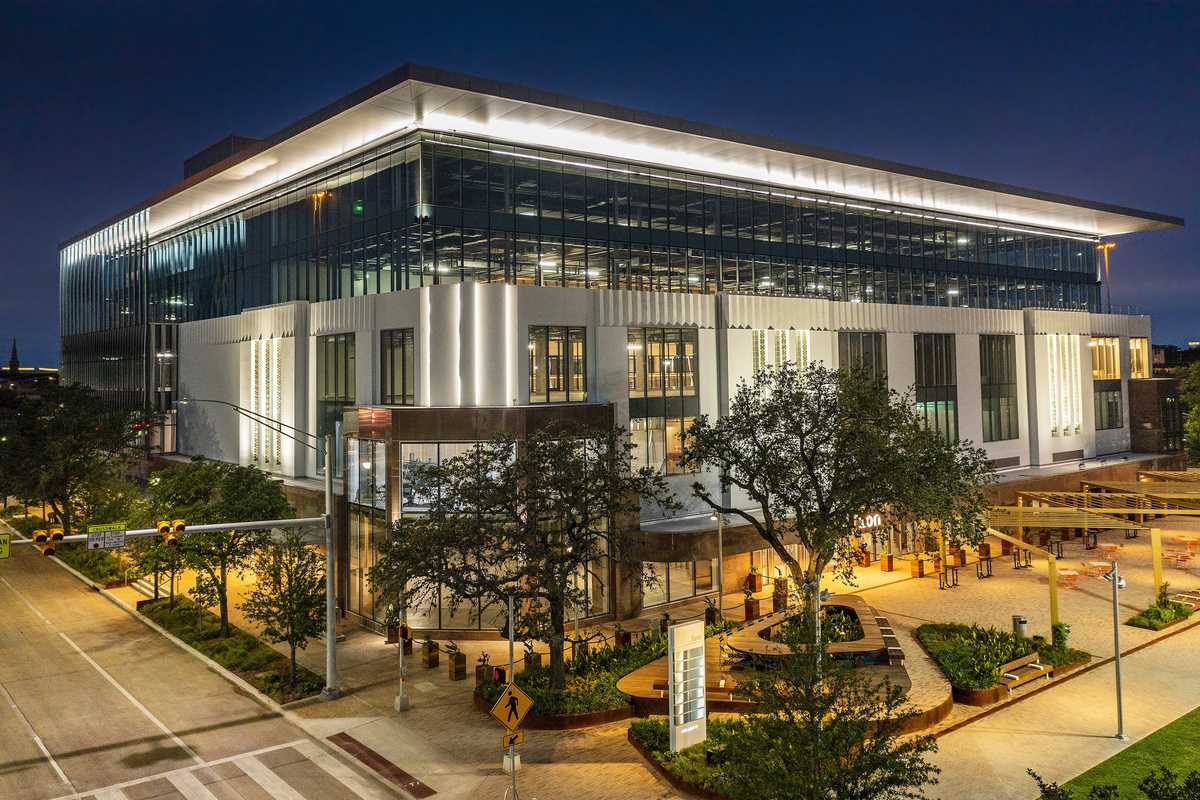
Hobby Airport's new solar canopy is operating at 100% capacity. Photo courtesy Houston Airports.

Houston's William P. Hobby Airport is generating its own clean energy.

Houston Airports announced that Hobby's red garage is now home to a "solar canopy" that is producing energy at 100 percent capacity to power daily operations. The photovoltaic (PV) solar system generated more than 1.1 gigawatt-hours of electricity in testing, and is expected to produce up to 1 megawatt-hour now that it's operating at full power.

“This project is proof that sustainability can be practical, visible and directly tied to the passenger experience,” Jim Szczesniak, director of aviation for Houston Airports, said in a news release. “Passengers now park under a structure that shields their cars from the Texas sun while generating clean energy that keeps airport operations running efficiently, lowering overall peak demand electrical costs during the day and our carbon footprint. It’s a win for travelers, the city and the planet.”

The project was completed by Texas A&M Engineering Experiment Station (TEES) and CenterPoint Energy. It's part of Houston Airport's efforts to reduce carbon emissions by 40 percent over its 2019 baseline.

In a separate announcement, the airport system also shared that it recently reached Level 3 in the Airports Council International (ACI) Airport Carbon Accreditation program after reducing emissions by 19 percent in three years. This includes reductions at George Bush Intercontinental Airport (IAH), Hobby and Ellington Airport/Houston Spaceport.

The reductions have come from initiatives such as adding electric vehicles to airport fleets, upgrading airfield lighting with LED bulbs, adding smarter power systems to terminals, and improving IAH's central utility plant with more efficient equipment. Additionally, the expansion to Hobby's West Concourse and renovations at IAH Terminal B incorporate cleaner equipment and technology.

According to Houston Airports, from 2019 to 2023:

  • IAH reduced emissions by 17 percent
  • Hobby reduced emissions by 32 percent
  • Ellington Airport reduced emissions by 4 percent

"I see firsthand how vital it is to link infrastructure with sustainability,” Houston City Council Member Twila Carter, chair of the council’s Resilience Committee, said in the release. “Reducing carbon emissions at our airports isn’t just about cleaner travel — it’s about smarter planning, safer communities and building a Houston that can thrive for generations to come.”

Ad Placement 300x100
Ad Placement 300x600

CultureMap Emails are Awesome

Sandbox VR brings new gaming center to Houston's tech-savvy population

Get In The Game

Sandbox VR, a futuristic, full-body virtual reality gaming experience, has announced it will enter the Houston market this month, opening its first local gaming center on January 23.

"Houston's reputation as a hub for innovation and technology makes it a perfect fit for Sandbox VR," said Steve Zhao, CEO and founder of Sandbox VR, in a statement. "The city's diverse, tech-savvy population and strong entertainment culture create an ideal environment for our immersive VR experiences. LOL Entertainment continues to exceed our expectations as a partner, and we're excited to bring our cutting-edge virtual reality gaming to Texas's largest city."

The new gaming center opens Friday, January 23 at 797 Sorella Court in CityCentre.

One of the games that stands out is the Stranger Things: Catalyst game, based on the blockbuster Netflix television series. Groups of one to six players will be dropped into the sinister Hawkins Lab and the mysterious Upside Down to fight Demogorgons and other monsters. The game features Matthew Modine reprising his role as Dr. Martin "Papa" Brenner, who imbues players with psychic powers.

Other games include the supernatural pirate title The Curse of Davy Jones and other Netflix tie-ins based on Zack Snyder's Rebel Moon and Squid Game. Sandbox VR offers fully-immersive group play activities that range from combat to puzzle solving for a variety of age groups.

The opening of Sandbox VR is another part of the expansion of LOL Entertainment, who touts itself as one of the pre-eminent hosts of immersive and gaming experiences in the U.S. Sandbox VR will be their first entry into the Houston market, with another immersive group adventure game, Time Mission, set to open at the the Marq'E Entertainment District later this year.

“Bringing Sandbox VR to CityCentre Houston is a big milestone for LOL Entertainment, for Sandbox VR, and for this market,” said Rob Cooper, CEO of LOL Entertainment. “Houston is a fast-growing, experience-driven city, and we’re excited to give locals and visitors a truly immersive, social gaming destination that you can’t replicate anywhere.”

Presale tickets for the grand opening of Sandbox VR are available here. Standard pricing is $55-$65 per event, but Sandbox VR is running a special for 30 percent off with code OPEN30 for those who purchase before Thursday, January 22. Presale buyers are also entered into a drawing for free Sandbox VR for one year.

---

This article originally appeared on CultureMap.com.

Baylor College of Medicine names Minnesota med school dean as new president, CEO ​

new leader

Dr. Jakub Tolar, dean of the University of Minnesota Medical School, is taking over as president, CEO and executive dean of Houston’s Baylor College of Medicine on July 1.

Tolar—who’s also vice president for clinical affairs at the University of Minnesota and a university professor—will succeed Dr. Paul Klotman as head of BCM. Klotman is retiring June 30 after leading Texas’ top-ranked medical school since 2010.

In tandem with medical facilities such as Baylor St. Luke’s Medical Center and Texas Children’s Hospital, Baylor trains nearly half of the doctors who work at Texas Medical Center. In addition, Baylor is home to the Dan L Duncan Comprehensive Cancer Center and the Texas Heart Institute.

The hunt for a new leader at Baylor yielded 179 candidates. The medical school’s search firm interviewed 44 candidates, and the pool was narrowed to 10 contenders who were interviewed by the Board of Trustees’ search committee. The full board then interviewed the four finalists, including Tolar.

Greg Brenneman, chair of Baylor’s board and the search committee, says Tolar is “highly accomplished” in the core elements of the medical school’s mission: research, patient care, education and community service.

“Baylor is phenomenal. Baylor is a superpower in academic medicine,” Tolar, a native of the Czech Republic, says in a YouTube video filmed at the medical school. “And everything comes together here because science saves lives. That is the superpower.”

Tolar’s medical specialties include pediatric blood and bone marrow transplants. His research, which he’ll continue at Baylor, focuses on developing cellular therapies for rare genetic disorders. In the research arena, he’s known for his care of patients with recessive dystrophic epidermolysis bullosa, a severe genetic skin disorder.

In a news release, Tolar praises Baylor’s “achievements and foundation,” as well as the school’s potential to advance medicine and health care in “new and impactful ways.”

The Baylor College of Medicine employs more than 9,300 full-time faculty and staff. For the 2025-26 academic year, nearly 1,800 students are enrolled in the School of Medicine, Graduate School of Biomedical Sciences and School of Health Professions. Its M.D. program operates campuses in Houston and Temple.

In the fiscal year that ended June 30, 2024, Baylor recorded $2.72 billion in operating revenue and $2.76 billion in operating expenses.

The college was founded in 1900 in Dallas and relocated to Houston in 1943. It was affiliated with Baylor University in Waco from 1903 to 1969.