


Eventually, Zoox futuristic robotaxis will be on Houston roads. Photo courtesy of Zoox

Amazon-owned robotaxi ride-hailing service Zoox is zooming into Houston in September, becoming the latest robotaxi operator jockeying for local riders.

Initially, self-driving retrofitted SUVs with safety drivers on board will serve downtown Houston, centrally located tourist hotspots, and certain residential neighborhoods. The SUVs will test Houston roads before Zoox rolls out autonomous robotaxis here, the company says.

Zoox takes Houston for a test drive

At the outset, Zoox says, a limited number of vehicles will be driven by people to gather data about Houston roads.
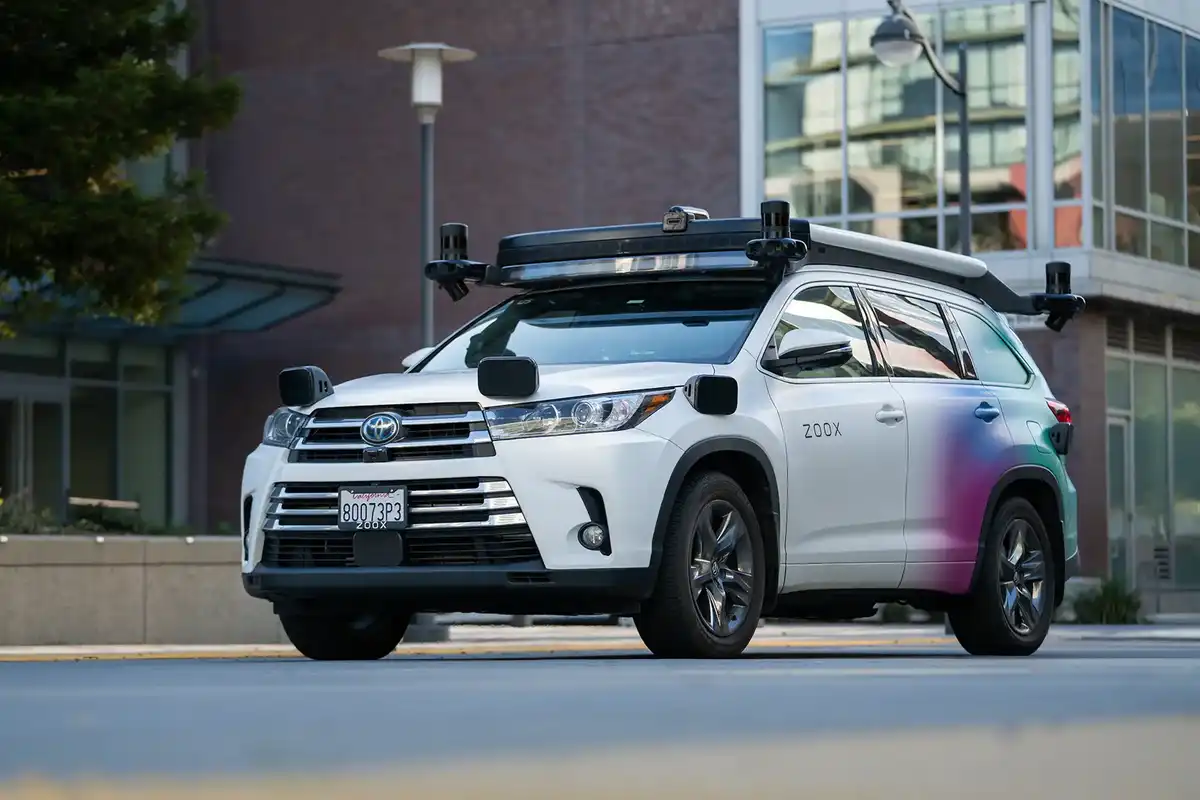
Zoox test drive Photo courtesy of Zoox

“This helps create a detailed picture of each street, from road geometry to traffic lights,” the company says. “Once we have mapped out an area, we will test autonomous driving capabilities. Safety and operational readiness govern the pace of our rollout.”

Zoox says its robotaxi differs from vehicles operated by other ride-hailing services.

The all-electric robotaxi “is purpose-built for autonomous ride-hailing and designed for riders from day one,” the company says. “It has no traditional driving controls and instead has carriage-style seating, sliding glass doors, and features that let the rider personalize their journey.”

To help manage the fleet, Zoox plans to open a depot in Houston for vehicle charging and maintenance, a representative says via email.

Along with Houston, Zoox is launching this month in San Diego. The ride-hailing service already operates in Austin, Dallas, Atlanta, Las Vegas, Los Angeles, Miami, Phoenix, the San Francisco Bay Area, Seattle, and Washington, D.C.

Zoox breaks into “sprawling” Houston market

Zoox describes Houston as its “most sprawling market to date.”

“Driving here means navigating complex service-road networks, unique merging scenarios, and challenging environmental conditions, including severe heat, heavy rain, and urban flooding,” the company says. “It’s a rigorous test of our technology across geography and terrain.”

Zoox will join two other autonomous ride-hailing services in Houston:

  • Waymo began rolling in Houston in February. Alphabet, the parent company of Google, owns Waymo.
  • Electric vehicle manufacturer Tesla began offering robotaxi services earlier this year.

A third Zoox competitor is arriving within the next year. A partnership comprising rideshare provider Uber, EV manufacturer Lucid, and autonomous technology company Nuro plans to launch a robotaxi service in Houston by mid-2027.

---

This article originally appeared on CultureMap.com.

Ad Placement 300x100
Ad Placement 300x600

CultureMap Emails are Awesome

Italian aerospace company sets up first U.S. office at Houston Spaceport

welcome to houston

Como, Italy-based aerospace company Involve Space recently made the Houston Spaceport the site of its first U.S. office.

Involve Space develops high-altitude balloon platforms for Earth observation, scientific research and hardware testing. The balloons carry instruments into the stratosphere (a layer of the upper atmosphere) to collect images and data, conduct experiments and test technology.

The company plans to launch its first commercial missions from Houston by the end of this year, according to a news release.

“Houston is the global center of aerospace, and our presence at Houston Spaceport strengthens our international growth trajectory,” Jonathan Polotto, founder and CEO of Involve Space, said in the release.

Founded in 2021, Involve Space incorporates aerospace hardware, AI and geospatial tools into its offerings. Its proprietary CLEAR platform uses conversational AI to help customers interpret data and support decision-making.

Located at Ellington Airport, the Houston Spaceport provides a base for Involve Space’s North American operations, including business development and partnerships with aerospace companies and researchers.

Other tenants at the Houston Spaceport include NASA, Axiom Space, Venus Aerospace and Intuitive Machines.

Involve Space’s relationship with the Houston Spaceport began in January 2025, when it conducted its first U.S. pilot launch. During the five-hour mission, the balloon reached an altitude of about 85,000 feet and traveled about 250 miles across Texas.

One of Involve Space’s first U.S. customers is Houston-based Rhodium Scientific, a space biotech company. Polotto and Rhodium Scientific founder and CEO Olivia Gamez Holzhaus signed a deal to conduct biotech experiments aboard Involve Space’s stratospheric balloon platforms before planned missions to orbit.

“The presence of innovative platforms like those developed by Involve strengthens the Spaceport’s role as a site for testing, validating, and deploying advanced technologies between aeronautics and space,” Jim Szczesniak, director of aviation for Houston Airports, added in the release.

UH lands $3M grant to expand opioid overdose training

Overdose Response

The University of Houston has received a $3 million federal grant to expand its potentially life-saving overdose response training program.

The grant will support the Houston Health Department’s FRONTLINES program that trains first responders in Harris and Fort Bend counties to recognize opioid overdoses and administer the drug naloxone, which can counter the effects of an opioid overdose. The four-year grant comes from the Substance Abuse and Mental Health Services Administration within the Department of Health and Human Services, and it builds on eight years of work at UH, according to a release from the university.

As part of the expansion, UH medical, social work and psychology students will now also be able to take part in FRONTLINES’ overdose-response training. Some of the students will also be selected to help train community members, ultimately passing along the life-saving skills throughout Houston.

FRONTLINES is a collaboration with the City of Houston, the Fertitta College of Medicine, Baylor College of Medicine and the Houston Recovery Center. It was co-founded by Dr. James Bray, chair of the Department of Behavioral and Social Sciences at the University of Houston’s Tilman J. Fertitta Family College of Medicine, in 2018.

“When someone experiencing an opioid overdose is reached in time, naloxone can save their life,” Bray said in a news release. “We’ve seen the impact this training can have in Houston, and now we have an opportunity to extend that reach across Harris and Fort Bend counties, putting lifesaving knowledge and tools into the hands of more first responders.”

In 2024, around 450 residents of Harris County died from opioid overdoses, according to a Texas Department of State Health Services report. The report found that fentanyl was involved in about three-quarters of the deaths.

In 2025, UH also received a $2.6 million gift from the estate of Dr. William A. Gibson to expand its opioid research and develop a vaccine to help block fentanyl's effectiveness in entering the brain. The vaccine research is part of the Michael C. Gibson Addiction Research Program led by UH professor of psychology Therese Kosten and founding member of the UH Drug Discovery Institute Colin Haile. Read more about the grant and the vaccine’s development here.

Texas public libraries drive billions in economic impact, report finds

Beyond the Stacks

A new statewide study examining the economic impacts of public libraries has revealed they have generated over $3.8 billion in value to local communities — a return of $4.74 for every $1 invested.

The report, "Beyond the Stacks: Measuring the Economic and Community Value of Texas Public Libraries" was conducted by third-party consultancy JBK Economics Group in partnership with the Texas Library Association. About 300 of the total 513 public libraries in Texas participated in a survey for the report.

A major finding from the survey revealed that public libraries create billions in economic value for the communities they serve at a fraction of what it costs to pay employee wages and benefits, operating expenditures, and capital expenditures. About 11,200 jobs were directly and indirectly supported by public libraries, the report found.

The report found its $4.74 to $1 ratio by adding up the total value of the services provided by these institutions (an estimated $2.48 billion), and comparing it to total expenditures ($808.6 million).

"Public libraries had about the same economic footprint as the Texas motion picture and sound recording industry ($2.9 billion in Gross Domestic Product in 2024) or the Texas paper manufacturing industry ($4.0 billion in Gross Domestic Product in 2024)," the report said.

Many Houstonians are already familiar with Houston Public Library's expansive catalog and programming, but there are many more services the library provides that might fly under the radar. A few examples include access to subscription-based research databases and news outlets, and the Library of Things, a collection of cookware and bake ware, musical instruments, craft kits, and other tools or activity materials that are available for cardholders to borrow. Individual branches also provide free Wi-Fi, computer access, and meeting spaces.

Houston-area residents also have access to services at several other local libraries depending on their address, such as the Harris County Public Library, Montgomery County Memorial Library System, or Fort Bend County Libraries, just to name a few.

These are additional services and partnerships that Texas public libraries commonly provide, per the survey results:

  • 93 percent provide voter registration and/or serve as voting locations
  • 84 percent provide partnerships with local social services agencies
  • 82 percent provide job application assistance
  • 68 percent facilitate applications for government benefits
  • 38 percent provide on-site social services
  • 30 percent provide telehealth rooms and/or resources
"Public libraries are practical, welcoming and rooted in the communities they serve — they are unmistakably Texan," said Texas Library Association executive director Shirley Robinson in a press release. "This study puts a dollar value on the opportunities libraries create every day. Whether someone visits a library to apply for a job, access the internet, learn a new skill or simply find a new favorite book, those services create real value for Texans and their communities."

------

This article first appeared on CultureMap.com.