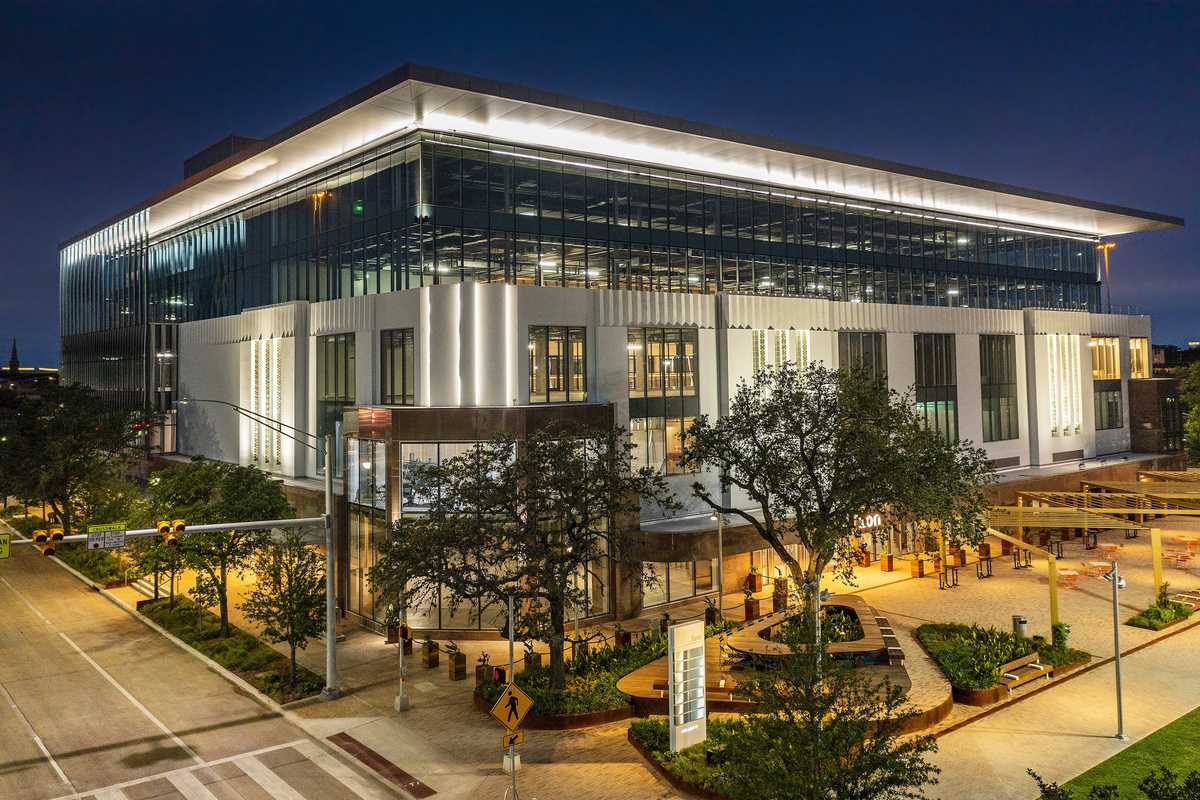
TMCi named its 2024 Accelerator for Cancer Therapeutics cohort.

For the fourth year, Texas Medical Center Innovation has named its annual cohort of Texas health tech innovators working on promising cancer therapeutics.

TMCi named its 2024 Accelerator for Cancer Therapeutics cohort last week, and the 23 Texas researchers and companies selected will undergo a nine-month program that will provide them with mentorship and programming, as well as open doors to potential investors and strategic partners.

“The ACT program provides a bridge to commercialization in Texas by surrounding innovators with strategic mentorship, milestone development, and a network of resources to move their projects forward,” Emily Reiser, associate director of TMC Innovation, says in a news release. "We are excited to welcome this year's cohort and to continue enabling participants to advance their solutions to treat cancer."

The program has accelerated 76 researchers and companies to date, many of which — like March Biosciences and Mongoose Bio — have gone on to secure $130 million in funding from venture capitalists and grant funding.

“Our program has cultivated a dynamic ecosystem where partners, researchers, and inventors, who have been part of the journey since its inception and received various forms of funding, continue to propel their life-saving products and technologies forward," Ahmed AlRawi, program manager of ACT, says in the release. "Our 2024 cohort represents our most diverse cohort to date, including eight companies led by women entrepreneurs. Additionally, we are particularly proud that the cohort includes a blend of new and recurring organizations that have leveraged this opportunity in the past to extend their work and continue the momentum to build off the successes of our previous years.”

The 2024 participants are:

  • Alexandre Reuben of UT-MD Anderson Cancer Center
  • Betty Kim & Jiang Wen of UT-MD Anderson Cancer Center
  • Bin He of Houston Methodist
  • Daniel Kiss & John Cooke of PeakRNA at Houston Methodist
  • Hongjun Liang of Texas Tech-Lubbock
  • Jacob Goell & Isaac Hilton of Mercator Biosciences at Rice University
  • Jay Hartenbach & Matthew Halpert of Diakonos Oncology Corp.
  • Kathryn O’Donnell of UT-Southwestern
  • Maralice Conacci Sorrell of UT-Southwestern
  • Neeraj Saini of UT-MD Anderson Cancer Center
  • Neil Thapar of Barricade Therapeutics Corp.
  • Nina Keshavarzi of Celine Biotechnologies
  • Raphael G. Ognar & Henri Bayle of NKILT Therapeutics Inc.
  • Richard Austin & Michael Abrahamson of Reglagene Inc.
  • Tim Peterson & Joppe Nieuwenhuis of Bioio Inc.
  • Todd Aguilera & Eslam Elghonaimy of UT-Southwestern
  • Venkata Lokesh Battula of Siddhi Therapeutics Inc. at UT-MD Anderson Cancer Center
  • Weei-Chin Lin & Fang-Tsyr Lin of Baylor College of Medicine
  • Yong Li & Dongxiao Feng of Sotla Therapeutics at Baylor College of Medicine
  • Anil Sood & Zhiqiang An of UT-MD Anderson Cancer Center
  • Narendra Kumar & Jayshree Mishra of Texas A&M-College Station
  • Tao Wang of NightStar Biotechnologies Inc. at UT-Southwestern
  • Jian Hu of UT-MD Anderson Cancer Center

Ad Placement 300x100
Ad Placement 300x600

CultureMap Emails are Awesome

New Houston-born app OpenToBites connects users over meals in 16 cities

Friends and Food

A Houston-born social is connecting foodies and social butterflies for shared meals. OpenToBites launched on Android on June 18 and iOS on June 22, and is available to use for free in Houston and beyond.

Founded and operated by Houston developer Kelvin John, OpenToBites allows users to connect over meals in 16 cosmopolitan cities. That includes Austin and Houston in Texas, plus other American cities like Denver and New York, and even international destinations including Paris, Tokyo, and Sydney.

The app is built on a simple concept, and a press release emphasizes that it's for anyone who wants "friendly company."

“We built OpenToBites in response to several trends, including the rise of solo travel and the demand for social experiences that don’t feel like dating, networking, or large organized events,” said a spokesperson in the release. “We are not a dating app. We are offering shared food and conversation for people who want simple, in-person meal company in a public setting.”

When signing up, users provide their first name, an optional profile photo, and a short bio. They mark themselves as a traveler, a local, or both, and have the option to select their age range or opt out.

Once a profile is created, the user can search for existing meals or create a meal happening within the next 72 hours. To find an existing meal to join as a guest, they select the city, date, and apply filters for the number of seats, type of cuisine, and whether they want to share food with the table or order their own.

Since someone has to get the party started, users can also take the initiative to start a meal as a host. They'll choose the date, time, and restaurant — anything is on the menu, as long as they can link to the restaurant on Google Maps or its own website.

This divides users into "host" and "guest." Guests request to join a table, and a host can decide to accept the request or not. Guests aren't able to see the exact restaurant until their request is accepted, so hosts have a "helpful note" field to fill out with more information about the restaurant.

A similar app called Timeleft launched in Austin in 2024, acting as a friendship matchmaker for small groups of strangers who answer personality questions, meet at a restaurant for dinner, and decide if they wanted to stay in touch.

Though OpenToBites has a similar concept, it seems to work more like Couchsurfing, an app that connects travelers on their own terms. OpenToBites also emphasizes the immediate over the long-term — the meal itself is the social goal.

OpenToBites is available for free on the App Store and Play Store; the app plans to grow each current city's user base before adding new locations.

---

This article originally appeared on CultureMap.com.

Houston mental health nonprofit expands platform statewide to connect more Texans with care

access granted

As mental health conversations evolve, the necessary pivot becomes how organizations across Texas navigate improved ways to help people access the care they need before their challenges become crises.

That’s why Mental Health America of Greater Houston recently announced that it is expanding its Care Connect platform statewide.

The expansion will address perhaps the most persistent barrier to behavioral healthcare—helping people find and navigate services that already exist.

Care Connect’s extended reach comes at a time when more than 3.5 million adults in the state live with some kind of mental health condition and scores of those in need continue to struggle with accessing care despite the growing awareness of mental health needs.

According to President and CEO Renae Vania Tomczak, Care Connect’s main goal was to remove as many obstacles as possible that Texans face when seeking mental health support.

“Care Connect was about a two-year planning process,” Tomczak says. “It really began with asking what challenges people in the Greater Houston Area were facing regarding mental health. It’s not just accessing care, but the difficulty in navigating the mental healthcare system.”

While provider shortages remain a challenge in some communities, Mental Health America of Greater Houston found that many individuals and families struggle simply to determine where to turn, how to identify the right provider and whether services are affordable.

“We wanted to make it easier for people who have questions, who may never have had a mental health challenge before, or they’re a caregiver for somebody who has a mental health issue,” Tomczak says. “We wanted to be the place that people can come to get their questions answered and be connected to care.”

Care Connect combines a vetted network of more than 1,000 providers and services across Texas with personalized navigation support.

Searches generate care results based on insurance coverage, language preferences, ZIP code and clinical specialties.

Additionally, one-on-one guidance and follow-up support are provided by bilingual resource specialists.

The platform also seeks to address affordability, one of the most significant barriers to mental healthcare access. Through participating providers, eligible individuals can receive six to eight counseling sessions at no cost.

“We have several providers who are willing to provide six to eight counseling sessions at no cost for people who do not have the means to pay for services themselves,” Tomczak says.

When provider matches are unavailable, the organization can connect individuals with master’s-level mental health professionals working under the supervision of licensed clinicians.

The statewide rollout builds on the platform’s early success in the Houston region, where it has helped thousands of individuals connect with mental health resources since launching last fall.

According to Tomczak, the decision to expand was driven in part by growing demand from outside the organization’s traditional service area.

“Last month we decided to take this program statewide,” she says. “It’s not just Houston that can use help in connecting to appropriate mental health services, but the whole state.”

The Care Connect program’s promotion through healthcare providers, community organizations and public-sector partners across Texas is now one of Mental Health America of Greater Houston’s top priorities.

Their goal is to create a stronger referral ecosystem that ultimately helps those who need access to mental health care more quickly.

To facilitate that, the organization has also added free mental health screenings to its website so that users will better identify any symptoms related to anxiety, depression and other conditions.

“Once they do that, then where do they go?” Tomczak says. “They’re not sure who to call and who can help them. At that point, we hope they’ll call us and talk to somebody live who can answer their questions and help them get started on the right path to improving their mental health.”

With eyes on the future, Tomczak believes public understanding of mental health has improved in recent years, particularly following the COVID-19 pandemic, which brought new attention to the effects of stress, isolation and uncertainty.

“The more we talk about it and have the opportunity to share that mental health conditions are traceable, the better,” she says.

According to Tomczak, long-term, Care Connect aims to reduce roadblocks that exist between recognizing the need for help and receiving it.

Ultimately, Care Connect hopes to create a robustly connected behavioral health system that gives Texans the ability to access mental health services swiftly and with confidence.

“No one should have to navigate mental health challenges alone,” Tomczak adds. “Care Connect is here to help connect people with resources, services and answers to ensure they get the care they need to take the next step toward better mental health.”