Houston loves a startup story. The harder story, the one that decides whether a company becomes an employer, a brand, and a fixture of the city, is what happens after the start. Most businesses that survive their early years still never cross $1 million in revenue. Fewer than 5 percent ever do. The rest get stuck in the messy middle, somewhere between $250,000 and $1 million, where the owner is still the salesperson, the product, and the back office all at once, and nothing runs without them.
Momentum, the accelerator run by EO Houston, exists for exactly that stage. It is a yearly accelerator for owners and co-founders between $250,000 and $1 million in revenue who are ready to push past seven figures, built around eight months of classes a year and a confidential monthly Forum. Members are invited to go through it for two years: the first pass to build the systems, the second to run them at a higher level, with a new lens and alongside a new cohort.
The next cohort launches in October, with applications open now at eohouston.com/momentum until September 30. Here is the case the chapter makes for joining, point by point.
A curriculum built by operators, not consultants
Momentum's curriculum was built by two operators. Al Danto, an EO Houston founding member who built and exited his own company, is now a Partner at Exit Advisors and a Senior Lecturer in Entrepreneurship at Rice University. He built the curriculum alongside Jacky Fischer, the owner of Houston's 3 Men Movers, who brought a working owner's eye, not an academic one, to how the program is structured. The material covers what actually decides whether a company scales: building systems, hiring and leading a team, and turning an annual vision into 90-day commitments with clear owners.
“Everything in this curriculum got tested inside a real company, either mine or one run by the people who shaped it. If a tool did not survive contact with a real business, it did not make the cut," Danto says.
Momentum is an independent program of EO Houston and requires no university affiliation; faculty and alumni participate as instructors and coaches in their individual capacities. What carries over is the standard: real experience over theory.
 A Momentum class in session. Photo courtesy of EO Houston
Entrepreneurs teaching entrepreneurs since 1987
Momentum works because of what sits behind it. The Entrepreneurs' Organization was founded in 1987 on a simple idea: business owners grow fastest alongside peers who have already been where they are going. Today, EO is a global, peer-to-peer network spanning 200+ chapters in over 80 countries, and it runs on a practice called Forum, a small, confidential group of six to 10 fellow owners who meet monthly. Forum members do not give advice. They share experience: what actually happened when they faced the same hire, the same cash crunch, the same decision. Ask EO members anywhere in the world and most will call Forum the single most valuable thing they belong to. Every Momentum member sits in one.
Built for scaling small businesses, not launching startups
Houston's accelerator landscape mostly serves the very early stage: the idea, the pitch deck, the startup swinging for a billion-dollar outcome. Momentum sits in the gap those programs leave behind. It is built for regular companies that are already real, with revenue, payroll, and customers, and an owner who needs help scaling what works into a business that matures. That focus is the point: EO Houston is the place a small business goes to get help growing.
The price is different too. Accelerators usually charge in ownership, a stake in the company in exchange for the program. Momentum takes none. EO Houston is a nonprofit, and the program runs on dues of $3,500 for the year. The outcome the chapter is after is simple: more Houston businesses crossing $1 million, still fully owned by the people who built them.
An on-ramp into Houston's most established founder community
EO Houston counts more than 200 member businesses, every one run by an owner who has already scaled past $1 million, with 75+ chapter events a year. Momentum members plug into that community from day one: the classes, their own Forum, the annual gala, the retreats, the socials. Two years around people who have already done the thing you are trying to do changes what you believe is normal. And when a Momentum member crosses $1 million, the on-ramp becomes a doorway: graduates step into EO Houston membership itself and the global network behind it. The program's full story and curriculum live at eomomentum.com.
Avneesh Oberoi, founder of Oberoi Investments and The DoughCone, walked that path, finishing the program and joining EO Houston in July 2026.
“I truly can say that the experience for the last two years has been life-changing and so memorable… I am also so filled with gratitude to have met so many people open to sharing their experiences and time. It’s made such a difference in how I think, operate, and spend my time and resources," Oberoi says. "I joined with the goal of taking my business I started personally, The DoughCone, and figuring out how to optimize the business and maximize revenue, while navigating a board seat and ownership in a much larger family business on its third generation of ownership… and EO has given me so many tools and experience shares and perspectives I’ve been able to take to both businesses. The growth has been unreal.”
The door swings both ways. EO Houston is opening Momentum to its own members too, owners whose companies average $3 million to $5 million in sales, because the chapter believes the same curriculum and Forum that carry a founder to $1 million keep working well past it.
Sarah Seitz shows how the pieces connect. A former teacher, she founded The Enrichery, a Houston education company offering academic coaching, test prep, and college counseling that has grown to locations across the city. She completed the Goldman Sachs 10,000 Small Businesses program, then joined EO Houston to keep growing. This year, a year after joining, The Enrichery made the Inc. 5000 list of America's fastest-growing private companies. She coached Momentum through its first year, and has since moved from coaching into leadership, helping shape the program's growth from its board.
For owners finishing a program like 10,000 Small Businesses who are not yet at $1 million, Momentum is where the coaching and community continue until they qualify for EO.
Apply by September 30
Momentum's next cohort begins in October 2026, and applications close September 30. The program is for owners and co-founders of Houston businesses doing more than $250,000 a year who are ready to build past $1 million, and now for EO Houston members ready to keep growing. The full curriculum, dues, dates, and FAQ are on the application page. Apply by September 30 at eohouston.com/momentum.
Fewer than 5 percent of businesses make it past $1 million, and there is nothing inevitable about which 5 percent. Houston has the founders. Momentum exists to give them the systems and the peers.
---
EO Houston is the Houston chapter of the Entrepreneurs' Organization, a global peer-to-peer network of business owners founded in 1987, with more than 200 member businesses and 75+ chapter events a year. Momentum is an independent program of EO Houston. Rice University faculty and alumni participate as instructors and coaches in their individual capacities.



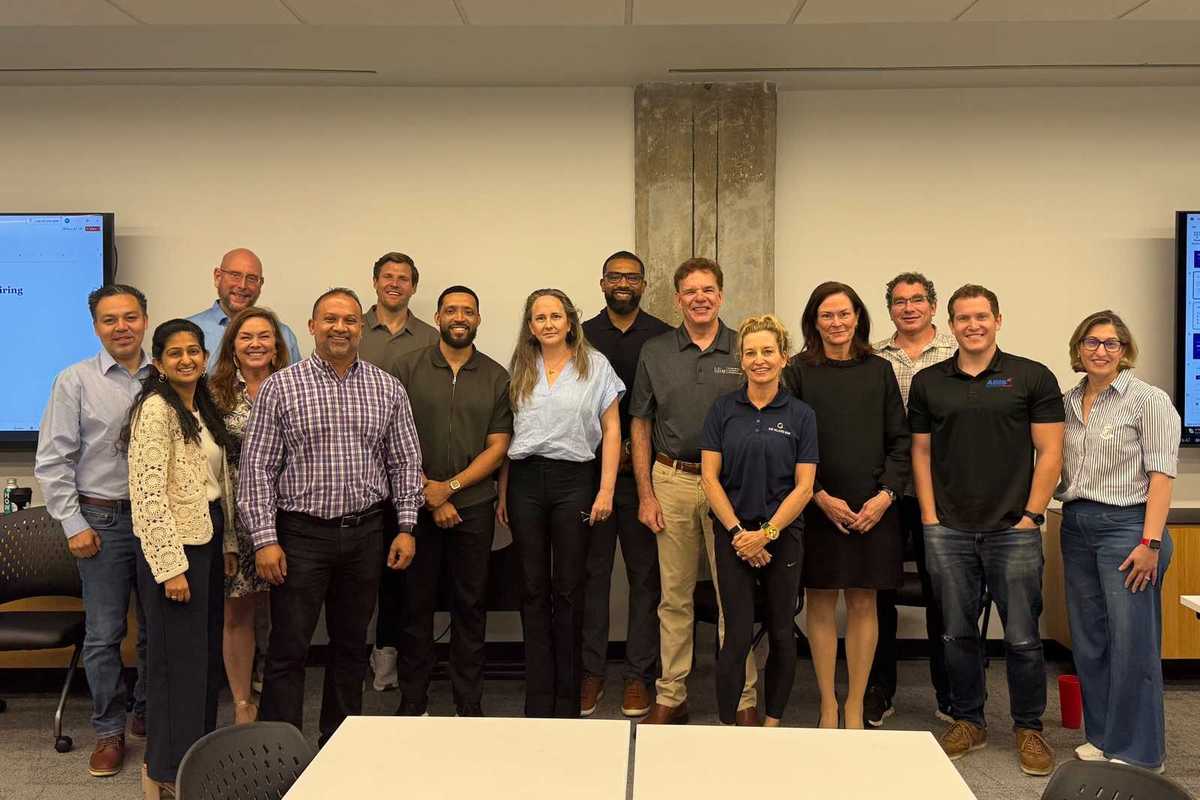 A Momentum class in session. Photo courtesy of EO Houston