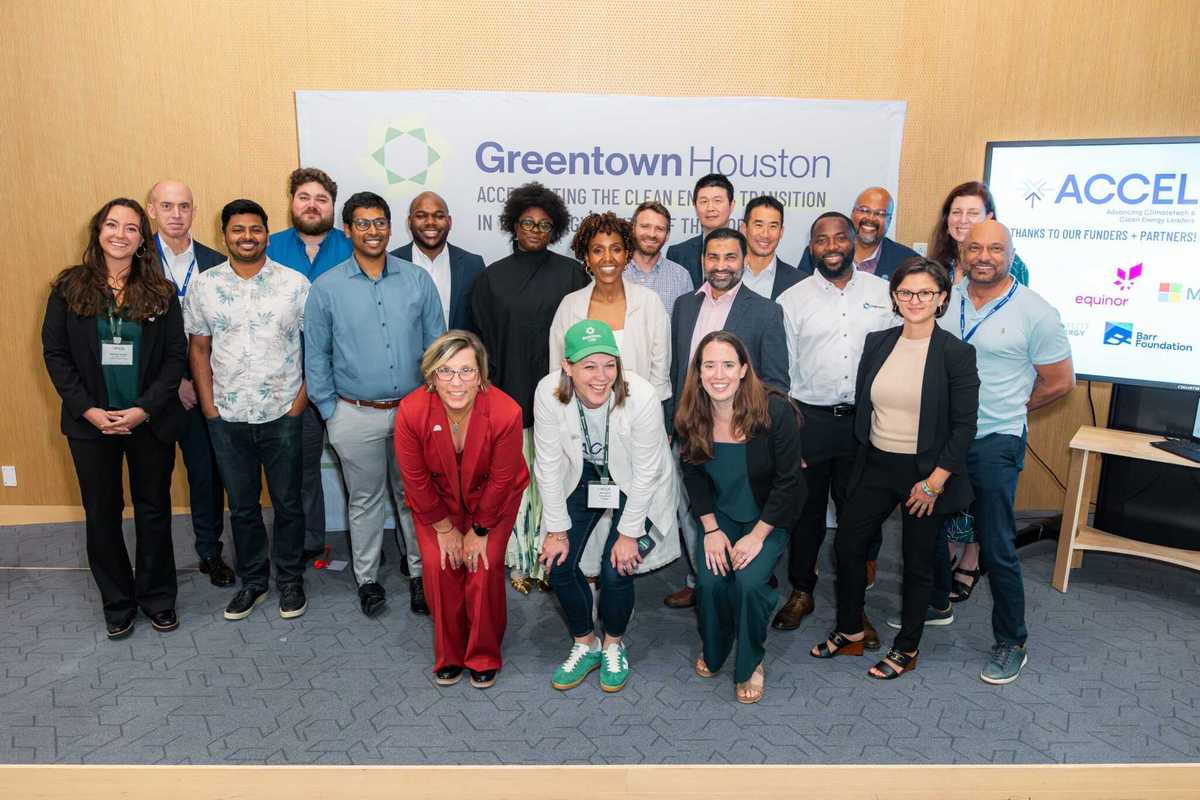
Dede Raad of Dress Up Buttercup created a unique pitch series — completely fueled by her social media community — that gave a spotlight to eight businesses. Photo via dressupbuttercup.com

After growing her audience to over a million followers on Instagram, Houston fashion blogger Dede Raad felt the pressure to expand her business — but she didn't feel inspired by any particular line of business to grow into.

"In the blogging world, which I've been doing for about seven years, everyone's next step is to start a brand and to start something of their own," Raad, founder of Dress Up Buttercup, tells InnovationMap. "I just don't have anything in my heart that I was really passionate about. I know once you start something, you have to give it your all."

But what Raad realized — after a year of thinking about her next move and a chance viewing of Shark Tank — was that tons of business founders were passionate about their own brands, and there was an opportunity for Raad use her community to support them instead of coming up with something of her own.

She put the call out to her followers to find founders with growing brands. Raad launched "Build Up Buttercup," an initiative that featured small business pitches for a select group of investors, with her husband, Ted. The event, which happened last October, resulted in eight business pitches across four episodes uploaded to Dress Up Buttercup's page that garnered hundreds of thousands of views. The initiative also resulted in a handful of investments and cash prizes.

"It was a crazy four days, but it was so cool to see the brands and the passion behind it and for Ted and I to help in both a financial and advising way," Raad says.

Raad was joined at the event with fellow investors, which included Houston-based investment firms Curate Capital and Trend Ventures, the investment arm of influencer management company Trend Management, founded by Ted Raad.

Of the eight that pitched, four companies received investments. Dress Up Buttercup invested in Houston-based jewelry company Burdlife and children's clothing brand Poppy Kids. Trend Ventures made investments in Cold Cork and Houston-based tech startup, AIM7, which closed its seed round in December.

Raad tells InnovationMap that she'd be interested in hosting another edition of "Build Up Buttercup" in the future, but for now she's focused on her two new brands. Her role within both of the companies is very hands on, she explains, and meets with the founders at least once a week. She also markets both brands to her Instagram community.

"We're not just sending you a check — we want to be involved," Raad says. "I've worked with brands for the past seven years, and I've seen what people are buying. I have such a power in my community, and I know what they like."

Ad Placement 300x100
Ad Placement 300x600

CultureMap Emails are Awesome

Houston researcher builds radar to make self-driving cars safer

eyes on the road

A Rice University researcher is giving autonomous vehicles an “extra set of eyes.”

Current autonomous vehicles (AVs) can have an incomplete view of their surroundings, and challenges like pedestrian movement, low-light conditions and adverse weather only compound these visibility limitations.

Kun Woo Cho, a postdoctoral researcher in the lab of Rice professor of electrical and computer engineering Ashutosh Sabharwal, has developed EyeDAR to help address such issues and enhance the vehicles’ sensing accuracy. Her research was supported in part by the National Science Foundation.

The EyeDAR is an orange-sized, low-power, millimeter-wave radar that could be placed at streetlights and intersections. Its design was inspired by that of the human eye. Researchers envision that the low-cost sensors could help ensure that AVs always pick up on emergent obstacles, even when the vehicles are not within proper range for their onboard sensors and when visibility is limited.

“Current automotive sensor systems like cameras and lidar struggle with poor visibility such as you would encounter due to rain or fog or in low-lighting conditions,” Cho said in a news release. “Radar, on the other hand, operates reliably in all weather and lighting conditions and can even see through obstacles.”

Signals from a typical radar system scatter when they encounter an obstacle. Some of the signal is reflected back to the source, but most of it is often lost. In the case of AVs, this means that "pedestrians emerging from behind large vehicles, cars creeping forward at intersections or cyclists approaching at odd angles can easily go unnoticed," according to Rice.

EyeDAR, however, works to capture lost radar reflections, determine their direction and report them back to the AV in a sequence of 0s and 1s.

“Like blinking Morse code,” Cho added. “EyeDAR is a talking sensor⎯it is a first instance of integrating radar sensing and communication functionality in a single design.”

After testing, EyeDAR was able to resolve target directions 200 times faster than conventional radar designs.

While EyeDAR currently targets risks associated with AVs, particularly in high-traffic urban areas, researchers also believe the technology behind it could complement artificial intelligence efforts and be integrated into robots, drones and wearable platforms.

“EyeDAR is an example of what I like to call ‘analog computing,’” Cho added in the release. “Over the past two decades, people have been focusing on the digital and software side of computation, and the analog, hardware side has been lagging behind. I want to explore this overlooked analog design space.”

12 winners named at CERAWeek clean tech pitch competition in Houston

top teams

Twelve teams from around the country, including several from Houston, took home top honors at this year's Energy Venture Day and Pitch Competition at CERAWeek.

The fast-paced event, held March 25, put on by Rice Alliance, Houston Energy Transition Initiative and TEX-E, invited 36 industry startups and five Texas-based student teams focused on driving efficiency and advancements in the energy transition to present 3.5-minute pitches before investors and industry partners during CERAWeek's Agora program.

The competition is a qualifying event for the Startup World Cup, where teams compete for a $1 million investment prize.

PolyJoule won in the Track C competition and was named the overall winner of the pitch event. The Boston-based company will go on to compete in the Startup World Cup held this fall in San Francisco.

PolyJoule was spun out of MIT and is developing conductive polymer battery technology for energy storage.

Rice University's Resonant Thermal Systems won the second-place prize and $15,000 in the student track, known as TEX-E. The team's STREED solution converts high-salinity water into fresh water while recovering valuable minerals.

Teams from the University of Texas won first and second place in the TEX-E competition, bringing home $25,000 and $10,000, respectively. The student winners were:

Companies that pitched in the three industry tracts competed for non-monetary awards. Here are the companies named "most-promising" by the judges:

Track A | Industrial Efficiency & Decarbonization

Track B | Advanced Manufacturing, Materials, & Other Advanced Technologies

  • First: Licube, based in Houston
  • Second: ZettaJoule, based in Houston and Maryland
  • Third: Oleo

Track C | Innovations for Traditional Energy, Electricity, & the Grid

The teams at this year's Energy Venture Day have collectively raised $707 million in funding, according to Rice. They represent six countries and 12 states. See the full list of companies and investor groups that participated here.

---

This article originally appeared on our sister site, EnergyCapitalHTX.com.