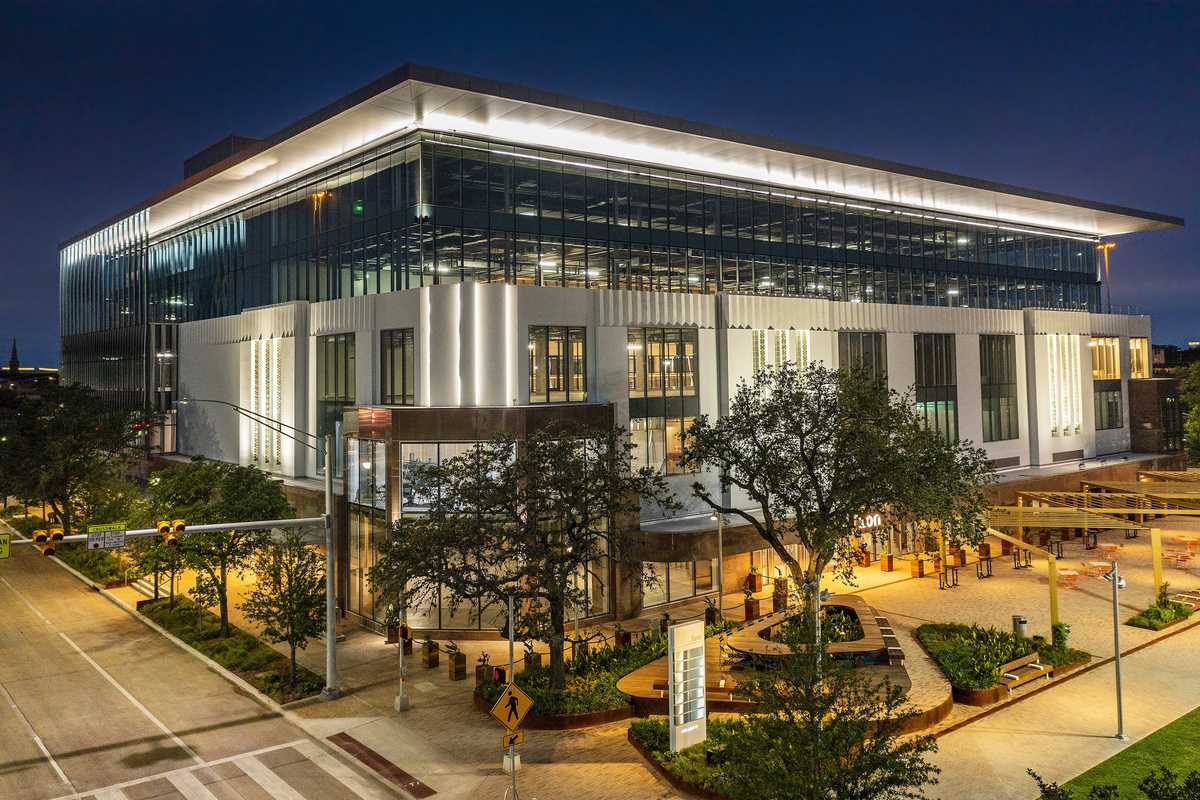
Houston-based Quidnet Energy has closed a $10 million series B round and secured a big contract with the state of New York. Getty Images

Houston-based renewable energy company that focuses on clean energy storage closed its $10 million series B financing round and secured a major contract.

Quidnet Energy announced its latest round and the execution of a contract with the New York State Energy Development Authority. Bill Gates-backed Breakthrough Energy Ventures and Canada-based Evok Innovations, which both previously invested in the company, contributed to the round. The round also featured new investors Trafigura and The Jeremy and Hannelore Grantham Environmental Trust.

"Long-duration electricity storage is critical to the energy transition. It's exciting to see how Quidnet is bringing this viable long-duration solution to the market," says Mike Biddle, managing director at Evok Innovations, in a news release. "Because they are leveraging long understood geologic principles, we are confident that they can scale rapidly. We are pleased to support the Quidnet team through its next phase of commercial growth."

According to the release, the company will use the funds to grow its team and scale up its operations in order to be able to deliver commercial-scale projects across the country's electric grid.

"Integrating renewables and replacing retiring thermal generation require cost-effective long-duration electricity storage at an immense scale," says Quidnet Energy CEO Joe Zhou in the release. "While traditional pumped hydro has provided over 95 percent of the world's grid-scale storage, that approach faces significant siting and cost limitations going forward. Quidnet unlocks these constraints to fundamentally change the economics and deployment profile of long-duration storage."

Quidnet's deal with NYSEDA is a part of the organization's efforts to reduce the state's carbon footprint while also lowering the cost of traditional energy storage.

"Under Governor Cuomo's leadership, New York is investing in the technology research and development needed to advance a 21st electric grid that can support the State's growing influx of renewable energy," says Alicia Barton, president and CEO of NYSERDA, in the release. "Congratulations to Quidnet on this opportunity to develop and demonstrate the value that this innovative technology can bring to New York as we work to reduce greenhouse gas emissions and transition to a 100 percent clean electric grid."

Last month, the Rice Alliance for Technology and Entrepreneurship hosted its annual Energy Tech Venture Day online, and Quidnet was among the Houston energy companies to pitch virtually.

Ad Placement 300x100
Ad Placement 300x600

CultureMap Emails are Awesome

Houston company plans lunar mission to test clean energy resource

lunar power

Houston-based natural resource and lunar development company Black Moon Energy Corporation (BMEC) announced that it is planning a robotic mission to the surface of the moon within the next five years.

The company has engaged NASA’s Jet Propulsion Laboratory (JPL) and Caltech to carry out the mission’s robotic systems, scientific instrumentation, data acquisition and mission operations. Black Moon will lead mission management, resource-assessment strategy and large-scale operations planning.

The goal of the year-long expedition will be to gather data and perform operations to determine the feasibility of a lunar Helium-3 supply chain. Helium-3 is abundant on the surface of the moon, but extremely rare on Earth. BMEC believes it could be a solution to the world's accelerating energy challenges.

Helium-3 fusion releases 4 million times more energy than the combustion of fossil fuels and four times more energy than traditional nuclear fission in a “clean” manner with no primary radioactive products or environmental issues, according to BMEC. Additionally, the company estimates that there is enough lunar Helium-3 to power humanity for thousands of years.

"By combining Black Moon's expertise in resource development with JPL and Caltech's renowned scientific and engineering capabilities, we are building the knowledge base required to power a new era of clean, abundant, and affordable energy for the entire planet," David Warden, CEO of BMEC, said in a news release.

The company says that information gathered from the planned lunar mission will support potential applications in fusion power generation, national security systems, quantum computing, radiation detection, medical imaging and cryogenic technologies.

Black Moon Energy was founded in 2022 by David Warden, Leroy Chiao, Peter Jones and Dan Warden. Chiao served as a NASA astronaut for 15 years. The other founders have held positions at Rice University, Schlumberger, BP and other major energy space organizations.

Houston co. makes breakthrough in clean carbon fiber manufacturing

Future of Fiber

Houston-based Mars Materials has made a breakthrough in turning stored carbon dioxide into everyday products.

In partnership with the Textile Innovation Engine of North Carolina and North Carolina State University, Mars Materials turned its CO2-derived product into a high-quality raw material for producing carbon fiber, according to a news release. According to the company, the product works "exactly like" the traditional chemical used to create carbon fiber that is derived from oil and coal.

Testing showed the end product met the high standards required for high-performance carbon fiber. Carbon fiber finds its way into aircraft, missile components, drones, racecars, golf clubs, snowboards, bridges, X-ray equipment, prosthetics, wind turbine blades and more.

The successful test “keeps a promise we made to our investors and the industry,” Aaron Fitzgerald, co-founder and CEO of Mars Materials, said in the release. “We proved we can make carbon fiber from the air without losing any quality.”

“Just as we did with our water-soluble polymers, getting it right on the first try allows us to move faster,” Fitzgerald adds. “We can now focus on scaling up production to accelerate bringing manufacturing of this critical material back to the U.S.”

Mars Materials, founded in 2019, converts captured carbon into resources, such as carbon fiber and wastewater treatment chemicals. Investors include Untapped Capital, Prithvi Ventures, Climate Capital Collective, Overlap Holdings, BlackTech Capital, Jonathan Azoff, Nate Salpeter and Brian Andrés Helmick.

---

This article originally appeared on our sister site, EnergyCapitalHTX.com.

Rice launches 'brain economy' initiative at World Economic Forum

brain health

Rice University has launched an initiative that will position “brain capital” as a key asset in the 21st century.

Rice rolled out the Global Brain Economy Initiative on Jan. 21 at the World Economic Forum in Davos, Switzerland.

“This initiative positions brain capital, or brain health and brain skills, at the forefront of global economic development, particularly in the age of artificial intelligence,” the university said in a news release.

The Rice-based initiative, whose partners are the University of Texas Medical Branch in Galveston and the Davos Alzheimer’s Collaborative, aligns with a recent World Economic Forum and McKinsey Health Institute report titled “The Human Advantage: Stronger Brains in the Age of AI,” co-authored by Rice researcher Harris Eyre. Eyre is leading the initiative.

“With an aging population and the rapid transformation of work and society driven by AI, the urgency has never been greater to focus on brain health and build adaptable human skills—both to support people and communities and to ensure long-term economic stability,” says Amy Dittmar, a Rice provost and executive vice president for academic affairs.

This initiative works closely with the recently launched Rice Brain Institute.

In its first year, the initiative will establish a global brain research agenda, piloting brain economy strategies in certain regions, and introducing a framework to guide financial backers and leaders. It will also advocate for public policies tied to the brain economy.

The report from the McKinsey Health Institute and World Economic Forum estimates that advancements in brain health could generate $6.2 trillion in economic gains by 2050.

“Stronger brains build stronger societies,” Eyre says. “When we invest in brain health and brain skills, we contribute to long-term growth, resilience, and shared prosperity.”