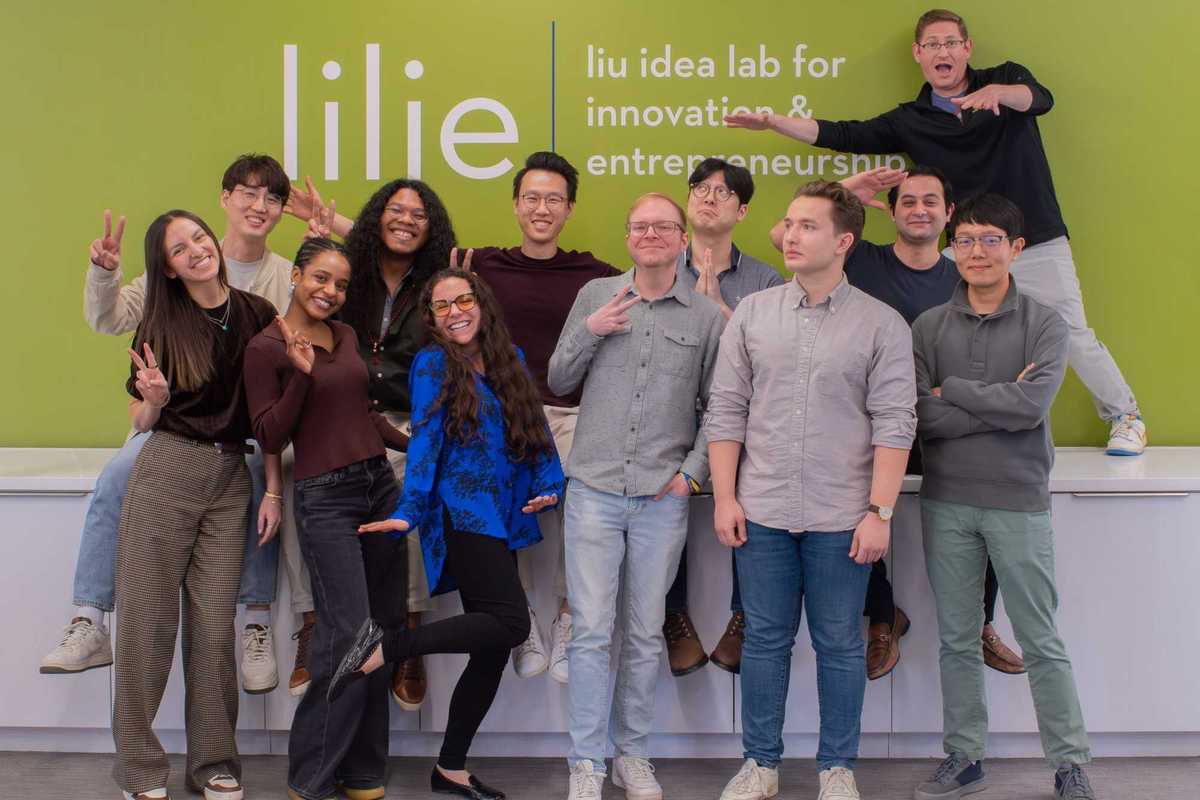
The University of Houston has more faculty named to this year’s senior member class of the National Academy of Inventors than any other Texas institution. Photos courtesy UH.

The University of Houston is now home to seven new senior members of the National Academy of Inventors.

The distinction honors active faculty, scientists and administrators from NAI member institutions that have demonstrated innovation and produced technologies that have “brought, or aspire to bring, real impact on the welfare of society,” according to the NAI. The members have also succeeded in patents, licensing and commercialization, and educating and mentoring.

According to UH, its seven new members represent the largest group from any single Texas institution this year, bringing the university's total senior member count to 46.

UH faculty also represented three of Houston's four new senior members in 2025. Six Houstonians were also named to the NIA's class of fellows late last year.

“This recognition affirms what we see every day at the University of Houston—bold, collaborative innovation focused on improving lives," Ramanan Krishnamoorti, vice president of energy at UH, said in a news release. "Having seven faculty members named Senior Members reflects our momentum and a culture where discovery moves beyond the lab into solutions that strengthen communities and drive economic growth.”

UH’s new senior members include:

  • Haleh Ardebili, endowed professor of mechanical and aerospace engineering and assistant vice president for Entrepreneurship and Startup Ecosystem. Ardebili develops flexible lithium batteries and holds four patents
  • Vemuri Balakotaiah, distinguished university chair and professor of chemical and biomolecular engineering. Balakotaiah holds is patents, with five pending, and develops mathematical models for the clean energy research.
  • Jakoah Brgoch, professor of chemistry. Brgoch develops next-generation inorganic materials and holds four patents.
  • Jose L. Contreras-Vidal, distinguished professor in electrical and computer engineering and director of UH’s NSF neurotechnology research center. Conreras-Vidal develops brain-machine interface technologies. He holds five patents, with two technologies advancing through clinical trials.
  • Preethi Gunaratne, professor in the department of biology and biochemistry and director of the UH Sequencing Core in UH’s College of Natural Sciences and Mathematics. Gunaratne holds five patents in biology and energy technologies and has made significant large-scale genome discoveries.
  • Jae-Hyun Ryou, professor of mechanical and aerospace engineering. Ryou holds 13 patents and has develops innovative semiconductor materials and devices for flexible electronics.
  • Yingcai Zheng, professor in applied geophysics and director of the UH Rock Physics Lab. Zheng's work focuses on energy production, geothermal development and carbon management strategies. He holds two patents.

Other Texas institutions also had strong showings this year. Additional new Texas senior members from NAI institutions include:

Texas A&M University

  • Guillermo Aguilar
  • Stavros Kalafatis
  • Narendra Kumar
  • Heng Pan
  • Xingyong Song
  • Yubin Zhou

Texas State University

  • Bahram Asiabanpour
  • Martin Burtscher
  • Nihal Dharmasiri
  • Alexander Kornienko
  • Ted Lehr
  • Christopher Rhodes

The University of Texas at Arlington

  • Brian H. Dennis
  • Nicholas Gans
  • Frederick M. MacDonnell
  • Charles Philip Shelor
  • Liping Tang

The University of Texas at San Antonio

  • Robert De Lorenzo
  • Marc Feldman
  • Daohong Zhou

The University of Texas at El Paso

  • XiuJun Li
  • Yirong Lin
  • David Roberson

Texas Tech University Health Sciences Center

  • Thomas John Abbruscato
  • Annette Louise Sobel
  • Sanjay K. Srivastava

Texas Tech University

  • Gerardo Games
  • Dy Dinh Le

Baylor University

  • David Jack

The University of Texas Rio Grande Valley

  • Upal Roy

This year's class is the largest since the NAI launched its senior member recognition program in 2018. The new senior members come from 82 NAI institutions ad hoe more than over 2,000 U.S. patents. Accoring to the NAI, it has 945 senior members who hold more than 11,000 U.S. patents today.

“This year’s senior member class is a truly impressive cohort. These innovators come from a variety of fields and disciplines, translating their technologies into tangible impact,” Paul R. Sanberg, president of NAI, added in a news release. “I commend them on their incredible pursuits and I’m honored to welcome them to the Academy.”

The Senior Member Induction Ceremony will honor the 2026 class at NAI’s Annual Conference June 1-4 in Los Angeles.

Ad Placement 300x100
Ad Placement 300x600

CultureMap Emails are Awesome

Uber, Nuro and Lucid plan to roll out robotaxi services in Houston

autonomous autos

More autonomous vehicles are expected to hit the roads in Houston next year.

Ridesharing giant Uber announced that it plans to roll out its premium robotaxi service in the Bayou City in mid-2027. Houston will be Uber’s second planned market for the program, following the San Francisco Bay Area, where the program is expected to be rolled out later this year.

Uber, Nuro and Lucid Group will bring the robotaxi program to Houston with more markets planned for the future. Currently, Nuro is conducting autonomous on-road testing with safety operators in Houston. Testing includes simulation, closed-course testing and supervised public-road testing.

“Houston is a city Nuro knows well, and we’re excited to help bring this robotaxi service to the city through our partnership with Uber and Lucid,” Andrew Chapin, chief operating officer at Nuro, said in a news release. “Houston’s large, complex metro area is an ideal market for demonstrating how Nuro’s universal autonomy platform can generalize across different geographies and operating environments. We look forward to continued engagement with the community as we prepare to launch service in 2027.”

The fleet of 100 vehicles across California and Texas will feature Lucid Gravity EVs and future Lucid Midsize vehicles equipped with Nuro Driver technology, Nuro’s Level 4 universal autonomy platform, plus a redundant sensor suite with cameras, lidar, radar and a roof-mounted halo.

The vehicles will be owned and operated by Uber and its fleet partners and made available to riders through the Uber network, according to the company.

In addition to the fleet of autonomous vehicles, Uber also announced that it has secured a 50,000-square-foot depot facility and dedicated charging pitstop in Houston. The facility will allow Uber and its partners to control vehicle maintenance, repairs, charging, cleaning, and day-to-day operations.

“Houston marks an important next step in our partnership with Lucid and Nuro as we expand autonomous mobility to more riders throughout the world,” Sarfraz Maredia, global head of autonomous mobility & delivery at Uber, added in the release. “Together, we’re combining best-in-class vehicle and autonomy technology with Uber’s scale, fleet operations expertise, and infrastructure capabilities to build a service that can grow across dozens of markets in the years ahead.”

Waymo launched its autonomous vehicle program in Houston in February.

The company later suspended its driverless car services in Houston, other major Texas cities, and Atlanta, after one of its vehicles was stranded by flooding during heavy rains. However, according to the Houston Chronicle, the fleet has resumed activity in Houston and is fully active.

Houston fintech company closes $7M funding round

fintech funding

Houston-based fintech company Receipts Depositary Corporation has closed a $7 million oversubscribed funding round and plans to scale.

The round was led by Austin-based LiveOak Ventures, with participation from Hivemind Capital, Onigiri Capital, OTC Markets Group, GTS, and Redbeard Ventures, according to a release from RDC.

RDC's platform issues depositary receipts (DRs) to qualified investors on digital and alternative assets, making it easier for investors to buy and trade hard-to-access and less traditional assets. Currently, the company offers DRs for cryptocurrencies including Bitcoin, Ethereum, Solana and XRP.

RDC says the new funding will allow it to launch new DR products across a wider range of asset categories, potentially including commodities. Additionally, it plans to grow its relationships with "banks, broker-dealers, market makers, custodians and exchange partners" and add to its product, operations, technology, and commercial functions teams. The company is actively hiring, according to a press release.

“Depositary Receipts are trusted, regulated capital markets products which RDC is bringing to an entirely new universe of assets, from commodities to digital assets, that have historically been out of reach of traditional securities markets," Krishna Srinivasan, founding partner at LiveOak Ventures, said the release. “The team's depth of experience in the DR business on a global scale, combined with the broad institutional validation from co-investors, anchor customers, and strategic partners across asset classes, makes RDC uniquely positioned to define this category. We're proud to lead this round and support the company as it scales.”

RDC was founded in 2022 by three Citibank alumni: CEO Ankit Mehta, CEO Bryant Kim and COO Ishaan Narain. It began offering its first DRs for Bitcoin in 2024.

“This funding round is a strong validation of what we’re building at RDC and the growing demand for modernized Depositary Receipt infrastructure,” Mehta added in the release. “With the support of LiveOak Ventures and our investor partners, we are accelerating development across our DR platform expanding our market reach, and building the team needed to support the next generation of DR product

Houston space co. adds local colleges to university alliance

space schools

Houston’s Axiom Space has added 26 new members to its University Alliance—including two from Houston—to support the next generation of space exploration.

Engineers, researchers and students from the partnering universities will be dedicated to advancing microgravity research, technology development and commercial innovation in low-Earth orbit.

Rice University and the University of Houston are among the new colleges to join the alliance, which launched with 15 members last year. The University of Texas at Austin and the University of Texas at El Paso have also joined, in addition to international institutions in Europe, Asia and Australia, and others from around the U.S. See full list here.

“Through the University Alliance, Axiom Space is uniting the international research community driven to enable human progress,” Lucie Low, Axiom Space chief science officer, said in a news release. “Together, alliance members are taking the initiative to ensure microgravity research benefits everyone on Earth and our shared goals fulfill a scientific purpose to advance civilization.”

Axiom is building the world’s first commercial space station, known as Axiom Station. The University Alliance “will support and advance space science during the transition from government-led to commercially owned and operated space stations,” the company said in a release. Partnering universities will contribute to the research community by participating in international collaborative scientific initiatives, identifying future research, and bolstering strategic positions in the commercial orbit research field.

Recently, the Rice Space Institute was also selected to lead the U.S. Space Force Strategic Institute 4 in addition to other space-centric partnerships.

“We’re excited to bring our expertise to this global alliance and to benefit from the deep expertise of our partners,” David Alexander, professor of physics and astronomy and director of the Rice Space Institute, said in a news release. “Space is truly a collaborative and global endeavor. Alliances like these are key to progress.”

UH and NASA’s Johnson Space Center expanded their collaboration in 2022. In 2024, UH launched its NASA MIRO Inflatable Deployable Environments and Adaptive Space Systems Center (IDEAS2) via a five-year, $5 million grant.

“As a major public research university located in Space City, the University of Houston has a unique opportunity and responsibility to help lead the future of space innovation, and our participation in Axiom Space’s University Alliance represents a major step forward in that mission,” Karolos Grigoriadis, the Hugh Roy and Lillie Cranz Cullen Endowed Professor and chair of mechanical and aerospace engineering at UH, added in a separate release.

Meanwhile, Axiom recently tacked on an additional $175 million to a previously announced capital raise, bringing the oversubscribed round to a total of more than $525 million. It also has announced plans to launch Swiss and Japanese subsidiaries.