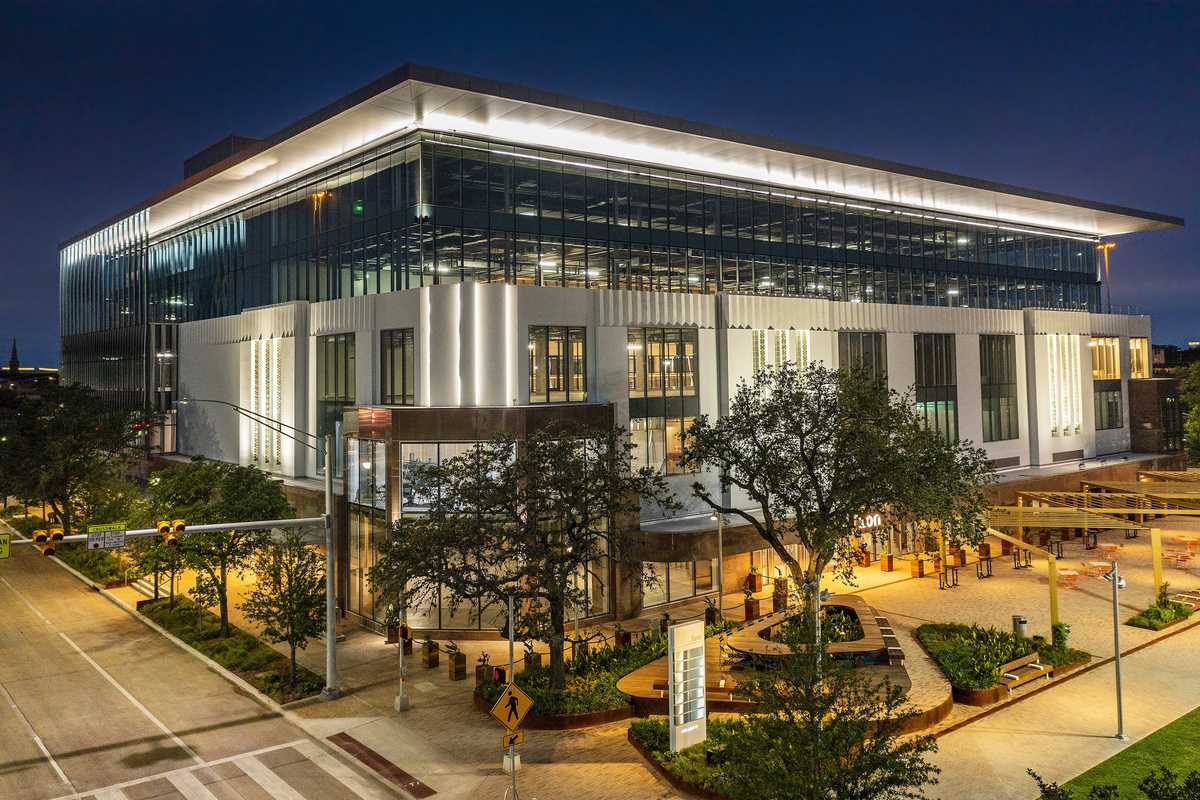
Rice University will lead a new U.S. Space Force-backed consortium to fast-track breakthrough remote sensing technologies. Photo via Getty Images

Rice University has signed an $8.1 million cooperative agreement to lead the U.S. Space Force University Consortium/Space Strategic Technology Institute 4 (SSTI).

The new entity will be known as the Center for Advanced Space Sensing Technologies (CASST) at Rice and will focus on developing innovative remote sensing technologies.

“This investment positions Rice at the forefront of the technologies that will define how we see, understand and operate in space,” Amy Dittmar, Howard R. Hughes Provost and executive vice president for academic affairs, said in a news release. “By bringing together advanced remote sensing, AI-driven analysis and cross-institutional expertise, CASST will help transform raw space data into real-time insight and expand the frontiers of scientific discovery.

The news comes shortly after the Texas Space Commission approved a nearly $14.2 million grant for the newly created Center for Space Technologies at Rice.

David Alexander, director of the Rice Space Institute, will lead CASST. Alexander is also an inaugural member of the Texas Aerospace Research and Space Economy Consortium and he serves on the boards of the Houston Spaceport Development Corporation, SpaceCom and the Sasakawa International Center for Space Architecture. The team also includes Rice professors and staff Kevin Kelly, Tomasz Tkaczyk, Kenny Evans, Kaden Hazzard, Mark Jernigan and Vinod Veedu, and collaborators from Houston-based Aegis Aerospace, University of California, Los Angeles, University of California, Santa Barbara and Georgia Institute of Technology.

In addition to bringing new space sensor innovation, the team will also work to miniaturize sensors while developing and implementing low-resource fabrication techniques, according to Rice. The researchers will also utilize AI and machine learning to analyze sensor data.

The U.S. Space Force uses space sensors to provide real-time information about space environments and assess potential threats. CASST is the fourth Space Strategic Technology Institute established by the USSF.

“Rice has helped shape the modern era of space research, and CASST marks a bold step into what comes next,” David Sholl, executive vice president for research at Rice, said in a news release. “As space becomes more contested and more essential to daily life, the ability to rapidly sense, interpret and act on what’s happening beyond Earth is critical. This center brings together the materials, engineering and data science innovations needed to deliver that capability."

The USSF University Consortium works with academic teams to develop breakthrough technologies and speed their transition into real-world applications for the U.S. Space Force.

The recent Rice award is part of $16 million over about three years. The USSF also signed a cooperative agreement with the University of Arizona in February.

The consortium has also helped facilitate several technological and commercial transitions over the last two years, including a $36 million commercial contract awarded to Axiom by Texas A&M University's in-space operations team and a follow-on $6 million contract to Axiom to build on technology developed by the University of Texas.


Ad Placement 300x100
Ad Placement 300x600

CultureMap Emails are Awesome

Houston founders launch edtech startup, pilot to pinpoint why students are struggling

learning gaps

Early detection. It sounds simple enough: identify a problem before it has the chance to become a bigger one.

But in practice, early detection is much more difficult to navigate, especially in education, when it comes to identifying the reasons behind a student's academic struggles.

That’s why co-founders Alapati “Al” Ware and Estela Montanez launched Progress Report, a Houston-built K-12 learning-intelligence platform designed to go beyond identifying that a student is struggling.

The platform recently began its pilot program with 35 educators and more than 200 students in Texas and Arizona.

“It’s a micro-learning school that works with children with disabilities, primarily dyslexia and nonverbal students,” Ware tells InnovationMap.

The platform is also being used by homeschool parents, home teachers and Houston educators, including those at SWPS College & Career Preparatory Academy, a Houston charter school.

Ware says Progress Report was designed to fill a gap he and Montanez saw in existing edtech. Some platforms cater almost entirely to students, leaving teachers with little insight into if and how a child is learning. Others focus heavily on district data, where “the student is just a number,” leaving teachers to navigate disconnected tools.

“Our goal was [to] focus purely on the teacher because the teacher is the backbone,” Ware says.

Progress Report traces student performance to learning gaps and prerequisite skills, helping educators understand not only where a student is struggling, but what may be causing it.

The platform then helps teachers build individualized instruction for general education students, students with special education and Individualized Education Program (IEP) needs, and Spanish-speaking learners—all within one educator-controlled system.

The goal is to reduce the guesswork and hours of manual work educators can spend developing individualized lesson plans.

Progress Report helps idenitify learning gaps and common roadblocks for each student. Image courtesy Progress Report

For Ware and Montanez, the mission is also personal.

The concept dates back to around 2023, when the co-founders first had to navigate and address their children’s educational needs.

Ware, Progress Report’s CEO and CTO with a background in edtech, built the platform end-to-end after watching his daughter, who had an IEP related to speech, struggle to get the support she needed.

Montanez, the company’s COO, brought another perspective. Her son is on the autism spectrum. She now leads Progress Report’s operations, partnerships and pilot execution while helping carry its focus on bilingual families from Puerto Rico to Houston.

Together, they began researching ways to personalize their children’s learning and help them progress academically. Montanez’s son went on to become an AP student and high school athlete, while Ware’s daughter began reading more than two grade levels above her grade, they tell InnovationMap.

But Progress Report isn’t designed simply to give a struggling student more work.

Take a student who appears to have difficulty with math.

The problem may not actually be math, the founders share. The student could understand the calculations but struggle to comprehend complex words used in a math problem.

Progress Report is designed to trace those performance patterns back to learning gaps, prerequisite skills or other instructional barriers. From there, it can recommend a next instructional step while leaving the educator in control.

The same concept applies to accommodations.

The system can read IEPs, 504 Plans, Present Levels of Academic Achievement and Functional Performance (PLAAFPs), evaluations and other special education records. Approved IEP goals can then be mapped into the student’s learning graph, while accommodations can carry over into lesson planning and question delivery.

The founders say that approach separates Progress Report from simply adding another artificial intelligence chatbot to a classroom. And still, they believe teachers have to remain at the center.

Teachers, in fact, helped build Progress Report.

The founders began meeting with Houston-area educators months before the pilot. Their feedback helped shape the platform before testing began.

“We’ve been building alongside these educators,” Ware says.

Parents are another piece.

Progress Report can give parents access to their child’s learning record so they can see learning gaps as they develop. Teachers can also see information on work being completed at home when the parent and educator are working together.

After the pilot wraps, Ware and Montanez plan to introduce a $29.99 monthly subscription for homeschool parents, teachers and other educators. They say the price was intentionally kept relatively low to help make the tools more accessible.

They are also exploring ways to work with organizations that could help families who can’t afford the platform.

Moving forward, the goal is considerably bigger.

Over the next five years, Ware and Montanez want Progress Report to become what they describe as a “gold standard” in every state. They know getting there will require building relationships with educators, technology leaders, policymakers and school board members.

For now, they’re starting with a few hundred students and a question that sounds simple but can be remarkably difficult to answer: Why is this student struggling?

If Progress Report works the way its founders envision, teachers and parents will have a clearer answer.

Pioneering cohousing development opens in Houston's historic 2nd Ward

Housing in Hou

An experimental, multi-generational building in the East End is now open and accepting residents. Only 10 of the 33 units remain available at East End Commons, the first project from CoHousing Houston.

Located at 115 Lenox, East End Commons was first conceived in 2017 and is designed to combine the security of home ownership with the community aspect of apartment life, essentially a condominium but with added focus on bringing neighbors together.

Units range from 900-2,000 square feet, offering ample private home space, but with a large Common House area and central courtyard for gatherings, working, and interaction. Large front porches encourage people to spend time outside where they can meet their neighbors, as do extensive foot paths for casual meetings.

"At East End Commons, you know your neighbors before you move in — so you have a network of people and spaces that are immediately there for you," said founding resident Kelli Soika. "We designed for larger shared spaces versus larger personal spaces in order to foster the breakdown of the barriers that lead to loneliness."

Combating loneliness and isolation is certainly necessary. A 2025 survey conducted by the American Psychological Association shows that most Americans feel a sense of societal division and lonely. A loss of "third spaces," where people gather outside the home or work, is a prime factor. East End Commons aims to alleviate some of that disconnectedness.

"I wanted to live in a neighborhood that is imbued with a sense of community above the individual, like we have all experienced in Houston during times of disaster recovery," said Lynn Morstead, one of East End Commons‘ founding residents. "In those instances, such as Hurricane Harvey, we surface from our separateness and come together in new and unexpected ways. With East End Commons, the goal is to translate that notion beyond a set period of time and make it a fixture of everyday life. I call it 'disaster-free neighborliness.'"

East End Commons was designed by Kathleen English of English + Associates. Sustainability is part of the project's design, with amenities such as geothermal heating and cooling exchange HVAC, pre-heated water systems, low-energy use air conditioning and heating, and native landscaping.

Prices for units range from $300,000 to the $900,000s, which can be more than double the home price in the rapidly gentrifying East End. HOA fees not only help maintain communal areas, they also cover shared internet, water, and other communal expenses. Similarly, government of the building is handled democratically via a community board that aims to make decisions by building consensus.

For more information, email info@cohousinghouston.com or call 832-900-2919.

MD Anderson president to retire after nine years, interim successor named

retirement plan

An era is ending at The University of Texas MD Anderson Cancer Center.

On Aug. 26, Dr. Peter WT Pisters announced his plans to retire from his role as president of the comprehensive cancer center. He will work on a smooth transition of leadership with interim president Dr. Jeffrey E. Lee throughout September.

“I first arrived at UT MD Anderson 32 years ago with a passion for doing everything I could to advance our mission to end cancer. Serving as the only faculty member to become president, and now marking nine years in the role, I can say with great pride and gratitude that there is no better place than UT MD Anderson to turn hope into healing for patients and families everywhere,” Pisters said in a news release. “With a timeless strategy, a strong leadership team, unprecedented levels of financial health, and a priceless culture anchored in our deeply held Core Values, now is the right time for me to transition to other opportunities. UT MD Anderson has never been stronger, and its future has never been brighter.”

Pisters assumed the presidency in 2017 and helped launch some of the most cutting-edge new clinics in MD Anderson history. One of those was the James P. Allison Institute, named for the Nobel Laureate scientist who discovered a way to suppress immune response on tumors so that immune cells would attack cancer cells instead. As head of his titular clinic, Allison pioneered several new immunotherapies against cancer.

Pisters also oversaw the creation of the Institute for Data Science in Oncology in 2024, an innovative consortium of scientists dedicated to enhancing single-cell imaging to improve precision in cancer treatments. The institute also brought together teams to use data-driven analytics regarding safety, quality and access.

The UT System Board of Regents praised the leadership and work of Pisters in a statement, wishing him well in the next phase of his career.

“The Board of Regents and I are profoundly grateful to Dr. Pisters for his exceptional presidency over the past nine years and for thoughtfully concluding his service when UT MD Anderson is thriving at its best position of peak performance, strength and impact. We wish him our very best with his retirement and in his next chapter,” Kevin P. Eltife, chairman of the UT System Board of Regents, added in the release.