


Six members of the UH community participated in the inaugural Innov8 Hub's Innovators to Founders Cohort. Photo via UH.edu

A new accelerator at the University of Houston recently wrapped its first program for a cohort of five early-stage startups.

Known as the Innov8 Hub's Innovators to Founders Cohort, the accelerator is a founder-driven program in partnership with the UH Technology Bridge, the Innovation Center, and the Texas Gulf Coast Small Business Development Center (SBDC). Innov8 is designed to aid six to eight aspiring entrepreneurs bring their concepts to market and assist them in applying for Small Business Innovation Research (SBIR) and Small Business Technology Transfer (STTR) grants.

Founders recently showcased their work before potential partners and investors at the hub's first-ever Startup Pitch Day following the conclusion of the 12-week program.

“The goal of the programs is for the founders to launch new ventures and develop business plans they can use to raise money and attract C-suite level employees to join their team,” Tanu Chatterji, associate director of startup development at Tech Bridge and co-founder of Innov8 Hub, said in a statement. “These programs aren’t classroom-teacher driven so the founders have to commit to engage and spend the time necessary to reap the benefits.”
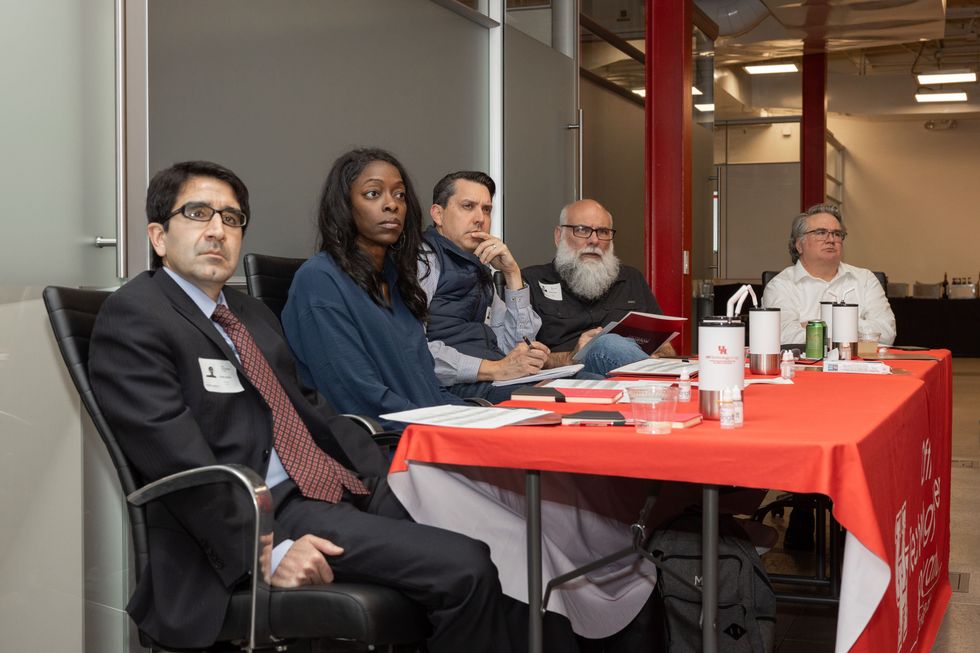
The Innovators to Founders Cohort runs for three months each semester. Cohort members will devote three hours each week to the program. Photo via UH.edu

The inaugural cohort included:

Shoujun Xu, UForce Biotechnology: Xu is a chemistry professor at UH and has developed a new technique of super-resolution force spectroscopy, or SURFS, and plans to launch his company, UForce Biotechnology, in the future. He aims to use the SURFS technique to advance drug screening. His pitch at the Startup Pitch Day was named the best of the night, and Xu went home with $7,500 in legal services and one year of coworking space free of charge.

Easy Anyama, ODX Health: Anyama is a fourth-year student in the UH College of Optometry. His company, ODX Health, aims to improve "data harmonization, interoperability and integration in eyecare to reduce inefficiencies and enhance health outcomes," according to UH.

Jeremy Tee and Easy Anyama, Ringit: Anyama joined fellow fourth-year student in the UH College of Optometry Jeremy Tee in a second pitch, Ringit. The startup aims to provide a low-cost medication management solution for the visually impaired. It is developing an adaptive labeling system that helps the visually impaired identify their medication and dosages independently via intuitive, "touch-based features," according to UH.

Jan Beetge, AltiSora: Beetge has developed "Botox for wood." The product is made from high- sustainability raw materials that are non-hazardous and non-toxic. Potential applications include waterproofing of electronic equipment or electrical cables or connections in cables, such as cables used in marine applications, according to the company's website.

Jason Shi, Smart Planter Project: Shi is developing a "high-tech planter, a device that autonomously takes care of your plants and keeps them healthy while you’re gone," according to UH. He aims to soon test the product with customers.

The Innovators to Founders Cohort runs for three months each semester. Cohort members will devote three hours each week to the program.

The Innov8 Hub also offers an SBIR/STTR Support Cohort and a WKI Program for Student Entrepreneurial Support Cohort.

Last year, UH also named eight graduate students to its first-ever UH-Chevron Energy Graduate Fellows cohort.
Ad Placement 300x100
Ad Placement 300x600

CultureMap Emails are Awesome

MD Anderson makes AI partnership to advance precision oncology

AI Oncology

Few experts will disagree that data-driven medicine is one of the most certain ways forward for our health. However, actually adopting it comes at a steep curve. But what if using the technology were democratized?

This is the question that SOPHiA GENETICS has been seeking to answer since 2011 with its universal AI platform, SOPHiA DDM. The cloud-native system analyzes and interprets complex health care data across technologies and institutions, allowing hospitals and clinicians to gain clinically actionable insights faster and at scale.

The University of Texas MD Anderson Cancer Center has just announced its official collaboration with SOPHiA GENETICS to accelerate breakthroughs in precision oncology. Together, they are developing a novel sequencing oncology test, as well as creating several programs targeted at the research and development of additional technology.

That technology will allow the hospital to develop new ways to chart the growth and changes of tumors in real time, pick the best clinical trials and medications for patients and make genomic testing more reliable. Shashikant Kulkarni, deputy division head for Molecular Pathology, and Dr. J. Bryan, assistant professor, will lead the collaboration on MD Anderson’s end.

“Cancer research has evolved rapidly, and we have more health data available than ever before. Our collaboration with SOPHiA GENETICS reflects how our lab is evolving and integrating advanced analytics and AI to better interpret complex molecular information,” Dr. Donna Hansel, division head of Pathology and Laboratory Medicine at MD Anderson, said in a press release. “This collaboration will expand our ability to translate high-dimensional data into insights that can meaningfully advance research and precision oncology.”

SOPHiA GENETICS is based in Switzerland and France, and has its U.S. offices in Boston.

“This collaboration with MD Anderson amplifies our shared ambition to push the boundaries of what is possible in cancer research,” Dr. Philippe Menu, chief product officer and chief medical officer at SOPHiA GENETICS, added in the release. “With SOPHiA DDM as a unifying analytical layer, we are enabling new discoveries, accelerating breakthroughs in precision oncology and, most importantly, enabling patients around the globe to benefit from these innovations by bringing leading technologies to all geographies quickly and at scale.”

Houston company plans lunar mission to test clean energy resource

lunar power

Houston-based natural resource and lunar development company Black Moon Energy Corporation (BMEC) announced that it is planning a robotic mission to the surface of the moon within the next five years.

The company has engaged NASA’s Jet Propulsion Laboratory (JPL) and Caltech to carry out the mission’s robotic systems, scientific instrumentation, data acquisition and mission operations. Black Moon will lead mission management, resource-assessment strategy and large-scale operations planning.

The goal of the year-long expedition will be to gather data and perform operations to determine the feasibility of a lunar Helium-3 supply chain. Helium-3 is abundant on the surface of the moon, but extremely rare on Earth. BMEC believes it could be a solution to the world's accelerating energy challenges.

Helium-3 fusion releases 4 million times more energy than the combustion of fossil fuels and four times more energy than traditional nuclear fission in a “clean” manner with no primary radioactive products or environmental issues, according to BMEC. Additionally, the company estimates that there is enough lunar Helium-3 to power humanity for thousands of years.

"By combining Black Moon's expertise in resource development with JPL and Caltech's renowned scientific and engineering capabilities, we are building the knowledge base required to power a new era of clean, abundant, and affordable energy for the entire planet," David Warden, CEO of BMEC, said in a news release.

The company says that information gathered from the planned lunar mission will support potential applications in fusion power generation, national security systems, quantum computing, radiation detection, medical imaging and cryogenic technologies.

Black Moon Energy was founded in 2022 by David Warden, Leroy Chiao, Peter Jones and Dan Warden. Chiao served as a NASA astronaut for 15 years. The other founders have held positions at Rice University, Schlumberger, BP and other major energy space organizations.

Houston co. makes breakthrough in clean carbon fiber manufacturing

Future of Fiber

Houston-based Mars Materials has made a breakthrough in turning stored carbon dioxide into everyday products.

In partnership with the Textile Innovation Engine of North Carolina and North Carolina State University, Mars Materials turned its CO2-derived product into a high-quality raw material for producing carbon fiber, according to a news release. According to the company, the product works "exactly like" the traditional chemical used to create carbon fiber that is derived from oil and coal.

Testing showed the end product met the high standards required for high-performance carbon fiber. Carbon fiber finds its way into aircraft, missile components, drones, racecars, golf clubs, snowboards, bridges, X-ray equipment, prosthetics, wind turbine blades and more.

The successful test “keeps a promise we made to our investors and the industry,” Aaron Fitzgerald, co-founder and CEO of Mars Materials, said in the release. “We proved we can make carbon fiber from the air without losing any quality.”

“Just as we did with our water-soluble polymers, getting it right on the first try allows us to move faster,” Fitzgerald adds. “We can now focus on scaling up production to accelerate bringing manufacturing of this critical material back to the U.S.”

Mars Materials, founded in 2019, converts captured carbon into resources, such as carbon fiber and wastewater treatment chemicals. Investors include Untapped Capital, Prithvi Ventures, Climate Capital Collective, Overlap Holdings, BlackTech Capital, Jonathan Azoff, Nate Salpeter and Brian Andrés Helmick.

---

This article originally appeared on our sister site, EnergyCapitalHTX.com.