


Six members of the UH community participated in the inaugural Innov8 Hub's Innovators to Founders Cohort. Photo via UH.edu

A new accelerator at the University of Houston recently wrapped its first program for a cohort of five early-stage startups.

Known as the Innov8 Hub's Innovators to Founders Cohort, the accelerator is a founder-driven program in partnership with the UH Technology Bridge, the Innovation Center, and the Texas Gulf Coast Small Business Development Center (SBDC). Innov8 is designed to aid six to eight aspiring entrepreneurs bring their concepts to market and assist them in applying for Small Business Innovation Research (SBIR) and Small Business Technology Transfer (STTR) grants.

Founders recently showcased their work before potential partners and investors at the hub's first-ever Startup Pitch Day following the conclusion of the 12-week program.

“The goal of the programs is for the founders to launch new ventures and develop business plans they can use to raise money and attract C-suite level employees to join their team,” Tanu Chatterji, associate director of startup development at Tech Bridge and co-founder of Innov8 Hub, said in a statement. “These programs aren’t classroom-teacher driven so the founders have to commit to engage and spend the time necessary to reap the benefits.”
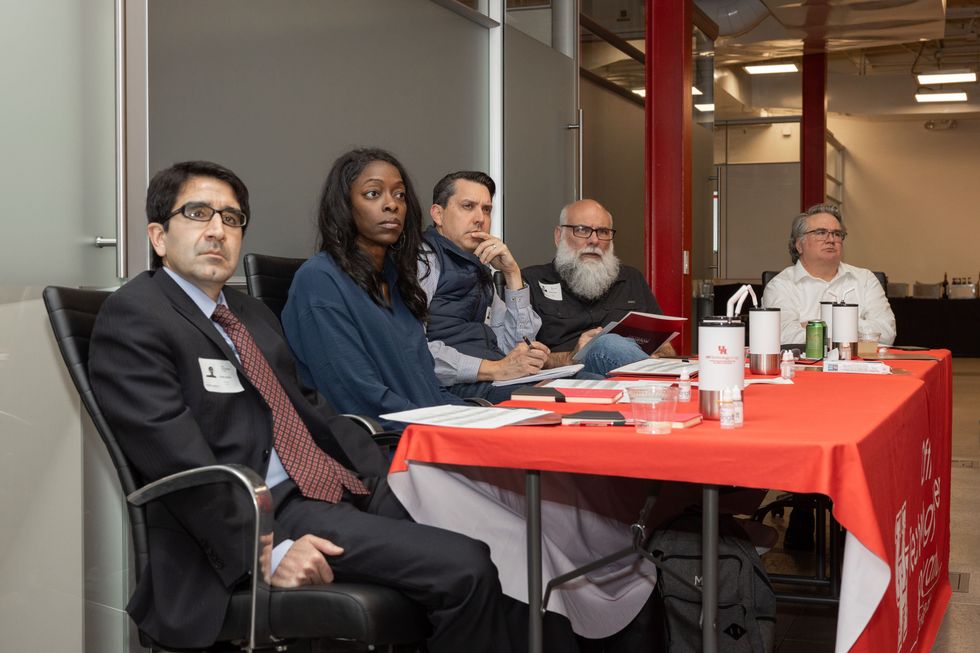
The Innovators to Founders Cohort runs for three months each semester. Cohort members will devote three hours each week to the program. Photo via UH.edu

The inaugural cohort included:

Shoujun Xu, UForce Biotechnology: Xu is a chemistry professor at UH and has developed a new technique of super-resolution force spectroscopy, or SURFS, and plans to launch his company, UForce Biotechnology, in the future. He aims to use the SURFS technique to advance drug screening. His pitch at the Startup Pitch Day was named the best of the night, and Xu went home with $7,500 in legal services and one year of coworking space free of charge.

Easy Anyama, ODX Health: Anyama is a fourth-year student in the UH College of Optometry. His company, ODX Health, aims to improve "data harmonization, interoperability and integration in eyecare to reduce inefficiencies and enhance health outcomes," according to UH.

Jeremy Tee and Easy Anyama, Ringit: Anyama joined fellow fourth-year student in the UH College of Optometry Jeremy Tee in a second pitch, Ringit. The startup aims to provide a low-cost medication management solution for the visually impaired. It is developing an adaptive labeling system that helps the visually impaired identify their medication and dosages independently via intuitive, "touch-based features," according to UH.

Jan Beetge, AltiSora: Beetge has developed "Botox for wood." The product is made from high- sustainability raw materials that are non-hazardous and non-toxic. Potential applications include waterproofing of electronic equipment or electrical cables or connections in cables, such as cables used in marine applications, according to the company's website.

Jason Shi, Smart Planter Project: Shi is developing a "high-tech planter, a device that autonomously takes care of your plants and keeps them healthy while you’re gone," according to UH. He aims to soon test the product with customers.

The Innovators to Founders Cohort runs for three months each semester. Cohort members will devote three hours each week to the program.

The Innov8 Hub also offers an SBIR/STTR Support Cohort and a WKI Program for Student Entrepreneurial Support Cohort.

Last year, UH also named eight graduate students to its first-ever UH-Chevron Energy Graduate Fellows cohort.
Ad Placement 300x100
Ad Placement 300x600

CultureMap Emails are Awesome

New UT Austin med center, anchored by MD Anderson, gets $1 billion gift

Future of Health

A donation announced Tuesday, April 21, breaks a major record at the University of Texas at Austin. Michael and Susan Dell are now UT Austin's first supporters to give $1 billion. In response, the university will create the UT Dell Campus for Advanced Research and the UT Dell Medical Center to "advance human health," per a press release.

The release also records "significant support" for undergraduate scholarships, student housing, and the Texas Advanced Computing Center for supercomputing research.

Both the new research campus and the UT Dell Medical Center will integrate advanced computing into their research and practices. At the medical center, the university hopes that will lead to "earlier detection, more precise and personalized care, and better health outcomes." The University of Texas MD Anderson Cancer Center will also be integrated into the new medical center.

That comes with a numeric goal measured in 10s: raise $10 billion and rank among the top 10 medical centers in the U.S., both in the next decade.

In the shorter term, the university will break ground on the medical center with architecture firm Skidmore, Owings & Merrill (SOM) "later this year."

“UT Austin, where Dell Technologies was founded from a dorm room, has always been a place where bold ideas become real-world impact,” said Michael and Susan Dell in a joint statement.

They continued, “What makes this moment so meaningful is the opportunity to build something that brings every part of the journey together — from how students learn, to how discoveries are made, to how care reaches families. By bringing together medicine, science and computing in one campus designed for the AI era, UT can create more opportunity, deliver better outcomes, and build a stronger future for communities across Texas and beyond.”

This is the second major gift this year for the planned multibillion-dollar medical center. In January, Tench Coxe, a former venture capitalist who’s a major shareholder in chipmaking giant Nvidia, and Simone Coxe, co-founder and former CEO of the Blanc & Otus PR firm, contributed $100 million$100 million.

Baylor scientist lands $2M grant to explore links between viruses and Alzheimer’s

Alzheimer’s research

A Baylor College of Medicine scientist will begin exploring the possible link between Alzheimer’s disease and viral infections thanks to a $2 million grant awarded in March.

Dr. Ryan S. Dhindsa is an assistant professor of pathology & immunology at Baylor and a principal investigator at Texas Children’s Duncan Neurological Research Institute (Duncan NRI). He hypothesizes that Alzheimer’s may have some link to previous viral infections contracted by the patient. To study this intriguing possibility, the American Brain Foundation has gifted him the Cure One, Cure Many award in neuroinflammation.

“It is an honor to receive this support from the Cure One, Cure Many Award. Viral infections are emerging as a major, underappreciated driver of Alzheimer's disease, and this award will allow our team to conduct the most comprehensive screen of viral exposures and host genetics in Alzheimer's to date, spanning over a million individuals,” Dhindsa said in a news release. “Our goal is to identify which viruses matter most, why some people are more vulnerable than others, and ultimately move the field closer to new therapeutic strategies for patients.”

Roughly 150 million people worldwide will suffer from Alzheimer’s by 2050, making it the most common cause of dementia in the world. Despite this, scientists are still at a loss as to what exactly causes it.

Dhindsa’s research is part of a new range of theories that certain viral infections may trigger Alzheimer’s. His team will take a two-fold approach. First, they will analyze the medical records of more than a million individuals looking for patterns. Second, they will analyze viral DNA in stem cell-derived brain cells to see how the infections could contribute to neurological decay. The scale of the genomic data gathering is unprecedented and may highlight a link that traditional studies have missed.

Also joining the project are Dr. Caleb Lareau of Memorial Sloan Kettering Cancer Center and Dr. Artem Babaian of the University of Toronto. Should a link be found, it would open the door to using anti-virals to prevent or treat Alzheimer’s.

Tesla Robotaxi service officially launches in Houston and Dallas

Future of the Roads

Tesla’s Robotaxi service has taken to the streets of Houston. In a brief statement Saturday, April 18 on its X social media account, Tesla Robotaxi says the autonomous rideshare service just launched in Texas’ two biggest metro areas — Houston and Dallas.

“Try Tesla Robotaxi in Dallas & Houston!” Tesla CEO Elon Musk says in a reposting on X of the Robotaxi announcement.

One of Robotaxi’s competitors, Alphabet-owned Waymo, beat the Tesla service to the Dallas, Houston, and Austin markets. Another competitor, Amazon-owned Zoox, has Dallas flagged for its autonomous rideshare service.

Robotaxi previously kicked off in Austin, where Tesla is based and manufactures electric vehicles, and the San Francisco Bay Area. Nearly 50 Robotaxis operate in Austin, where the service’s inaugural rides happened last year, and more than 500 in the San Francisco area.

Of the three rides logged in a 31-square-mile area in Dallas as of Monday morning, the average fare was $7.96 and the average trip was 3.5 miles, according to an online tracker of autonomous rideshare services. The tracker showed only one Robotaxi was on the roads in Dallas.

As of Monday morning, a 25-square-mile area in Houston had two Robotaxis on the road, according to the online tracker. The average fare for five recorded rides was $11.34 and the average trip was six miles.

“We want Robotaxi pricing to be simple and easy for you to understand,” according to the Robotaxi website. “Initially, as part of our introductory program, we will charge a simple, affordable rate plus applicable taxes and fees for all rides within the available service area.”

The tracker shows the Robotaxi in Dallas did not have a human aboard to monitor each trip, and only one of Houston’s two Robotaxis did not have a human monitor in the driver’s seat.

For now, all passengers ride in Tesla Model Y cars. Robotaxi operates from 6 am-2 am daily.

To use the service, you first must download the Robotaxi app, which works only on iPhones.

Robotaxi lets you stream music and adjust climate settings and seat positioning from the Robotaxi app or the vehicle’s touchscreen. Climate and media settings are stored in your Robotaxi profile and automatically transfer from one vehicle to another. If you own a Tesla, certain profile settings and media preferences are available in your own car as well as in a Robotaxi.

In January at the World Economic Forum in Davos, Switzerland, Musk said a “widespread” network of driverless rideshare vehicles would be operating in the U.S. by the end of this year, CNBC reported.

---

This article originally appeared on CultureMap.com.