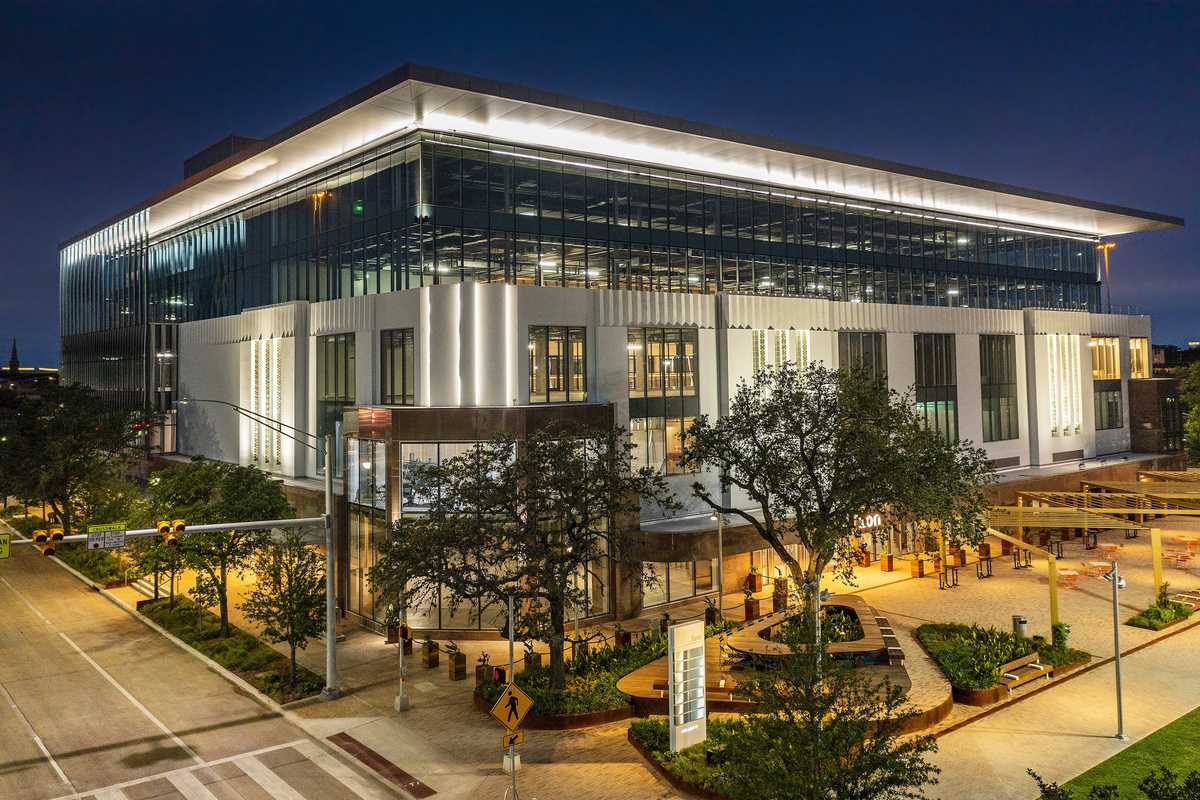
The University of Michigan's Intero Biosystems earned a top-place finish and the largest total investment from the 2025 Rice Business Plan Competition. Photo courtesy Rice University.

Editor's note: As 2026 ramps up, the Houston innovation scene is looking for the latest groups of innovative startups that'll make an impact. A number of accelerators and competitions have opened applications. Read below to see which might be a good fit for you or your venture. And take careful note of the deadlines. Please note: this article may be updated to include additional information and programs.

Did we miss an accelerator or competition accepting applications? Email innoeditor@innovationmap.com for editorial consideration.

2026 HCC Business Plan Competition

Deadline: Jan. 26

Details: HCC’s annual Business Plan Competition (BPC) is an opportunity for proposed, startup and existing entrepreneurs to develop focused plans to start or grow their businesses. Accepted teams will be announced and training will begin in late February and run through early June, with six free, three-hour training sessions. Advising will be provided to each accepted team. Applicants can apply as a team of up to five persons. Finalists will present to to gudges on May 27, 2026. Last year, $26,000 was awarded in seed money to the top five teams. In-kind prizes were also awarded to all graduating teams including free products, services and memberships, with an estimated in-kind value totaling $147,000. Find more information here.

University of Houston Technology Bridge Innov8 Hub (Spring 2026)

Deadline: Jan . 30

Details: UHTB Innov8 Hub’s immersive, 12-week startup acceleration program designed to help early-stage founders launch and scale their technology startups. Selected participants will gain access to expert mentors and advisors, collaborate with a cohort of peers, and compete for cash prizes during our final pitch event. The cohort begins Feb. 16, 2026. The program culminates in Pitch Day, where participants present their ventures to an audience of investors and partners from across the UH innovation ecosystem. Find more information here.

Rice Business Plan Competition 2026

Deadline: Jan. 31

Details: The Rice Business Plan Competition, hosted by the Rice Alliance for Technology and Entrepreneurship, gives collegiate entrepreneurs real-world experience to pitch their startups, enhance their business strategy and learn what it takes to launch a successful company. Forty-two teams will compete for more than $1 million in cash, investments and prizes on April 9-11, 2026. Find more information here.

Rice Veterans Business Battle 2026

Deadline: Jan. 31

Details: The Rice Veterans Business Battle is one of the nation’s largest pitch competitions for veteran-led startups, providing founders with mentorship, exposure to investors and the opportunity to compete for non-dilutive cash prizes. The event has led to more than $10 million of investments since it began in 2015. Teams will compete April 8-9, 2026. Find more information here.

TEX-E Fellows Application 2026-2027

Deadline: Feb. 10

Details: The TEX‑E Fellowship is a hands-on program designed for students interested in energy, climate, and entrepreneurship across Texas. It connects participants with industry mentors, startup founders, investors and academic leaders while providing practical, "real-world" experience in customer discovery, business modeling, and energy-transition innovation. Fellows gain access to workshops, real-world projects, and a statewide network shaping the future of energy and climate solutions. Participants must be a student at PVAMU, UH, UT Austin, Rice University, MIT or Texas A&M. Find more information here.

2026 Energy Venture Day & Pitch Competition

Deadline: Feb. 13

Details: The Rice Alliance, the Houston Energy Transition Initiative (HETI) and TEX-E will present the annual Energy Venture Day and Pitch Competition during CERAWeek on March 24-25, 2026. Energy Venture Day features two days of presentations by energy tech ventures driving efficiency and advancements toward the energy transition. On March 24, the Pitch Preview at the Ion will feature over 50 companies presenting in front of Rice Alliance's robust network of investors and industry partners. On March 25, the Energy Venture Day and Pitch Competition during CERAWeek will showcase 36 ventures at the George R Brown Convention Center. The pitch competition is divided up into the TEX-E university track, in which Texas student-led energy startups compete for $50,000 in cash prizes, and the industry ventures track. The industry track is subdivided into three additional tracks, spanning materials to clean energy. The top three companies from each industry track will be named. The winner of the CERAWeek competition will also have the chance to advance and compete for the $1 million investment prize at the Startup World Cup. Find more information here.

Greentown Go Make 2026

Deadline: March 10

Details: Greentown Go Make 2026 is an open-innovation program with Shell and Technip Energies. The six-month program is advancing industrial decarbonization by accelerating catalytic innovations. Selected startups will gain access to a structured platform to engage leadership from Shell and Technip Energies and explore potential partnership outcomes, including pilots and demonstrations. They’ll also receive networking opportunities, partnership-focused programming, and marketing visibility throughout the program. The cohort will be selected in May. Find more information here.

Ad Placement 300x100
Ad Placement 300x600

CultureMap Emails are Awesome

Houston startup debuts bio-based 'leather' fashion collection in Milan

sustainable fashion

Earlier this month, Houston-based Rheom Materials and India’s conscious design studio Econock unveiled a collaborative capsule collection that signaled more than just a product launch.

Hosted at Lineapelle—long considered the global epicenter of the world's premier leather supply chain—in the vaulted exhibition halls of Rho-Fiera Milano, the collection centered around Rheom’s 91 percent bio-based leather alternative, Shorai.

It was a bold move, one that shifted sustainability from a concept discussed in panel sessions to garments that buyers could touch and wear.

The collection featured a bomber-style jacket, an asymmetrical skirt and a suite of accessories—all fabricated from Shorai.

The standout piece, a sculptural jacket featuring a funnel neck and dual-zip closure, was designed for movement, challenging assumptions about performance limitations in bio-based materials. The design of the asymmetrical skirt was drawn from Indian armored warrior traditions, according to Rheom, with biodegradable corozo fasteners.

Built as a modular wardrobe rather than isolated pieces, the collection reflects a shared belief between Rheom and Econock in designing objects that adapt to daily life, according to the companies.

The collection was born out of a new partnership between Rheom and Econock, focused on bringing biobased materials to the market. According to Rheom, the partnership solves a problem that has stalled the adoption of many next-gen textiles: supply chain friction.

While Rheom focuses on engineering scalable bio-based materials, New Delhi-based Econock brings the complementary design and manufacturing ecosystem that integrates artisans, circular materials and production expertise to translate the innovative material into finished goods.

"This partnership removes one of the biggest barriers brands face when adopting next-generation materials,” Megan Beck, Rheom’s director of product, shared in a news release. “By reducing friction across the supply chain, Rheom can connect brands directly with manufacturers who already know how to work with Shorai, making the transition to more sustainable materials far more accessible.”

Sanyam Kapur, advisor of growth and impact at Econock, added: “Our partnership with Rheom Materials represents the benchmark of responsible design where next-gen materials meet craft, creativity, and real-world scalability.”

Rheom, formerly known as Bucha Bio, has developed Shorai, a sustainable leather alternative that can be used for apparel, accessories, car interiors and more; and Benree, an alternative to plastic without the carbon footprint. In 2025, Rheom was a finalist for Startup of the Year in the Houston Innovation Awards.

Shorai is already used by fashion lines like Wuxly and LuckyNelly, according to Rheom. The company scaled production of the sugar-based material last year and says it is now produced in rolls that brands can take to market with the right manufacturer.

Houston startup debuts leather alternative fashion collection in Milan

Houston clean energy co. secures $100M to deploy tech on global scale

Going Global

Houston-based Utility Global has raised $100 million in an ongoing Series D round to globally deploy its decarbonization technology at an industrial scale.

The round was led by Ara Partners and APG Asset, according to a news release. Utility plans to use the funding to expand manufacturing, grow its teams and support its commercial developments and partnerships.

“This financing marks a critical step in Utility’s transition from a proven technology to full-scale global commercial execution,” Parker Meeks, CEO and president of Utility Global, said in the release. “Industrial customers are no longer looking for pilots or promises; they need deployable solutions that work within existing assets and deliver true economic industrial decarbonization today that is operationally reliable and highly scalable. Utility’s technology produces both economic clean hydrogen and capture-ready CO2 streams, and this capital enables us to scale and deploy that impact globally with speed, discipline, and rigor.”

Utility Global's H2Gen technology produces low-cost, clean hydrogen from water and industrial off-gases without requiring electricity. It's designed to integrate into existing industrial infrastructure in hard-to-abate assets in the steel, refining, petrochemical, chemical, low-carbon fuels, and upstream oil and gas sectors.

“Utility is tackling one of the most difficult challenges in the energy transition: decarbonizing hard‑to‑abate industrial sectors,” Cory Steffek, partner at Ara Partners and Utility Global board chair, said in the release. “What sets Utility apart is its ability to compete head‑to‑head with conventional fossil‑based solutions on cost and reliability, even as it materially reduces emissions. With this new funding, Utility is well-positioned for its next chapter of commercial growth while maintaining the technical excellence and capital discipline that have defined its development to date.”

Utility Global reached several major milestones in 2025. After closing a $53 million Series C, the company agreed to develop at least one decarbonization facility at an ArcelorMittal steel plant in Brazil. It also signed a strategic partnership with California-based Kyocera International Inc. to scale global manufacturing of its H2Gen electrochemical cells.

The company also partnered with Maas Energy Works, another California company, to develop a commercial project integrating Maas’ dairy biogas systems with H2Gen to produce economical, clean hydrogen.

"These projects were never intended to stand alone. They anchor a deep and growing pipeline of commercial projects now in development globally across steel, refining, chemicals, biogas and other hard-to-abate sectors worldwide, Meeks shared in a 2025 year-in-review note. He added that 2026 would be a year of "focused acceleration to scale."

---

This article originally appeared on EnergyCapitalHTX.com.

Houston Methodist awarded $4M grant to recruit head of Neal Cancer Center

new hire

Armed with a $4 million state grant, the Houston Methodist Academic Institute has recruited a renowned expert in ovarian and endometrial cancer research to lead the Dr. Mary and Ron Neal Cancer Center.

The grant, provided by the Cancer Prevention and Research Institute of Texas, enabled the institute to lure Dr. Daniela Matei away from Northwestern University’s Feinberg School of Medicine in Chicago. There, she is the Diana Princess of Wales Professor in Cancer Research and chief of the Division of Reproductive Science in Medicine.

Matei will succeed Dr. Jenny Chang, who was hired last year to run the Houston Methodist Academic Institute.

At the Neal Cancer Center, located in the Texas Medical Center complex, oncologists work on innovations in cancer research, treatment, and technology. The center opened in 2021 after the Neals donated $25 million to expand Houston Methodist’s cancer research capabilities. It handles about 7,000 new cases each year involving more than two dozen types of cancer.

U.S. News & World Report puts Houston Methodist Hospital at No. 19 among the country’s best hospitals for cancer care, two spots below Chicago’s Northwestern Memorial Hospital. The University of Texas MD Anderson Cancer Center in Houston sits at No. 1 on the list.

Matei’s research related to ovarian and endometrial cancer holds the potential to benefit tens of thousands of American women. The American Cancer Society estimates:

  • 21,010 women in the U.S. will be diagnosed with ovarian cancer, and 12,450 women will die from it.
  • 68,270 women in the U.S. will be diagnosed with endometrial cancer, and 14,450 women will die from it.

Matei is leaving Northwestern in the wake of widespread cuts in federal funding for medical research. The National Institutes of Health (NIH) has canceled or frozen tens of millions of dollars in grants for Northwestern, the Wall Street Journal reports, and the university has been plugging the gaps with its own money.

“The university is totally keeping us on life support,” Matei told the newspaper last year. “The big question is for how long they can do this.”

According to the Wall Street Journal, Matei’s $5 million NIH grant supporting 69 cancer trials has been caught up in the federal funding chaos, so Northwestern stepped in to cover trial expenses such as nurses’ salaries and diagnostic procedures.

Trial participants include some patients with rare, incurable tumors who are undergoing experimental treatments aligned with the genetics of their condition, the newspaper says.

“It’s certainly a life-and-death situation for cancer patients on these trials,” Matei said in 2025.

Matei is among the beneficiaries of more than $15 million in grants approved February 18 by CPRIT’s board. The grants went toward recruiting five cancer researchers to institutions in Texas.

One of those grants, totaling $1.5 million, went to the University of Houston to recruit Akash Gupta, a research scientist at MIT’s Koch Institute for Integrative Cancer Research. The remaining grants went to recruit scientists to The University of Texas at Dallas and The University of Texas Southwestern Medical Center.