


The site will manufacture Lilly's first synthetic oral GLP-1 medication and other advanced therapeutics. Photo via gov.texas.gov

Leading pharmaceutical company Eli Lilly broke ground today, Sept. 21, on its $6.5 billion manufacturing site at Houston's Generation Park.

The 236-acre, state-of-the art factory is expected to come online in 2030 and will manufacture Foundayo, the company's first synthetic oral GLP-1 medication, as well as other advanced therapeutics.

"We are thrilled to break ground on our latest ‘medicines made in America’ site in the great state of Texas," David Ricks, Lilly chair and CEO, said in a prepared statement. "This $6.5 billion investment will help change the game for tens of millions of people suffering from overweight, obesity and its consequences like diabetes. We will make and ship Lilly’s latest products from Texas to people here at home and around the world.”

Houston was up against more than 300 locations in the U.S. for the factory, as part of Lilly’s $50 billion investment in domestic medicine production that has launched 10 manufacturing sites since 2020. Lilly first announced Houston had been selected for the site last September.
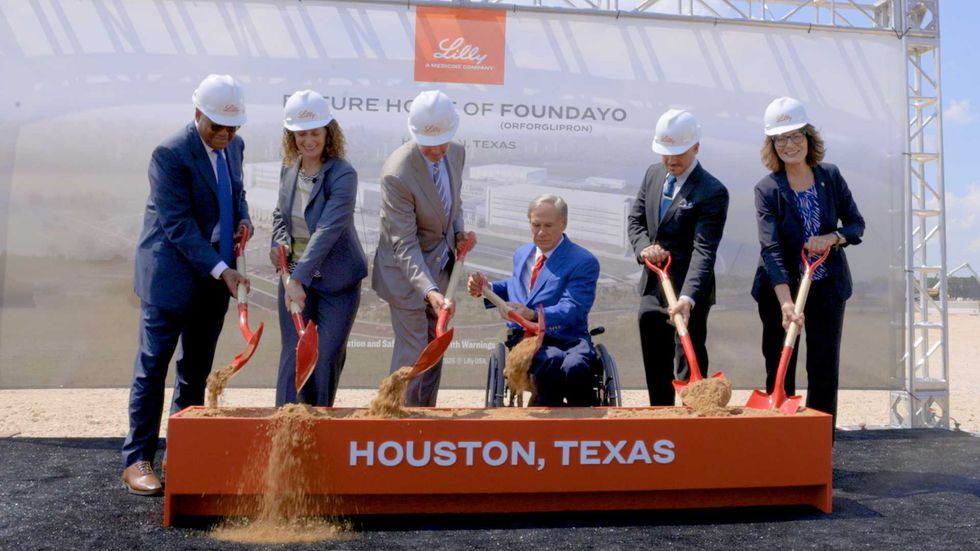
Photo via gov.texas.gov

As Abbott mentioned, the site is expected to create hundreds of jobs, and will hire engineers, scientists, operations personnel and lab technicians once up and running. It will create 4,000 construction jobs while being built.

In an effort to support workforce development, Lilly also announced a $12.5 million commitment to Houston's San Jacinto College in addition to a $2.5 million charitable donation to the San Jacinto College Foundation. The funding will go toward hands-on training, equipment and facilities to support future technicians, operators, maintenance professionals, and other manufacturing talent, according to Lilly. The charitable donation will fund scholarships for students.

"This relationship will build a strong, sustainable talent pipeline for Lilly while creating meaningful, high-demand career opportunities across our region,” Brenda Hellyer, chancellor of San Jacinto College, said in the release.

"When you invest in a place like Houston, you invest in its people first," Edgardo Hernandez, executive vice president and president of Lilly Manufacturing Operations, added. "This facility will run on the talent of this community, powered by our relationship with San Jacinto College. We're hiring across the greater Houston area to help residents build careers close to home."
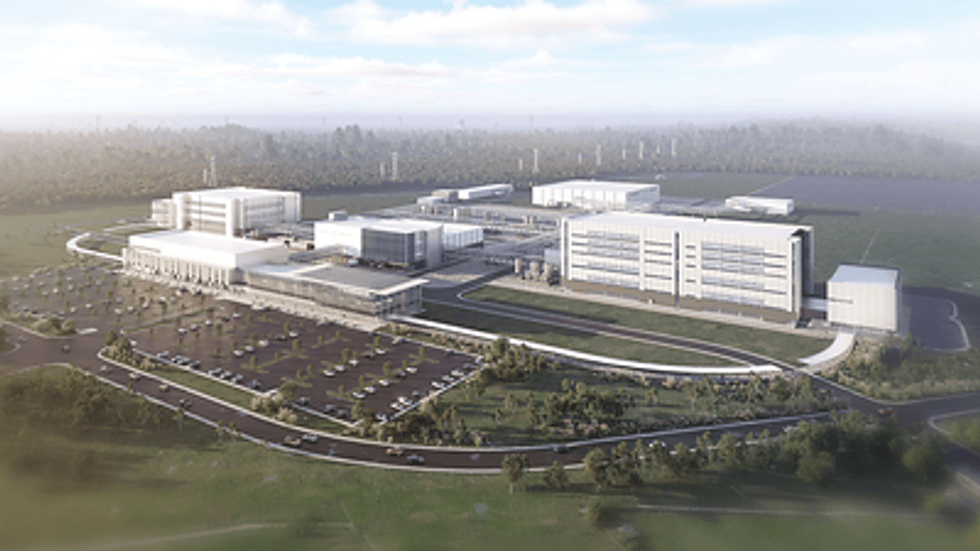
Rendering courtesy Eli Lilly

Lilly previously said it chose Generation Park, a 4,300-acre, master-planned commercial district near Lake Houston, because of factors such as financial incentives, access to utilities and transportation and the region’s business-friendly environment. Generation Park is home to campuses for San Jacinto College and Lone Star College.

Since Lilly first announced plans for the site, another fellow pharma giant has made plans to move into Generation Park. Bristol Myers Squibb Co. announced last month that it would build a $2.3 billion factory in the district. The site is expected to manufacture small molecule, biologic and antibody-drug conjugates and will also come online around 2030. Read more here.

Another pharma giant will build a massive manufacturing facility in Houston. Rendering courtesy Bristol Myers Squibb Co.

Bristol Myers Squibb to build $2.3B Houston pharma manufacturing campus

coming soon

New Jersey-based pharmaceutical giant Bristol Myers Squibb Co. has officially named Houston as the home of its new state-of-the-art manufacturing site.

The 60,000-square-foot facility represents a $2.3 billion investment, according to a news release. It is expected to create 500 skilled jobs and will be located in Houston's Generation Park.

BMS first announced that it was considering Houston among 16 other cities for the facility in May. The new hub will manufacture small molecule, biologic and antibody-drug conjugates and is part of a $40 billion commitment to invest in the United States over five years. Construction is slated to begin next year, with the facility coming online in 2030.

"We're building the domestic manufacturing capabilities needed to deliver the next generation of medicines and support future scientific breakthroughs. Houston and the state of Texas offer the talent, infrastructure, and partnership needed to help bring that vision to life," Christopher Boerner, CEO and board chair of BMS, said in the release.

The new facility will feature a modular, multi-modal design, which will allow the company to reconfigure and add to its manufacturing capabilities over time. BMS says it expects the facility to "(grow) in scale and capability well beyond its opening configuration."

"Our decision to build this state-of-the-art manufacturing campus in Houston, Texas, reflects our confidence in the region’s ability to support a world-class, digitally advanced supply operation,” Karin Shanahan, EVP and chief supply chain and operations officer of BMS, added in the release. “This facility is designed to deliver the speed, quality, and reliability that patients depend on, combining flexible, modular manufacturing with advanced digital capabilities to ensure consistent supply across multiple modalities. It strengthens our ability to operate with resilience and positions us to reliably deliver medicines to patients today while adapting future demands.”

Texas Gov. Greg Abbott shared that the state has granted BMS a $4.89 million Texas Enterprise Fund (TEF) grant for the project. TEF grants, administered by the Texas Economic Development & Tourism Office, support business relocation or expansion projects that create "new, good-paying jobs in the community and attract significant new capital investment to the state." The development is also a qualified project under the Texas Jobs, Energy, Technology, and Innovation (JETI) program.

“Texas is a global hub for life sciences, where today’s innovations shape the future of healthcare,” Abbott said in a news release. “This $2.3 billion investment by Bristol Myers Squibb in the dynamic biotech ecosystem in Houston is a testament to the depth of our skilled workforce and the pipeline of talent coming through our nation-leading technical colleges and research universities. With lower operating costs and easy access to markets across the U.S. and the world, Texas drives affordability for consumers.”

"Bristol Myers Squibb’s announcement is a tremendous win for Texas and the Houston region, further reinforcing our position as a premier destination for life sciences and advanced manufacturing,” added Greater Houston Partnership President and CEO Steve Kean.

Last fall, Eli Lilly and Co. selected Generation Park, a 4,300-acre, master-planned commercial district near Lake Houston, for its $6.5 billion manufacturing plant. More than 300 locations in the U.S. competed for the factory. Read more here.

Bristol Myers Squibb Co. is considering the Generation Park for a new $1 billion manufacturing campus. Rendering courtesy McCord

Pharma giant considers Houston for $1 billion manufacturing campus

in the works

Another pharmaceutical giant is considering Houston’s Generation Park for a manufacturing hub.

According to a recent filing with the Texas Jobs, Energy, Technology and Innovation (JETI) program, Bristol Myers Squibb Co. is considering the northeast Houston management district for a new $1 billion multi-modal pharmaceutical manufacturing campus.

If approved, the campus, known as Project Argonaut, could create 489 jobs in Texas by 2031. Jobs would include operations technicians, engineering roles, administrative and management roles, production specialists, maintenance support, and quality control/assurance. The company predicts annual average wages for these positions to be around $96,000, according to the filing.

The project currently includes the 600,000-square-foot facility, but according to the filing, Bristol Myers Squibb “envisions this site growing in scale and capability well beyond its opening configuration."

The Texas JETI program offers companies temporary school property tax limitations in exchange for major capital investment and job creation. E.R. Squibb & Sons LLC applied for a 10-year tax abatement agreement in the Sheldon Independent School District.

The agreement promises a $ 1 billion investment. Construction would begin in 2027 and wrap in 2029.

“The proposed project reflects [Bristol Myers Squibb Co.’s] enduring commitment to bringing innovative medicines to patients and ensuring the long-term supply reliability they depend on,” the filing says. “The proposed project is purpose-built to support and manufacture medicines spanning multiple therapeutic areas and modalities, positioning the site as a long-term launch and commercial campus for decades to come. These medicines will provide therapies to the [Bristol Myers Squibb Co.’s] patients located in markets both nationally and internationally.”

The Fortune 100 company is considering 16 other cities for the new manufacturing facility in the Central and Eastern markets in the U.S. According to the Houston Chronicle, Bristol Myers Squibb Co is still in the “evaluation process” for its potential manufacturing site.

Last fall, Eli Lilly and Co. selected Generation Park for its $6.5 billion manufacturing plant. More than 300 locations in the U.S. competed for the factory. Read more here.

Ad Placement 300x100
Ad Placement 300x600

CultureMap Emails are Awesome

New report ranks Texas among top 10 states where AI could disrupt jobs

AI Workforce

A new nationwide report examining where AI could "reshape" the most jobs has ranked Texas No. 9 among the most at-risk states for AI job disruption.

The new SmartAsset report compared all 50 states and the District of Columbia to calculate the estimated percent of the workforce employed in the 26 occupations with the highest AI exposure, as determined by June 2026 research by the Virginia Economic Information and Analytics Division.

The findings revealed that 500,000 Texas workers, or 3.55 percent of the total workforce, are employed in occupations with "high exposure to potential AI disruption."

This also places the Lone Star State as the 9th most at-risk state in the U.S. where AI exposure can lead to "declining hiring demand, wage pressure, task automation, and other forms of disruption."

"States with larger concentrations of highly exposed occupations could experience more pronounced labor-market changes, particularly in roles where core tasks are more vulnerable to AI-driven restructuring," the report's author wrote.

Texas' biggest cities, like Houston and Austin, are known for their thriving tech and business industries, and the study noted that many of the occupations within those sectors are the most at risk. The Virginia Economic Information and Analytics Division said the top five most AI-exposed occupations in the U.S. are: mathematicians, proofreaders, correspondence clerks, court reporters, and media and communication workers. Additionally, computer programmers, database administrators, web developers, telephone operators, and communications equipment operators round out the top 10 most at-risk positions.

These are the 16 remaining occupations most exposed to AI disruption, in order:

  • Data Entry Keyers
  • Statistical Assistants
  • Office Support Workers
  • Interpreters and Translators
  • Database Architects
  • Software Quality Assurance Analysts
  • Medical Transcriptionists
  • Software Developers
  • Writers and Authors
  • Payroll Clerks
  • Web Designers
  • Miscellaneous Computer Occupations
  • Insurance Claims Processors
  • Telemarketers
  • Computer Numerically Controlled Tool Programmers
  • Bookkeeping and Accounting Clerks

A separate SmartAsset report from April 2026 found about 20.5 percent of Texas workers use AI to do their jobs in some capacity. That trend will continue to shift further as employers and employees choose to adopt — or reject — AI implementation.

Across the U.S., Washington topped the list as the state with the highest concentration of AI-exposed jobs, with nearly 5.7 percent of the state's workforce employed in the 26 most at-risk positions. SmartAsset said Washington's high prevalence of technology companies is a significant factor that skyrocketed the state to the top of the list.

"Home to major technology companies including Microsoft, Amazon, T-Mobile and Expedia, the state has large numbers of computer programmers and software developers, two occupations with high exposure," the report said.

Meanwhile, Mississippi ranked No. 51 with the lowest concentration of AI-exposed jobs in the nation. About 22,500 workers in Mississippi, or 1.93 percent of its workforce, are at risk for AI disruption.

The top 10 states where AI could reshape the most jobs are:

  • No. 1 – Washington
  • No. 2 – Virginia
  • No. 3 – District of Columbia
  • No. 4 – California
  • No. 5 – Utah
  • No. 6 – Maryland
  • No. 7 – Colorado
  • No. 8 – New Hampshire
  • No. 9 – Texas
  • No. 10 – North Carolina
---

This article originally appeared on CultureMap.com.

UH lands $1.2M NIH grant to fight superbugs using AI, quantum sensing

drug defense

The fight against antibiotic-resistant bacteria like MRSA is getting science fiction-like upgrades at the University of Houston thanks to a new four-year, $1.26 million grant from the National Institutes of Health.

The university says the recent funding brings total federal support up to $3.5 million for 11 years for the project, which uses AI and quantum-sensing technology to better understand how bacterial proteins develop resistance to drugs.

Any medical professional will tell you that one of the worst things that can happen is almost killing an infection. Bacteria that survive attacks from conventional antibiotic treatments emerge tougher, more resistant and more aggressive than before–making them much harder to treat. A good example is the superbug methicillin-resistant Staphylococcus aureus (MRSA).

UH chemistry professors Yuhong Wang and Shoujun Xu are working on this issue. They know full well that fighting superbugs requires new technology and new approaches, which is what they aim to pioneer with their new grant.

“Drug-resistant bacterial infections such as MRSA are becoming harder to treat, creating an urgent need for faster ways to understand how antibiotics and other small molecules interact with bacterial proteins,” Wang said in a news release.

Wang and Xu’s work centers around GTP, a cellular fuel that can cause tiny changes to a cell's structure when it mutates. Sometimes, those shape changes make it easier for drugs to breach the wall and attack the cells.

The UH scientists are employing AlphaFold, an AI-powered tool that can scan large molecular libraries in seconds. From these models, they can see promising drug combinations for future testing.

Once identified, the team uses their invention, super-resolution force spectroscopy, to monitor the cells. Tiny magnetic beads are attached to genetic material, then magnified to see how strong that material is when pulled. They can measure this incredible microscopic process through an atomic magnetometer, typically used in quantum physics. Combined, all these tools allow a high-definition look at how each molecule might respond to new chemical approaches.

“We're the only chemists in the world that use an atomic magnetometer for biological research,” Xu said. “It's a technique developed by physicists, and there is usually a gap between techniques developed by physicists and biological applications. Yuhong and I have been bridging that gap together for the past 10 years.”

Eventually, Wang and Xu hope to develop powerful software that can be used by drug manufacturers to model cellular responses. With enough predictive data, the software could even get ahead of superbugs’ own mutation, allowing drugs to be developed before new strains arrive.

"We want an algorithm where you input a protein sequence, score the mutation hotspots, and develop new inhibitors before a drug-resistant species even emerges," Wang added.

SpaceX to get more than 700 acres of Texas wildlife refuge in land swap

Space News

A federal judge on Monday, September 21, refused to block the Trump administration from giving SpaceX more than 700 acres of wildlife refuge as part of a land swap in Texas, while environmental groups vowed to continue their legal challenge.

U.S. District Judge Fernando Rodriguez Jr. declined the plaintiffs' request for a preliminary injunction to prevent the parcel exchange, saying they failed to prove it would worsen ecological risks to a Gulf Coast region already transformed by billionaire Elon Musk’s rocket operations.

In June, the U.S. Fish and Wildlife Service approved moving forward with the deal with SpaceX, which would surrender 683 acres the company owns in exchange for the federal land in the Lower Rio Grande Valley National Wildlife Refuge. The 103,000-acre refuge spans four counties along the Texas border and is home to animal habitats and historical landmarks.

Maps show the land SpaceX would acquire would be closer to the company's launchpad near the U.S.-Mexico border.

The swap amounts to a gift of public lands to SpaceX, “clearing the way for bulldozers to tear into this wildlife refuge as soon as next week and turn a public treasure into a private payday,” said Laiken Jordahl, a spokesperson with the Center for Biological Diversity, which filed the lawsuit alongside other opponents including tribal groups. Jordahl said Monday that the litigation will continue even as the exchange goes forward.

“This court order is not the final word. These lands hold incredible spiritual, historical and conservation value for the people and wildlife of South Texas. We won’t stop fighting to keep this irreplaceable public wildlife refuge safe from SpaceX bulldozers,” Jordahl said in a statement.

The lawsuit asks the federal court to halt the exchange, which has worried SpaceX opponents in the area who have long criticized the company's expanding footprint over lost access to beaches and concerns over exploding rockets.

The Fish and Wildlife Service didn’t respond to a request for comment on Monday’s decision. Previously, a spokesperson had said the agency does not comment on ongoing litigation.

The agency issued a final environmental assessment report in June that determined the exchange would cause no significant impact to the area. The report said the federal government believed the acquisition would represent a “net conservation benefit” and provide “substantial long-term conservation value and improving landscape-scale habitat connectivity across refuges in South Texas.”

The judge said that the plaintiffs offered “relatively weak” evidence of environmental harm.

“While they rightfully argue that the preservation of wildlife and historical lands furthers the public interest, they present no evidence demonstrating that the Property will suffer aesthetic, environmental, cultural, or historical degradation during the pendency of this lawsuit,” Rodriguez wrote in his ruling.

In addition, the judge said a preliminary injunction would result in modifications to SpaceX’s development plans, “placing additional hardship on the company’s ability to meet milestones and contractual obligations.”

SpaceX did not return an email seeking comment on the judge's ruling.

The space exploration company first broke ground in Texas more than a decade ago and has expanded rapidly, so much that SpaceX employees last year voted to incorporate their own local government called Starbase.