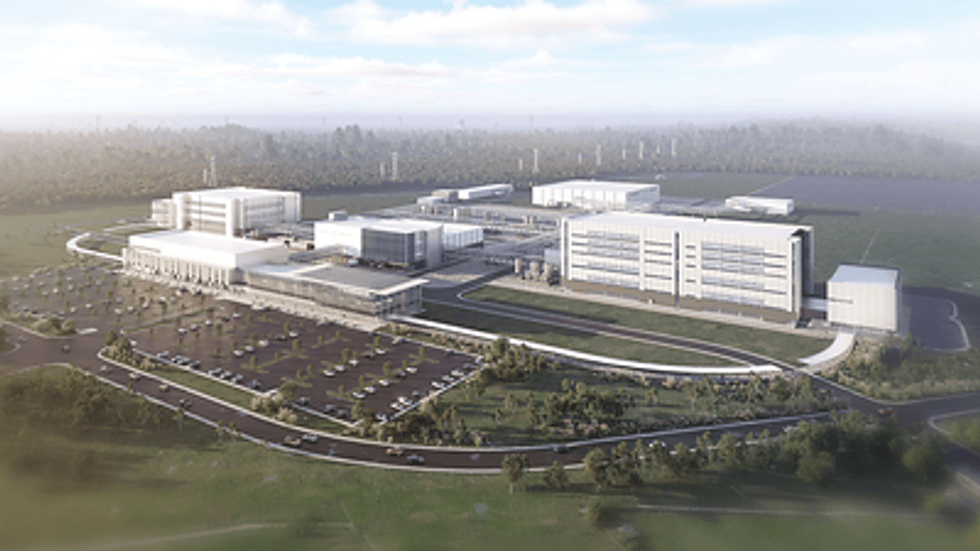
Bristol Myers Squibb Co. is considering the Generation Park for a new $1 billion manufacturing campus. Rendering courtesy McCord

Another pharmaceutical giant is considering Houston’s Generation Park for a manufacturing hub.

According to a recent filing with the Texas Jobs, Energy, Technology and Innovation (JETI) program, Bristol Myers Squibb Co. is considering the northeast Houston management district for a new $1 billion multi-modal pharmaceutical manufacturing campus.

If approved, the campus, known as Project Argonaut, could create 489 jobs in Texas by 2031. Jobs would include operations technicians, engineering roles, administrative and management roles, production specialists, maintenance support, and quality control/assurance. The company predicts annual average wages for these positions to be around $96,000, according to the filing.

The project currently includes the 600,000-square-foot facility, but according to the filing, Bristol Myers Squibb “envisions this site growing in scale and capability well beyond its opening configuration."

The Texas JETI program offers companies temporary school property tax limitations in exchange for major capital investment and job creation. E.R. Squibb & Sons LLC applied for a 10-year tax abatement agreement in the Sheldon Independent School District.

The agreement promises a $ 1 billion investment. Construction would begin in 2027 and wrap in 2029.

“The proposed project reflects [Bristol Myers Squibb Co.’s] enduring commitment to bringing innovative medicines to patients and ensuring the long-term supply reliability they depend on,” the filing says. “The proposed project is purpose-built to support and manufacture medicines spanning multiple therapeutic areas and modalities, positioning the site as a long-term launch and commercial campus for decades to come. These medicines will provide therapies to the [Bristol Myers Squibb Co.’s] patients located in markets both nationally and internationally.”

The Fortune 100 company is considering 16 other cities for the new manufacturing facility in the Central and Eastern markets in the U.S. According to the Houston Chronicle, Bristol Myers Squibb Co is still in the “evaluation process” for its potential manufacturing site.

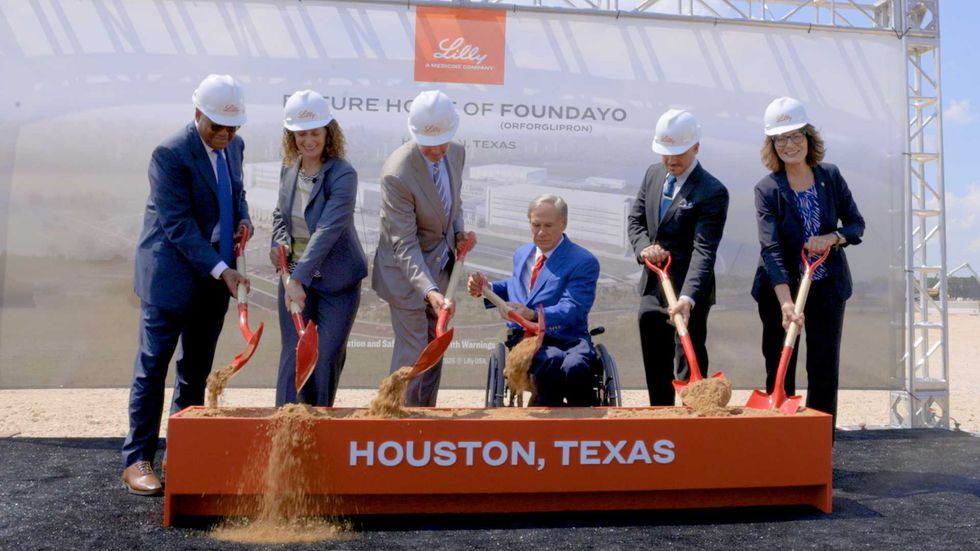
Last fall, Eli Lilly and Co. selected Generation Park for its $6.5 billion manufacturing plant. More than 300 locations in the U.S. competed for the factory. Read more here.

Eli Lilly is looking to build an active pharmaceutical ingredient manufacturing facility at Generation Park. Rendering courtesy of McCord

Pharmaceutical giant looks to bring $5.9 billion facility to Houston

in the works

Pharmaceutical company Eli Lilly and Company is looking to build a $5.9 billion active pharmaceutical ingredient (API) manufacturing facility in Houston, according to a recent filing with the state of Texas.

The proposal states that the project plans to employ 604 full-time direct employees at the site upon ramp-up completion. These would include operations technicians, production specialists, maintenance support, quality control/assurance, engineering, administration, and management. Construction is projected to begin in 2026, with a completion target of 2030 and commercial operations beginning in 2031.

If completed, Lilly would purchase 236 acres at Houston’s Generation Park from McCord Development, the commercial development’s owner. The purchase would include multiple buildings, outdoor facilities, infrastructure buildout, and equipment installation.

This proposed Texas plant would be part of Lilly’s $27 billion effort to expand its U.S. production capacity, which was announced in February and includes construction on four new facilities in America. Lilly has previously referred to the plants as “mega sites.”

"This represents the largest pharmaceutical expansion investment in U.S. history," Lilly CEO David Ricks said during the February news conference.

The company has applied for school tax abatements under the new Texas Jobs, Energy, Technology, and Innovation program, according to reports from the Houston Business Journal. This incentive program allows school districts to limit the taxable value of a property for a portion of school taxes, which could save companies millions of dollars on a large portion of property tax bills. It also gives a 10-year tax cut for new manufacturing and development facilities, as long as there is localized job creation.

Ad Placement 300x100
Ad Placement 300x600

CultureMap Emails are Awesome

UT team develops wearable technology for atmospheric water harvesting

In The Air

Engineers at the University of Texas at Austin have developed a prototype jacket that harvests clean drinking water directly from the atmosphere, and it works even in the driest desert conditions.

The research, published in Science Advances, marks the latest milestone in nearly a decade of work by materials scientist and chair professor Guihua Yu and his team at the Cockrell School of Engineering's Walker Department of Mechanical Engineering and Texas Materials Institute. The wearable technology marks a significant leap: instead of a bulky, stationary machine, this jacket does the work.

Photo courtesy of UT Austin

"We have been working on atmospheric water harvesting technology for a number of years," Yu says. "This current version is even more wearable. We're transitioning from conventional, more stationary water harvesting to something truly portable and personal."

Yu's lab first published work on hydrogel-based water harvesting around 2019, and the jacket is the latest evolution of that platform, now called AirGel. Last year, the broader AirGel invention won the top prize in the graduate category of the National Collegiate Inventors Competition.

The jacket is woven with specially engineered hydrogel fibers; ultra-porous materials that attract and absorb moisture from the surrounding air much like a household desiccant. Unlike a desiccant, the material doesn't require intense heat to release that water. The hydrogel is thermally responsive, meaning a modest rise in temperature — even from mild solar heating — is enough to release the water it has captured.

Condenser test in AustinSo, somebody would be wearing the jacket, or perhaps carrying this gel-like textile as a blanket, as it passively absorbs moisture from the air. Then they would detach the textile panels and place them into a small, portable collector unit; essentially a compact heater. The water evaporates out of the textile, condenses inside the collector, and drips out as clean, drinkable water.

"It immediately becomes drinkable because it already goes through the distillation process," Yu explains.

In trials, the jacket produced between 400 and 900 milliliters of water per day depending on humidity, or roughly 14-30 ounces, nearly a quart, depending on the air's humidity. With one kilogram of the textile, the researchers found they could generate approximately 3.7-4 liters of water in arid conditions, and potentially double that in humid ones. So far, the team has tried the jacket out in very dry, semi-dry, and humid areas, and the jacket was able to pull water from each climate.

Lead researcher Chuxin Lei, a postdoctoral researcher on Yu's team and co-author on the paper, says the goal was to rethink who this technology could serve.

Portable bag contents

"Many current [atmospheric water harvesting] systems are still built as rigid or stationary platforms, making them less suitable for people who are moving, working outdoors, or operating in some remote environment. This lead us to ask whether we could build a water harvesting system that could become more like clothing — light, wearable, flexible, and naturally suited for personal use," Lei says.

The potential applications are wide-ranging. Yu's team has previously worked with the Department of Defense on water solutions for soldiers, where water logistics can be dangerous and costly. The technology could also serve hikers, emergency responders, disaster relief workers, and agricultural and field workers. Anyone who needs clean water on the go and far from infrastructure.

The team also sees a potential future where the technology complements large-scale centralized water systems rather than replacing them.

"Our solution cannot be a universal solution for all," Yu acknowledges. "But I think it's an extremely important alternative."

For now, the jacket is still a laboratory prototype, but Yu and Lei are optimistic. With the right industry partnerships, they say, the technology could realistically reach commercial scale within three to five years.

---

This article originally appeared on CultureMap.com, written by Natalie Grigson.

Houston ranks among world’s top 30 emerging startup ecosystems

Startup Status

Long known as the Energy Capital of the World, Houston also ranks among the world’s top 30 emerging startup ecosystems, according to a new report.

The report from Startup Genome, a research and advisory organization, doesn’t assign a specific numeric ranking to Houston’s startup ecosystem. Rather, it puts Houston in the ranking range of 21 to 30 for emerging ecosystems. Startup Genome weighed factors such as early-stage funding, performance and talent to identify the top emerging ecosystems.

Houston also gained notice for being one of the world’s 20 emerging ecosystems with at least four unicorn startups in the past 10 years. Houston and nine other ecosystems each had four unicorns.

According to StartupBlink, a startup research platform, Houston’s startup ecosystem grew 24 percent in 2025, with over 1,300 startups and total startup funding exceeding $808 million. StartupBlink places Houston at No. 46 among the world’s top 100 startup ecosystems.

In a recent post on LinkedIn, David Horsup, executive in residence at the Rice Alliance Clean Energy Accelerator, wrote that Houston “has all the ingredients to be wildly successful if it stays true to its differentiated pillars that drive the economy — energy, medical, and aerospace.”

Mumbai topped Startup Genome’s list of emerging ecosystems, followed by Istanbul, Madrid, Salt Lake City-Provo and Barcelona. After Salt Lake City-Provo, the top U.S. ecosystems were Phoenix, Detroit, Minneapolis and Las Vegas.

Silicon Valley led Startup Genome’s ranking of the world’s top established ecosystems, followed by New York City, London, Tel Aviv and Boston. Austin landed at No. 18 in this category and Dallas at No. 27.

“For much of the past decade, this report has chronicled the welcome dispersion of opportunity beyond the traditional hubs,” Startup Genome writes. “That trend has not died — but it has been complicated. Capital and scale are consolidating once more, particularly in the United States, and the gap between leading and emerging ecosystems is widening.”

KBR names C-suite duo to lead $5.3B government services spinoff

new leaders

In advance of the spinoff of its Mission Technology Solutions unit, Houston-based KBR has made two C-suite hires for the new business.

Michael LaRouche is coming aboard as president and CEO of the spinoff, currently called SpinCo, on Sept. 26. Nicholas Veasey is joining as executive vice president and chief financial officer on July 1.

“Michael and Nick bring a highly complementary combination of operational leadership, financial expertise, and mission-driven experience, and together they will accelerate our impact for stakeholders,” Stuart Bradie, chairman, president and CEO of publicly traded KBR, said in a news release.

LaRouche currently is CEO of Serco North America, a Herndon, Virginia-based government services contractor. Veasey most recently was CFO of MAG Aerospace, a Fairfax, Virginia-based defense contractor.

SpinCo, a government services contractor, will launch with more than $5.3 billion in annual revenue and 20,000 employees. KBR’s total headcount is around 36,000. Branding for SpinCo, including a formal name, will be revealed in July.

“SpinCo is positioned as a top-tier provider of differentiated technology solutions, anchored by deep mission expertise, global scale, and a relentless commitment to delivering for our customers,” LaRouche says.

After the spinoff, the slimmed-down KBR will focus on its Sustainable Technology Solutions business, a provider of energy and industrial technology that generated $2.5 billion in revenue in 2025. Bradie will remain chairman, president and CEO of the business.

Both SpinCo and the new KBR will be public companies. The spinoff is scheduled to be completed in January.