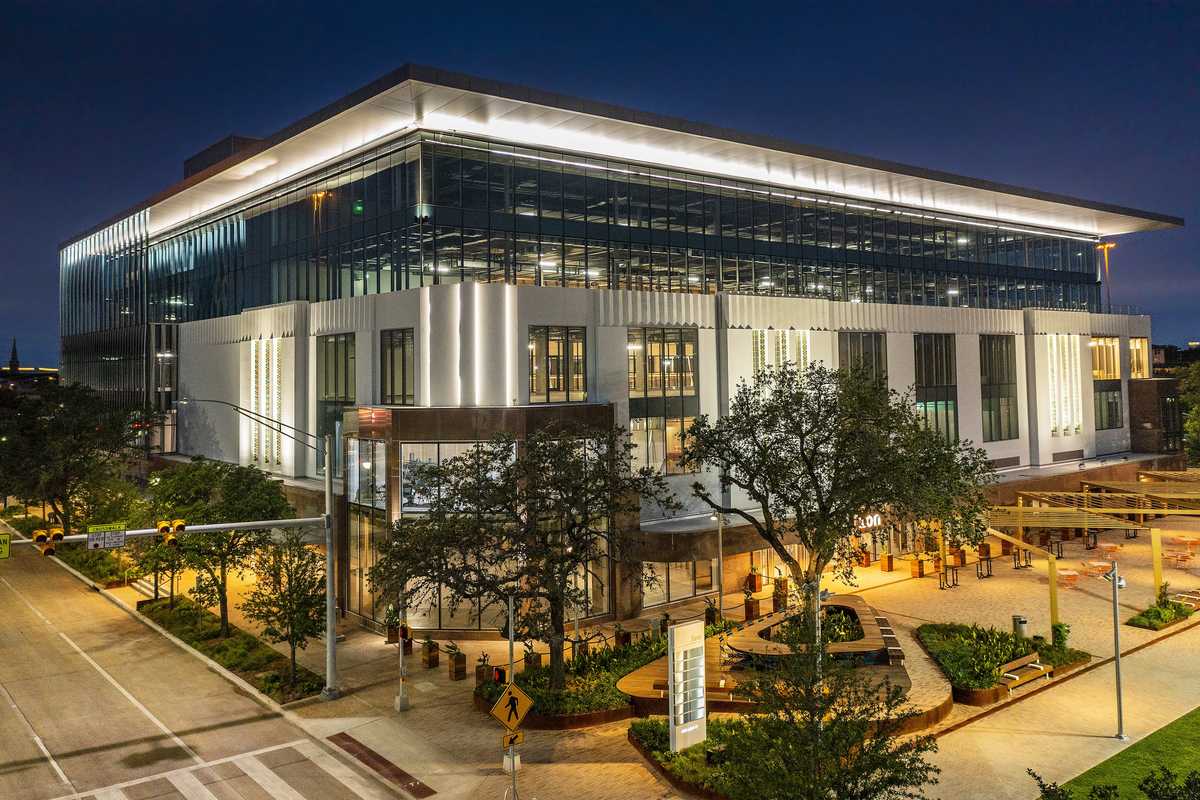

The new initiative aims to create clear pathways for workers in technical jobs, like welding, electrical work and machining. Photo via Unsplash

The Texas Space Commission is one of seven organizations tapped by NASA to lead the space agency's new state and regional Skilled Technical Workforce Hubs.

The $10.5 million initiative aims to help foster the next generation of skilled workers in the aerospace industry.

Through the new program, the hubs will work together over the next three years to meet growing industry needs by aligning “industry employers, community colleges, high school career and technical education programs, and workforce systems,” according to a news release from NASA.

It aims to create clear pathways for workers in technical jobs, like welding, electrical work and machining, plus other jobs that require advanced STEM knowledge but do not require a bachelor’s degree.

“The need for technical talent is already urgent and will only continue to grow as we return humanity to the Moon and set our sights on Mars and beyond,” Elaine Ho, associate administrator for the Office of STEM Engagement at NASA, said in the release. “NASA is uniquely positioned to be the catalyst and convener that accelerates America’s aerospace workforce development and fosters the next generation of technicians.”

As part of the initiative, the TSC plans to launch the statewide network known as the Texas Space STEM Alliance (TSSA). According to a TSC release, the TSSA will link up schools, colleges, workforce groups and aerospace companies to build a pipeline for space-industry workers.

Additionally, the TSC is developing the Texas Aerospace Pathways Plus (TAP+) portal to consolidate information on training programs, internships, apprenticeships, employment opportunities and scholarships, while also identifying regional gaps in workforce opportunities.

Other state and regional organizations to receive the award include:

  • Antelope Valley Community College District in Lancaster, California
  • Georgia Tech Research Corporation
  • Minnesota State Colleges and Universities
  • Southern Utah University
  • Space Florida
  • State Board for Community Colleges and Occupation Education, Arapahoe Community College in Littleton, Colorado

The Houston area is home to more than 43,000 aerospace and aviation professionals, according to the Greater Houston Partnership. The Texas Space Commission has been awarded $150 million for 24 projects since being established to increase the state’s space economy in 2023.

The funding for the NASA state hubs comes from NASA’s Office of STEM Engagement through its Next Gen STEM Project.


Ad Placement 300x100
Ad Placement 300x600

CultureMap Emails are Awesome

Houston ranks among 15 U.S. hot spots for women in tech

Ranking It

Houston is soaring among the best places in the U.S. for women in tech, a new report says. Houston ranked No. 15 nationwide in SmartAsset's new report, "Best and Worst Cities for Women in Tech — 2026 Study," which compared the 50 biggest U.S. cities across four metrics:

  • Gender pay gap — women's median earnings as a percentage of men’s median earnings in tech
  • The share of all tech workers that are women
  • The overall concentration of employment for tech workers, defined as "tech workers as a share of the local workforce"
  • Women tech workers’ median earnings, adjusted for regional price parity
For the purpose of the study, tech workers are defined as "city residents employed in computer and mathematical occupations." The study's findings show that fewer than 9,500 tech workers in Houston are women, or 25.6 percent of the total tech workforce in the city. In total, tech workers in general make up less than 3 percent of the Houston workforce.Despite the high ranking, women tech workers in Houston have a sizeable gap to cross to receive equal pay compared to their male counterparts in the same industry. Women tech workers make just over $97,000 in median earnings after adjusting for regional price parity, which is only 93 percent of what male tech workers make, SmartAsset found.

There are only two U.S. cities where women in tech earn more than what their male counterparts: Miami and Memphis, Tennessee. Women tech workers in Miami make an adjusted $88,650 in median earnings, or 101.7 percent of what men in tech make. In Memphis, women make $84,718 in adjusted earnings, or 101.5 percent of what men in tech earn.

The findings also assert that women remain underrepresented in the nation's overall tech sector, despite making up nearly half of the total workforce. Only 22.6 percent of the country's tech labor force is made up of women, according to the Equal Employment Opportunity Commission."Opportunities for women in tech can vary considerably by location, and these differences shape access to jobs, career advancement and earning potential," the report's author wrote. "In some places, women account for a larger share of tech workers, face narrower pay gaps and enjoy a stronger local labor market. In others, they may encounter a more challenging career environmentThe six other Texas cities that earned spots in the report are Austin (No. 6), Fort Worth (No. 26), Dallas (No. 32), Arlington (No. 38), San Antonio (No. 42), and El Paso (No. 49).

The top 10 best U.S. cities for women in tech are:

  • No. 1 – San Jose, California
  • No. 2 – Seattle, Washington
  • No. 3 – San Francisco, California
  • No. 4 – Atlanta, Georgia
  • No. 5 – Baltimore, Maryland
  • No. 6 – Austin, Texas
  • No. 7 – Oakland, California
  • No. 8 – Portland, Oregon
  • No. 9 – Boston, Massachusetts
  • No. 10 – Minneapolis, Minnesota
---

This article first appeared on CultureMap.com.

5 female-founded Houston startups shine as Innovation Awards finalists

meet the finalists

Houston is home to many standout female founders, making inroads and breakthroughs in every industry.

As part of the 2026 Houston Innovation Awards, our Female-founded Business category honors women-led startups that are shaping Houston innovation.

Five female-founded businesses have been named finalists for the 2026 award. This year's finalists, selected by our esteemed panel of judges, range from an AI startup for C-Suite execs to a company developing semi-autonomous crawler robots for corrosion detection.

Read more about these innovative startups and the visionary female founders behind them below. The 2026 winners will be announced on InnovationMap.com in mid-November.

Adair

Artificial intelligence startup Adair uses computational linguistics and behavioral economics to measure, model and quantify the impact of spoken and written language on firm valuation and stock prices. The company works with C-Suite executives of public companies on high-stakes communications before they go live.

The company was founded last year by CEO Kathleen Perley, CPO Alex Duong and CTO Anthony Grivet. It raised $5.6 million earlier this year, according to its application.

ARIX Technologies

Energytech startup ARIX Technologies has developed a semiautonomous VENUS crawler robot to detect corrosion under insulation before it becomes a failure. The robots climb insulated piping in refineries, chemical plants and energy facilities to capture inspection data without removing insulation or building scaffolding. ARIX's inspection portal then turns information from the inspection into data a company can act on.

ARIX was founded in 2017 by Dianna Liu, who serves as director, and Head of Product Petter Wehlin. Craig Malloy serves as CEO. The company has raised more than $22 million in seed funding and a Series A round, according to its application.

Bairitone Health

Healthtech startup Bairitone Health is bringing anatomy imaging for sleep apnea to the home environment. The company's platform maps users' anatomy during natural sleep using a facial patch to determine the root cause of airway obstruction. It then offers effective therapies for each patient.

The company was founded in 2022 in the Texas Medical Center's Biodesign program by CEO Meagan Pitcher, CTO Onur Kilic and chief medical officer Britt Cross. It was a member of Activate Houston's inaugural cohort and has participated in numerous accelerators and incubators. The company raised an oversubscribed seed round for $2.4 million earlier this year and received Breakthrough Device Designation from the Food and Drug Administration in April.

FlowCellutions

Energytech startup FlowCellutions is developing a chemistry-agnostic diagnostics platform for flow and metal-air batteries supporting data centers and critical infrastructure. The platform is designed to help reduce operating costs, prevent failures and costly downtime, and extend battery lifetime from approximately seven years to more than 30 years. It has deployed four paid pilots and plans to take insights from the programs to develop its next-gen sensor platform technology.

CEO Becca Segel founded the company in 2022. It is a member of Greentown Labs, and Segel was a 2025 Activate Fellow. The company has raised over $2 million in non-dilutive funding and received a $1.5 million NSF SBIR Fast-Track award earlier this year.

ParaDocs Health

Healthtech startup ParaDocs Health is developing a clinical intelligence platform that helps doctors and care teams streamline administrative tasks and make better use of patient records. Its technology organizes fragmented clinical data into actionable insights, helping care teams identify gaps in care, assess patient risks and simplify documentation and reimbursement.

ParaDocs was founded in 2022 by CEO Dr. Dhini Nasution and CTO Dr. Omar Mohtar. The company participated in the TMCi Biodesign Program and raised a preseed round last year, according to its application.