


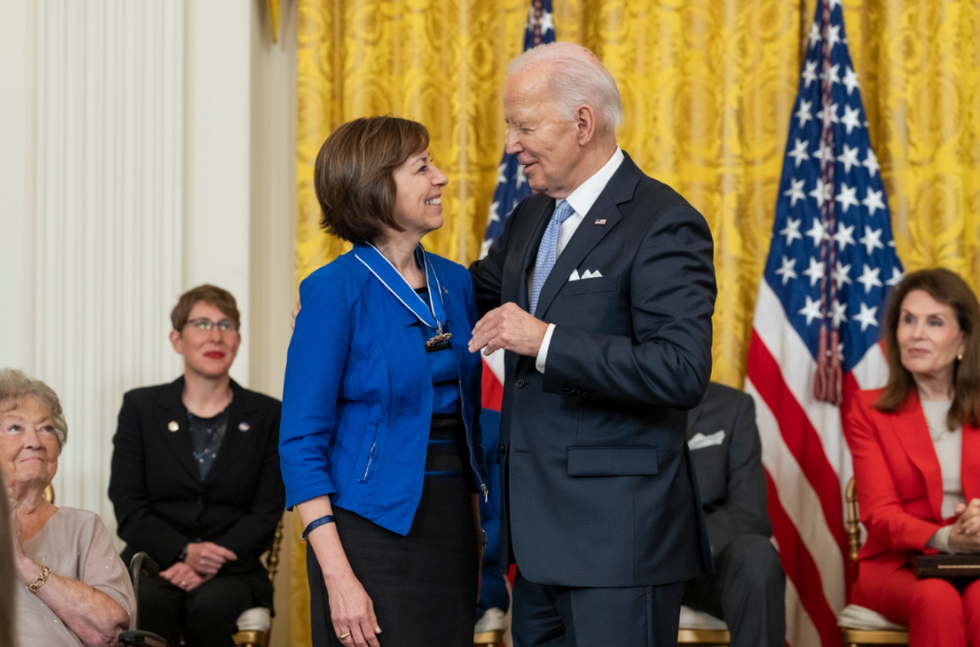
Ellen Ochoa, the former center director and astronaut at the NASA's Johnson Space Center in Houston, and Jane Rigby (pictured), senior project scientist for NASA’s James Webb Space Telescope, were honored at the White House on May 3. Photo via the White House

Two astronauts recently received Presidential Medals of Freedom from President Joe Biden for their leadership in space.

Ellen Ochoa, the former center director and astronaut at the NASA's Johnson Space Center in Houston, and Jane Rigby, senior project scientist for NASA’s James Webb Space Telescope, were honored at the White House on May 3.

Ochoa was recognized for her leadership at NASA Johnson and for being the first Hispanic woman in space. Rigby was honored for her work on leading NASA’s transformational space telescope.

Ochoa spent 30 years with NASA, which included being the 11th director of JSC, deputy center director of JSC, and director of Flight Crew Operations. She served on the nine-day STS-56 mission aboard the space shuttle Discovery in 1993, and became the first Hispanic woman in space. She flew four more times to space with STS-66, STS-96, STS-110, and more.
“I’m so grateful for all my amazing NASA colleagues who shared my career journey with me,” Ochoa says in a NASA news release.

Rigby has published 160 peer-reviewed publications. She has been recognized with various awards like NASA’s Exceptional Scientific Achievement Medal, the Fred Kavli Prize Plenary Lecture from the American Astronomical Society (AAS), and the 2022 LGBTQ+ Scientist of the Year from Out to Innovate. Currently, she is an astrophysicist at NASA’s Goddard Space Flight Center.

Part of Rigby’s Medal of Freedom honor is due to her role in the success of NASA’s Webb mission. Webb is considered the most powerful space telescope, which launched on Dec. 25, 2021.

“I am proud Ellen and Jane are recognized for their incredible roles in NASA missions, for sharing the power of science with humanity, and inspiring the Artemis Generation to look to the stars,” says NASA Administrator Bill Nelson in the release. “Among her many accomplishments as a veteran astronaut and leader, Ellen served as the second female director of Johnson, flew in space four times, and logged nearly 1,000 hours in orbit. Jane is one of the many wizards at NASA who work every day to make the impossible possible. The James Webb Space Telescope represents the very best of scientific discovery that will continue to unfold the secrets of our universe. We appreciate Ellen and Jane for their service to NASA, and our country.”

With three weeks left until game time, South by Southwest announced another long list of featured and keynote speakers. Photo via SXSW

SXSW announces even more featured speakers joining the 2023 program

headed to texas

Whether the return of South by Southwest (SXSW) in three weeks is putting butterflies in your tummy or sweat on your brow, we're in the home stretch. The newest announcement — another wave of featured speakers — does not say it's the final round, but time is running out to make adjustments before the start of the festival on March 10.

Previous announcements included keynote addresses from Patagonia CEO Ryan Gellert and team members who worked on the James Webb Space Telescope. There have also been two rounds of music showcase announcements, culminating in a list of nearly 500 performances.

The announcement on February 14 is heavy with big names including three entertainers presenting keynotes: actor, producer, and New York Times bestselling author Priyanka Chopra Jonas; Grammy Award-nominated singer-songwriter, producer, and author Margo Price; and Academy Award winner Tilda Swinton.

Two more newly announced keynote sessions come with longer descriptions: Chef José Andrés presents The Stories We Tell Can Change the World, and Bernard Sumner, Stephen Morris, and Gillian Gilbert of New Order appear in conversation with The Times rock & pop critic Will Hodgkinson.The former keynote tackles the responsibility of storytellers to address crises around the world, using Andrés' humanitarian group World Central Kitchen as a lens. The latter discusses the discography and history of the history-making band.

“Today's speaker announcement is a fantastic milestone for the 2023 event and spotlights five additional Keynotes and numerous Featured Speakers, including influential icons and up and coming innovators,” said Chief Programming Officer and Co-President Hugh Forrest. “We are extremely proud to have assembled a diverse, comprehensive conference program for SXSW, and we can’t wait to share it with our community in March.”

Organized into 25 programming tracks presented in a variety of session formats, SXSW celebrates the convergence of technology, film, television, and music. Tracks include civic engagement, climate change, design, film and TV, psychedelics, sports, travel, and more.

Just some featured speakers and sessions joining the 2023 lineup include:

  • Chair and CEO of General Motors Mary Barra with CEO, CTO, President, and co-founder of Cruise and co-founder of Twitch Kyle Vogt
  • Actress, philanthropist, entrepreneur, New York Times bestselling author, and co-founder of Hello Bello Kristen Bell, CEO of Hello Bello Erica Buxton, and actor, comedian, filmmaker, host of the podcast Armchair Expert, and co-founder of Hello Bello Dax Shepard
  • Chief Diversity Officer of TBWA\North America Aliah Berman with activist, advocate, author, and founder of the #MeToo Movement Tarana Burke
  • Founder and CEO of Joby Aviation Joe
  • Ben Bevirt with Chief Sustainability Officer at Delta Air Lines Pam Fletcher
  • Chief Digital and Commercial Officer at Unilever Conny Braams, President, Worldwide Advertising at Netflix Jeremi Gorman, founder and CEO of Media
  • Link Michael Kassan, and Senior Vice President and Chief Marketing and Communications Officer at Delta Air Lines Tim Mapes
  • Co-founder and President of OpenAI Greg Brockman with founder and CEO of Dot Dot Dot Media Laurie Segall
  • United States Secretary of Energy Jennifer M. Granholm
  • General Partner at Benchmark Bill Gurley with investor, New York Times bestselling author and host of the podcast The Tim Ferriss Show Tim Ferriss
  • The Art of Creating Influence 101 on navigating entertainment careers
  • The Blog Era: Hip-Hop's Wild Wild West on the influence of music bloggers
  • Daddy Issues in Film on fathers in film
  • Dateline 24/7: How the True Crime Powerhouse Became a Podcast Empire on a genre leader
  • Driving Personal Health Forward: The Role of Apple Watch and iPhone on digitally monitoring health at home
  • Evil Dead Rise: Flesh-Possessing Demons Come Home on the new Evil Dead film
  • An Inside Look at “Blindspotting” Season 2 with Rafael Casal and Daveed Diggs on the continuation of the series
  • Onyx Collective Presents “UnPrisoned” on a new Hulu series
  • The Kids Are (Not) Alright: Gun Violence Terrorizing Youth of America on activism and justice
  • Leguizamo Does America: Next Stop – Austin on the contributions of U.S. Latinos

For a full lineup and more information on featured sessions, visit SXSW.com.

------

This article originally ran on CultureMap.

Ad Placement 300x100
Ad Placement 300x600

CultureMap Emails are Awesome

Houston institutions launch Project Metis to position region as global leader in brain health

brain trust

Leaders in Houston's health care and innovation sectors have joined the Center for Houston’s Future to launch an initiative that aims to make the Greater Houston Area "the global leader of brain health."

The multi-year Project Metis, named after the Greek goddess of wisdom and deep thought, will be led by the newly formed Rice Brain Institute, The University of Texas Medical Branch's Moody Brain Health Institute and Memorial Hermann’s comprehensive neurology care department. The initiative comes on the heels of Texas voters overwhelmingly approving a ballot measure to launch the $3 billion, state-funded Dementia Prevention and Research Institute of Texas (DPRIT).

According to organizers, initial plans for Project Metis include:

  • Creating working teams focused on brain health across all life stages, science and medical advances, and innovation and commercialization
  • Developing a regional Brain Health Index to track progress and equity
  • Implanting pilot projects in areas such as clinical care, education and workplace wellness
  • Sharing Houston’s progress and learnings at major international forums, including Davos and the UN General Assembly

The initiative will be chaired by:

  • Founding Chair: Dr. Jochen Reiser, President of UTMB and CEO of the UTMB Health System
  • Project Chair: Amy Dittmar, Howard R. Hughes Provost and Executive Vice President of Rice University
  • Project Chair: Dr. David L. Callender, President and CEO of Memorial Hermann Health System

The leaders will work with David Gow, Center for Houston’s Future president and CEO. Gow is the founder and chairman of Gow Media, InnovationMap's parent company.

“Now is exactly the right time for Project Metis and the Houston-Galveston Region is exactly the right place,” Gow said in a news release. “Texas voters, by approving the state-funded Dementia Prevention Institute, have shown a strong commitment to brain health, as scientific advances continue daily. The initiative aims to harness the Houston’s regions unique strengths: its concentration of leading medical and academic institutions, a vibrant innovation ecosystem, and a history of entrepreneurial leadership in health and life sciences.”

Lime Rock Resources, BP and The University of Texas MD Anderson Cancer Center served as early steering members for Project Metis. HKS, Houston Methodist and the American Psychiatric Association Foundation have also supported the project.

An estimated 460,000 Texans are living with dementia, according to the Alzheimer’s Association, and more than one million caregivers support them.

“Through our work, we see both the immense human toll of brain-related illness and the tremendous potential of early intervention, coordinated care and long-term prevention," Callender added in the release. "That’s why this bold new initiative matters so much."

Texas launches cryptocurrency reserve with $5 million Bitcoin purchase

Money Talks

Texas has launched its new cryptocurrency reserve with a $5 million purchase of Bitcoin as the state continues to embrace the volatile and controversial digital currency.

The Texas Comptroller’s Office confirmed the purchase was made last month as a “placeholder investment” while the office works to contract with a cryptocurrency bank to manage its portfolio.

The purchase is one of the first of its kind by a state government, made during a year where the price of Bitcoin has exploded amid the embrace of the digital currency by President Donald Trump’s administration and the rapid expansion of crypto mines in Texas.

“The Texas Legislature passed a bold mandate to create the nation’s first Strategic Bitcoin Reserve,” acting Comptroller Kelly Hancock wrote in a statement. “Our goal for implementation is simple: build a secure reserve that strengthens the state’s balance sheet. Texas is leading the way once again, and we’re proud to do it.”

The purchase represents half of the $10 million the Legislature appropriated for the strategic reserve during this year’s legislative session, but just a sliver of the state’s $338 billion budget.

However, the purchase is still significant, making Texas the first state to fund a strategic cryptocurrency reserve. Arizona and New Hampshire have also passed laws to create similar strategic funds but have not yet purchased cryptocurrency.

Wisconsin and Michigan made pension fund investments in cryptocurrency last year.

The Comptroller’s office purchased the Bitcoin the morning of Nov. 20 when the price of a single bitcoin was $91,336, according to the Comptroller’s office. As of Friday afternoon, Bitcoin was worth slightly less than the price Texas paid, trading for $89,406.

University of Houston energy economist Ed Hirs questioned the state’s investment, pointing to Bitcoin’s volatility. That makes it a bad investment of taxpayer dollars when compared to more common investments in the stock and bond markets, he said.

“The ordinary mix [in investing] is one that goes away from volatility,” Hirs said. “The goal is to not lose to the market. Once the public decides this really has no intrinsic value, then it will be over, and taxpayers will be left holding the bag.”

The price of Bitcoin is down significantly from an all-time high of $126,080 in early October.

Lee Bratcher, president of the Texas Blockchain Council, argued the state is making a good investment because the price of Bitcoin has trended upward ever since it first launched in early 2009.

“It’s only a 16-year-old asset, so the volatility, both in the up and down direction, will smooth out over time,” Bratcher said. “We still want it to retain some of those volatility characteristics because that’s how we could see those upward moves that will benefit the state’s finances in the future.”

Bratcher said the timing of the state’s investment was shrewd because he believes it is unlikely to be valued this low again.

The investment comes at a time that the crypto industry has found a home in Texas.

Rural counties have become magnets for crypto mines ever since China banned crypto mining in 2021 and Gov. Greg Abbott declared “Texas is open for crypto business” in a post on social media.

The state is home to at least 27 Bitcoin facilities, according to the Texas Blockchain Council, making it the world’s top crypto mining spot. The two largest crypto mining facilities in the world call Texas home.

The industry has also come under criticism as it expands.

Critics point to the industry’s significant energy usage, with crypto mines in the state consuming 2,717 megawatts of power in 2023, according to the comptroller’s office. That is enough electricity to power roughly 680,000 homes.

Crypto mines use large amounts of electricity to run computers that run constantly to produce cryptocurrencies, which are decentralized digital currencies used as alternatives to government-backed traditional currencies.

A 2023 study by energy research and consulting firm Wood Mackenzie commissioned by The New York Times found that Texans’ electric bills had risen nearly 5%, or $1.8 billion per year, due to the increase in demand on the state power grid created by crypto mines.

Residents living near crypto mines have also complained that the amount of job creation promised by the facilities has not materialized and the noise of their operation is a nuisance.

“Texas should be reinvesting Texan’s tax money in things that truly bolster the economy long term, living wage, access to quality healthcare, world class public schools,” said state Sen. Molly Cook, D-Houston, who voted against the creation of the strategic fund. “Instead it feels like they’re almost gambling our money on something that is known to be really volatile and has not shown to be a tide that raises all boats.”

State Sen. Charles Schwertner, R-Georgetown, who authored the bill that created the fund, said at the time it passed that it will allow Texas to “lead and compete in the digital economy.”

___

This story was originally published by The Texas Tribune and distributed through a partnership with The Associated Press.

Houston-based HPE wins $931M contract to upgrade military data centers

defense data centers

Hewlett Packard Enterprise (HPE), based in Spring, Texas, which provides AI, cloud, and networking products and services, has received a $931 million contract to modernize data centers run by the federal Defense Information Systems Agency.

HPE says it will supply distributed hybrid multicloud technology to the federal agency, which provides combat support for U.S. troops. The project will feature HPE’s Private Cloud Enterprise and GreenLake offerings. It will allow DISA to scale and accelerate communications, improve AI and data analytics, boost IT efficiencies, reduce costs and more, according to a news release from HPE.

The contract comes after the completion of HPE’s test of distributed hybrid multicloud technology at Defense Information Systems Agency (DISA) data centers in Mechanicsburg, Pennsylvania, and Ogden, Utah. This technology is aimed at managing DISA’s IT infrastructure and resources across public and private clouds through one hybrid multicloud platform, according to Data Center Dynamics.

Fidelma Russo, executive vice president and general manager of hybrid cloud at HPE, said in a news release that the project will enable DISA to “deliver innovative, future-ready managed services to the agencies it supports that are operating across the globe.”

The platform being developed for DISA “is designed to mirror the look and feel of a public cloud, replicating many of the key features” offered by cloud computing businesses such as Amazon Web Services (AWS), Microsoft Azure and Google Cloud Platform, according to The Register.

In the 1990s, DISA consolidated 194 data centers into 16. According to The Register, these are the U.S. military’s most sensitive data centers.

More recently, in 2024, the Fort Meade, Maryland-based agency laid out a five-year strategy to “simplify the network globally with large-scale adoption of command IT environments,” according to Data Center Dynamics.