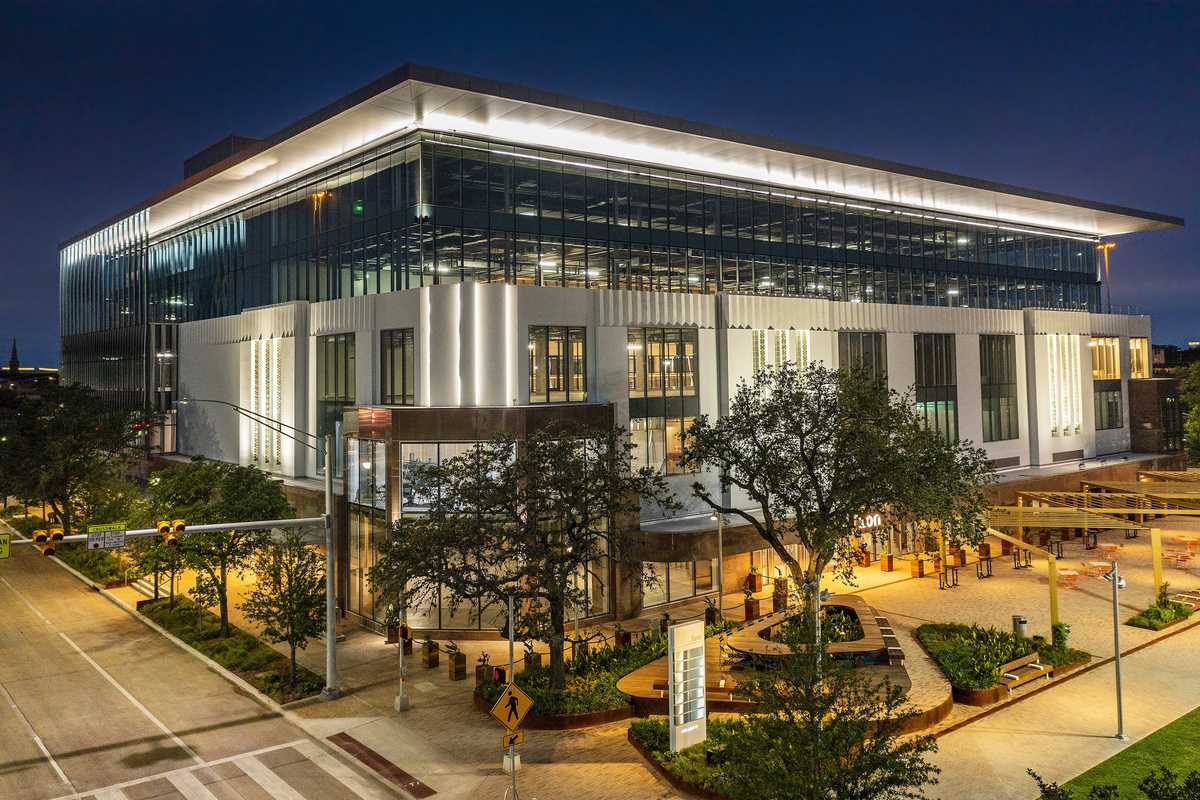
Sage Geosystems is the No. 3 most innovative startup in Texas. Photo via sagegeosystems.com

Three Houston companies claimed spots on LexisNexis's 10 Most Innovative Startups in Texas report, with two working in the geothermal energy space.

Sage Geosystems claimed the No. 3 spot on the list, and Fervo Energy followed closely behind at No. 5. Fintech unicorn HighRadius rounded out the list of Houston companies at No. 8.

LexisNexis Intellectual Property Solutions compiled the report. It was based on each company's Patent Asset Index, a proprietary metric from LexisNexis that identifies the strength and value of each company’s patent assets based on factors such as patent quality, geographic scope and size of the portfolio.

Houston tied with Austin, each with three companies represented on the list. Caris Life Sciences, a biotechnology company based in Dallas, claimed the top spot with a Patent Asset Index more than 5 times that of its next competitor, Apptronik, an Austin-based AI-powered humanoid robotics company.

“Texas has always been fertile ground for bold entrepreneurs, and these innovative startups carry that tradition forward with strong businesses based on outstanding patent assets,” Marco Richter, senior director of IP analytics and strategy for LexisNexis Intellectual Property Solutions, said in a release. “These companies have proven their innovation by creating the most valuable patent portfolios in a state that’s known for game-changing inventions and cutting-edge technologies.We are pleased to recognize Texas’ most innovative startups for turning their ideas into patented innovations and look forward to watching them scale, disrupt, and thrive on the foundation they’ve laid today.”

This year's list reflects a range in location and industry. Here's the full list of LexisNexis' 10 Most Innovative Startups in Texas, ranked by patent portfolios.

  1. Caris (Dallas)
  2. Apptronik (Austin)
  3. Sage Geosystems (Houston)
  4. HiddenLayer (Austin)
  5. Fervo Energy (Houston)
  6. Plus One Robotics (San Antonio)
  7. Diligent Robotics (Austin)
  8. HighRadius (Houston)
  9. LTK (Dallas)
  10. Eagle Eye Networks (Austin)

Sage Geosystems has partnered on major geothermal projects with the United States Department of Defense's Defense Innovation Unit, the U.S. Air Force and Meta Platforms. Sage's 3-megawatt commercial EarthStore geothermal energy storage facility in Christine, Texas, was expected to be completed by the end of last year.

Fervo Energy fully contracted its flagship 500 MW geothermal development, Cape Station, this spring. Cape Station is currently one of the world’s largest enhanced geothermal systems (EGS) developments, and the station will begin to deliver electricity to the grid in 2026. The company was recently named North American Company of the Year by research and consulting firm Cleantech Group and came in at No. 6 on Time magazine and Statista’s list of America’s Top GreenTech Companies of 2025. It's now considered a unicorn, meaning its valuation as a private company has surpassed $1 billion.

Meanwhile, HighRadius announced earlier this year that it plans to release a fully autonomous finance platform for the "office of the CFO" by 2027. The company reached unicorn status in 2020.

---

This article originally appeared on Energy Capital HTX.

Ad Placement 300x100
Ad Placement 300x600

CultureMap Emails are Awesome

Intuitive Machines secures $175M equity investment to fuel growth

space funding

Houston-based space infrastructure and services company Intuitive Machines has secured a $175 million equity investment from unidentified institutional investors. The investors received shares of Class A stock in exchange for their funding.

Publicly held Intuitive Machines (Nasdaq: LUNR) says it plans to use the capital to help build revenue and invest in technology, including communications and data-processing networks.

“We are building a scalable infrastructure platform from low-Earth orbit to the moon and into deep space,” Intuitive Machines CEO Steve Altemus said in a news release. “With this investment, we can accelerate the integration of the combined company’s collective capabilities to deliver next-generation data, communications, and space-based infrastructure services.”

Intuitive Machines says the $175 million investment will improve its ability to secure deals for satellite systems, the proposed Golden Dome missile defense system and the proposed Mars telecommunications orbiter.

As the company pursues those deals, it’s seeking partners to develop space-based data centers.

The $175 million equity stake comes on the heels of Intuitive Machines completing its $800 million cash-and-stock purchase of Lanteris Space Systems. Intuitive Machines bought the satellite manufacturer from private equity firm Advent International.

In the third quarter, which ended Sept. 30, Intuitive Machines posted a $10 million net loss on revenue of $52.4 million.

Houston startup debuts bio-based 'leather' fashion collection in Milan

sustainable fashion

Earlier this month, Houston-based Rheom Materials and India’s conscious design studio Econock unveiled a collaborative capsule collection that signaled more than just a product launch.

Hosted at Lineapelle—long considered the global epicenter of the world's premier leather supply chain—in the vaulted exhibition halls of Rho-Fiera Milano, the collection centered around Rheom’s 91 percent bio-based leather alternative, Shorai.

It was a bold move, one that shifted sustainability from a concept discussed in panel sessions to garments that buyers could touch and wear.

The collection featured a bomber-style jacket, an asymmetrical skirt and a suite of accessories—all fabricated from Shorai.

The standout piece, a sculptural jacket featuring a funnel neck and dual-zip closure, was designed for movement, challenging assumptions about performance limitations in bio-based materials. The design of the asymmetrical skirt was drawn from Indian armored warrior traditions, according to Rheom, with biodegradable corozo fasteners.

Built as a modular wardrobe rather than isolated pieces, the collection reflects a shared belief between Rheom and Econock in designing objects that adapt to daily life, according to the companies.

The collection was born out of a new partnership between Rheom and Econock, focused on bringing biobased materials to the market. According to Rheom, the partnership solves a problem that has stalled the adoption of many next-gen textiles: supply chain friction.

While Rheom focuses on engineering scalable bio-based materials, New Delhi-based Econock brings the complementary design and manufacturing ecosystem that integrates artisans, circular materials and production expertise to translate the innovative material into finished goods.

"This partnership removes one of the biggest barriers brands face when adopting next-generation materials,” Megan Beck, Rheom’s director of product, shared in a news release. “By reducing friction across the supply chain, Rheom can connect brands directly with manufacturers who already know how to work with Shorai, making the transition to more sustainable materials far more accessible.”

Sanyam Kapur, advisor of growth and impact at Econock, added: “Our partnership with Rheom Materials represents the benchmark of responsible design where next-gen materials meet craft, creativity, and real-world scalability.”

Rheom, formerly known as Bucha Bio, has developed Shorai, a sustainable leather alternative that can be used for apparel, accessories, car interiors and more; and Benree, an alternative to plastic without the carbon footprint. In 2025, Rheom was a finalist for Startup of the Year in the Houston Innovation Awards.

Shorai is already used by fashion lines like Wuxly and LuckyNelly, according to Rheom. The company scaled production of the sugar-based material last year and says it is now produced in rolls that brands can take to market with the right manufacturer.

Houston startup debuts leather alternative fashion collection in Milan