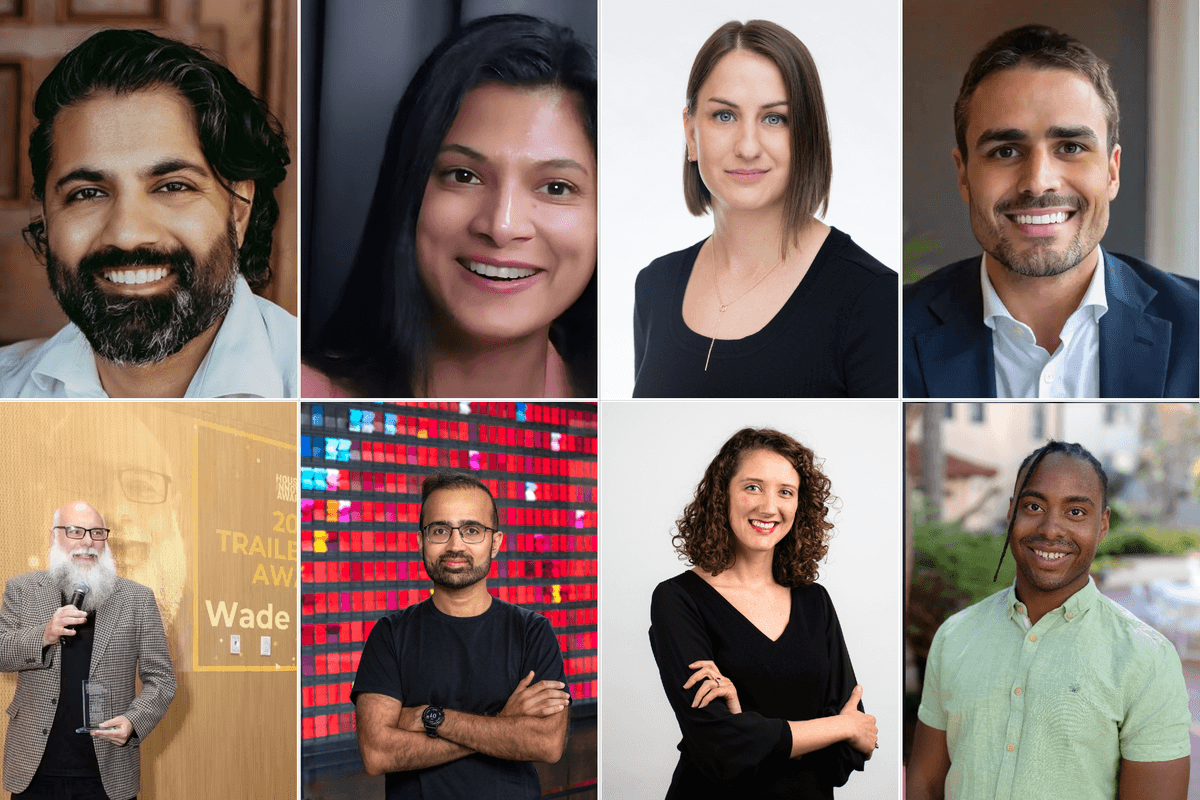
U.S. Secretary of the Interior Doug Burgum and U.S. Secretary of Energy Chris Wright will return to CERAWeek this month, along with dozens of energy executives and innovators. Photos courtesy CERAWeek.

CERAWeek returns this month, March 23-27, and will once again bring leading energy executives and government officials to Houston.

The 44th annual event will again host U.S. Secretary of Energy Chris Wright and U.S. Secretary of the Interior Doug Burgum.

Wright will participate in a plenary session focused on energy policy with Daniel Yergin, conference chair and vice chairman of S&P Global, on March 23. The following day, he will be featured in the Celebrating 10 Years of U.S. LNG reception with Jack Fusso, president and CEO, of Cheniere Energy. Both events are part of the Executive Conference track.

Burgum will participate in a leadership dialogue plenary session with Yergin on March 25. It is also part of the Executive Conference track. Burgum is also chairman of the National Energy Dominance Council, established by President Trump in 2025.

Top energy executives, many of whom are based in Houston, will also be featured prominently at the week-long event. Other speakers include:

  • Bill Blevins, director of grid coordination for the Electric Reliability Council of Texas (ERCOT)
  • Trevor Best, CEO of Syzygy Plasmonics
  • Marie Contour Carrere, executive director of the Rice Sustainability Institute
  • Ryan DuChanois, co-founder and CEO of Solidec
  • Reginald DesRoches, president of Rice University
  • Georgina Campbell Flatter, CEO of Greentown Labs
  • Jim Fitterling, chair and CEO of Dow Inc.
  • Vicki Hollub, CEO of Occidental Petroleum Corp.
  • Renu Katon, chancellor and president of the University of Houston
  • Ryan Lance, chairman and CEO of ConocoPhillips
  • Olivier Le Peuch, CEO of SLB
  • Patrick Pouyanné, chairman and CEO of TotalEnergies SE
  • Adrian Tromel, chief innovation officer and interim VP for Innovation at Rice University
  • Bobby Tudor, founder and CEO of Artemis Energy Partners and chairman of HETI
  • Wael Sawan, CEO of Shell plc
  • Lorenzo Simonelli, chairman and CEO of Baker Hughes Co.
  • Mike Wirth, chairman and CEO of Chevron Corp.
  • Jeremy Pitts, managing director of Activate Houston
  • And many others

This year, CERAWeek will center around the theme of Convergence and Competition: Energy, Technology and Geopolitics.

"Change is inescapable," Yergin said in a news release. "The global energy landscape—and to a large extent the entire global economy—is being fundamentally reshaped by the dual forces of convergence and competition. The race for AI is fusing the energy and technology industries like never before, bringing into sharp relief the need to align energy expansion with sustainable economic growth."

"Yet, the potential for collaboration and innovation is increasingly matched by the risk for collision and conflict in a world marked by geopolitical rivalry, tariffs and fragmented supply chains," he continued. "Reconciling an increasingly complex world with the growing demand for energy that is stable, secure and affordable is a complex reality that CERAWeek 2026 will tackle when global energy leaders meet in Houston."

Key topics of discussion will include:

  • Politics, Economics, Trade and Supply Chains
  • Policy, Regulations and Stakeholders
  • Oil Value Chain
  • Power, Renewables, Generation and Grid
  • AI and Digital
  • Minerals and Mining
  • Electrification Technologies
  • Investment and Financing
  • Chemicals and Materials
  • Business Strategies
  • The Innovation Ecosystem
  • Managing Emissions
  • Low-Carbon Fuels and Mobility
  • Climate and Sustainability
  • Workforce Strategy

The CERAWeek Innovation Agora track, which is the program's deeper dive into technology and innovation, will feature thought leadership on "AI, decarbonization, low carbon fuels, cybersecurity, hydrogen, nuclear, mining and minerals, mobility, automation and more," according to the release.

Agora Hubs will return this year and be divided into three zones: new energies, carbon and climate, and AI. The hubs will feature amphitheater-style sessions and panels. Agora Pods will allow energy startups to showcase their ideas in 20- to 30-minute presentations.

Additionally, CERAWeek will introduce a new program this year on Friday, March 27. Known as Look Forward, it will focus on economics, politics and technology.

See the full agenda for the week here. Find more information and register for the event here.

---

This article originally appeared on our sister site, EnergyCapitalHTX.com.

Ad Placement 300x100
Ad Placement 300x600

CultureMap Emails are Awesome

Cancer diagnostics startup wins top prize at annual Rice competition​

winner, winners

Rice University student-founded companies took home a total of $115,000 in equity-free funding at the annual Liu Idea Lab for Innovation and Entrepreneurship's H. Albert Napier Rice Launch Challenge last week.

2025 Rice Innovation Fellow Alexandria Carter won the top prize and $50,000 for her startup Bionostic. The startup offers personalized diagnostics for cancer patients by using 3D culturing through its Advanced Tumor Landscape Analysis System (ATLAS) platform.

Carter is working toward her PhD in bioengineering in Professor Michael King's laboratory. She recently completed the Rice Innovation Fellows program and plans to commercialize ATLAS, according to a news release from Rice.

Actile Technologies, founded by another former Rice Innovation Fellow, Barclay Jumet, won second place and $25,000. The company is developing and commercializing textile-integrated technologies. InnovationMap first covered Jumet's wearable technology back in 2023.

Kairos took home the third-place prize and $15,000, plus the $2,000 audience choice award and the $5,000 undergraduate business award. Founded last year by Sanjana Kavula and Adhira Tippur, Kairos is an AI-powered patient intake platform built specifically for independent dental practices.

The NRLC features top startups founded by undergraduate, graduate and MBA students at Rice each year. The top three finishers were named among a group of five finalists earlier this year, which also included HAAST Autonomous and Project Kestrel.

HAAST is developing an unmanned aircraft for organ transport, while Kestrel uses machine learning to organize bird photographers’ photo collections.

Teams presented multiple five-minute pitches throughout the application process over Zoom and in-person before the five finalists presented at the NRLC Championships April 21 at the Rice Memorial Center. Each finalist walked away with an equity-free investment.


Other awards went to:

UnitCode

  • $5,000 MBA Venture Award

HAAST Autonomous

  • $2,500 Chan-Kang Family Prize for Bold Ambition
  • $1,000 Healthcare Innovations Prize

Telstar Networks

  • $2,500 Outstanding Undergraduate Startup Award

Multiplay

  • $1,500 Frank Liu Jr. Prize for Creative Innovation in Music, Fashion, & the Arts

Butterfly Books

  • $1,500 Social Impact Award

SOOZ

  • $1,000 Interdisciplinary Innovation Prize sponsored by OURI

Dooly

  • $1,000 Consumer Goods Prize

Project Kestrel

  • $1,000 AI Prize

Veloci Running won the NRLC last year for its naturally shaped running shoe. Founder and CEO Tyler Strothman recently told InnovationMap that the company has gone on to sell roughly 10,000 pairs of its flagship Ascent shoe, designed to relieve lower leg tightness and absorb impact. Read more here.

Houston-based, NASA-founded cleantech startup closes $12M seed round

Fresh Funds

Houston-based Helix Earth Technologies has closed a $12 million Seed 2 funding round to scale manufacturing of its energy-efficient commercial HVAC add-on technology.

Veriten, a Houston-based energy investment firm, led the round. Rua Ventures, Carnrite Ventures, Skywriter LLC and Textbook Ventures also participated.

Helix Earth—which was founded based on NASA technology, spun out of Rice University and has been incubated at Greentown Labs—is developing high-efficiency retrofit dehumidification systems that aim to reduce the energy consumption of commercial HVAC units. The company reports that its technology can lead to "healthier indoor air, lower energy bills, reduced building maintenance, and more comfortable spaces for building owners and occupants."

"Building owners are dealing with rising energy costs, uncontrolled humidity, and aging infrastructure with no viable, cost-effective path forward. We are in the field today solving these problems for commercial customers, and this capital puts us on an aggressive path to scale,” Rawand Rasheed, Helix Earth co-founder and CEO, said in a news release.

“The strength of this round reinforces our team's conviction that we can transform innovation-starved sectors with transformational solutions that deliver order-of-magnitude improvements to owners and operators, for both their bottom line and the environment,” Rasheed added.

Maynard Holt, Veriten’s founder and CEO, said that the investment firm is tripling its investment in Helix Earth.

"The team has built breakthrough technology with real applicability across multiple industries,” Holt said in the release. “Their first product will have an immediate and measurable impact on our energy system, and they are already pursuing adjacent innovations to help heavy industries operate more efficiently and with less waste. This is a well-rounded team with a proven track record of strong execution and disciplined capital management.”

Helix Earth also closed a $5.6 million seed funding round in 2024, led by Veriten.

Last year, the company secured a $1.2 million Small Business Innovation Research (SBIR) Phase II grant and won in the Smart Cities, Transportation & Sustainability contest at the 2025 SXSW Pitch Showcase. Rasheed was also named to the Forbes 30 Under 30 Energy and Green Tech list for 2025.

---

This article originally appeared on EnergyCapital HTX.com.

Texas earns 22nd 'best state for business' title as GDP hits $2.9T

booming economy

The Texas business sector recently received a double dose of good news.

For the 22nd consecutive year, Chief Executive magazine named Texas the best state for business. In tandem with that achievement, preliminary new estimates from the U.S. Bureau of Economic Analysis show the size of Texas’ economy jumped to $2.9 trillion in 2025, up by a nation-leading growth rate of 2.5 percent compared with the previous year.

Speaking about the Chief Executive honor, Gov. Greg Abbott says Texas benefits from pro-growth policies, a strong workforce, strategic investments in education, training for high-demand skills and the presence of critical infrastructure.

“Texas is where businesses innovate and where opportunity abounds. … We will continue to move at the speed of business as we build a more prosperous Texas for generations to come,” the governor says.

An annual Chief Executive survey of CEOs, presidents and business owners determines which state is the best for business. Texas has landed at No. 1 every year since Chief Executive launched the ranking.

“Truly, this is an incredible run that Texas has going,” says Christopher Chalk, publisher of Chief Executive. “CEOs are a tough group to please, and yet year after year Texas continues to earn the top spot—no small feat.”

It’s also no small feat for a state to notch annual gains in its gross domestic product (GDP), a measurement of economic power based on the value of goods and services produced each year.

With an estimated GDP of $2.9 trillion last year, Texas maintains its position as the eighth-largest global economy compared with the nations of the world, based on preliminary estimates from the International Monetary Fund.

In reference to Texas’ GDP growth, Abbott says the Lone Star State is “the premier destination for job creators from across the country and world. We will keep attracting world-class investment, create jobs, and expand opportunity for Texans for generations to come.”