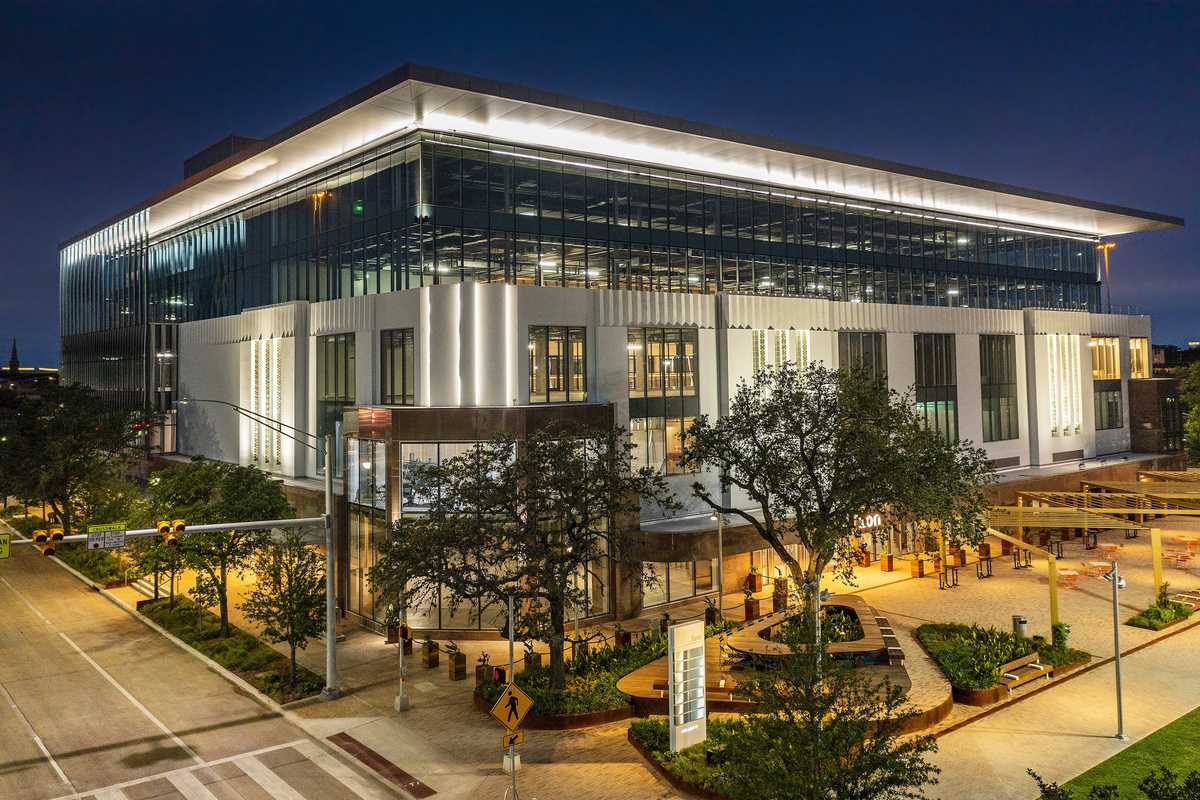
Halliburton Labs has named its newest cohort — and applications are open for the spring. Photo courtesy of Halliburton

Halliburton Labs has named for clean energy companies to its accelerator program.

Halliburton Labs, which originally launched in 2020, has 12 member companies now. The startups will have access to the Halliburton facilities, the company's experts, and its network, and will be located in the company's North Houston headquarters.

"This strong group of companies further establishes Halliburton Labs as the place where innovative companies come together with technical and operational scaling resources to advance commercial success," says Dale Winger, managing director of Halliburton Labs, in a news release. "We are excited to collaborate with the founders and their respective teams to support their clean energy solutions."

Here are the four new additions to the program:

  • Massachusetts-based Helix Power aims to provide high power, high cycle and short duration energy storage with its patented flywheel energy storage technology.
  • Icarus RT, based in San Diego, is working to develop a power boosting and energy storage technology to improve system performance and return on investment in commercial and utility scale solar photovoltaic systems.
  • SolvCor, based in New Jersey, developed a patented technology platform to significantly improve heat transfer versus water for use in a wide range of industrial applications such as cooling systems and thermal storage.
  • New York-based Strayos helps mining and cement companies more efficiently extract raw minerals by adding artificial intelligence-powered tools to certain essential steps of the mining value chain.

The program announced its last cohort in July. Applications for the spring cohort are open now — deadline for submission is December 23.
Ad Placement 300x100
Ad Placement 300x600

CultureMap Emails are Awesome

Houston doctor wins NIH grant to test virtual reality for ICU delirium

Virtual healing

Think of it like a reverse version of The Matrix. A person wakes up in a hospital bed and gets plugged into a virtual reality game world in order to heal.

While it may sound far-fetched, Dr. Hina Faisal, a Houston Methodist critical care specialist in the Department of Surgery, was recently awarded a $242,000 grant from the National Institute of Health to test the effects of VR games on patients coming out of major surgery in the intensive care unit (ICU).

The five-year study will focus on older patients using mental stimulation techniques to reduce incidences of delirium. The award comes courtesy of the National Institute on Aging K76 Paul B. Beeson Emerging Leaders Career Development Award in Aging.

“As the population of older adults continues to grow, the need for effective, scalable interventions to prevent postoperative complications like delirium is more important than ever,” Faisal said in a news release.

ICU delirium is a serious condition that can lead to major complications and even death. Roughly 87 percent of patients who undergo major surgery involving intubation will experience some form of delirium coming out of anesthesia. Causes can range from infection to drug reactions. While many cases are mild, prolonged ICU delirium may prevent a patient from following medical advice or even cause them to hurt themselves.

Using VR games to treat delirium is a rapidly emerging and exciting branch of medicine. Studies show that VR games can help promote mental activity, memory and cognitive function. However, the full benefits are currently unknown as studies have been hampered by small patient populations.

Faisal believes that half of all ICU delirium cases are preventable through VR treatment. Currently, a general lack of knowledge and resources has been holding back the advancement of the treatment.

Hopefully, the work of Faisal in one of the busiest medical cities in the world can alleviate that problem as she spends the next half-decade plugging patients into games to aid in their healing.

Houston scientists develop breakthrough AI-driven process to design, decode genetic circuits

biotech breakthrough

Researchers at Rice University have developed an innovative process that uses artificial intelligence to better understand complex genetic circuits.

A study, published in the journal Nature, shows how the new technique, known as “Combining Long- and Short-range Sequencing to Investigate Genetic Complexity,” or CLASSIC, can generate and test millions of DNA designs at the same time, which, according to Rice.

The work was led by Rice’s Caleb Bashor, deputy director for the Rice Synthetic Biology Institute and member of the Ken Kennedy Institute. Bashor has been working with Kshitij Rai and Ronan O’Connell, co-first authors on the study, on the CLASSIC for over four years, according to a news release.

“Our work is the first demonstration that you can use AI for designing these circuits,” Bashor said in the release.

Genetic circuits program cells to perform specific functions. Finding the circuit that matches a desired function or performance "can be like looking for a needle in a haystack," Bashor explained. This work looked to find a solution to this long-standing challenge in synthetic biology.

First, the team developed a library of proof-of-concept genetic circuits. It then pooled the circuits and inserted them into human cells. Next, they used long-read and short-read DNA sequencing to create "a master map" that linked each circuit to how it performed.

The data was then used to train AI and machine learning models to analyze circuits and make accurate predictions for how untested circuits might perform.

“We end up with measurements for a lot of the possible designs but not all of them, and that is where building the (machine learning) model comes in,” O’Connell explained in the release. “We use the data to train a model that can understand this landscape and predict things we were not able to generate data on.”

Ultimately, the researchers believe the circuit characterization and AI-driven understanding can speed up synthetic biology, lead to faster development of biotechnology and potentially support more cell-based therapy breakthroughs by shedding new light on how gene circuits behave, according to Rice.

“We think AI/ML-driven design is the future of synthetic biology,” Bashor added in the release. “As we collect more data using CLASSIC, we can train more complex models to make predictions for how to design even more sophisticated and useful cellular biotechnology.”

The team at Rice also worked with Pankaj Mehta’s group in the department of physics at Boston University and Todd Treangen’s group in Rice’s computer science department. Research was supported by the National Institutes of Health, Office of Naval Research, the Robert J. Kleberg Jr. and Helen C. Kleberg Foundation, the American Heart Association, National Library of Medicine, the National Science Foundation, Rice’s Ken Kennedy Institute and the Rice Institute of Synthetic Biology.

James Collins, a biomedical engineer at MIT who helped establish synthetic biology as a field, added that CLASSIC is a new, defining milestone.

“Twenty-five years ago, those early circuits showed that we could program living cells, but they were built one at a time, each requiring months of tuning,” said Collins, who was one of the inventors of the toggle switch. “Bashor and colleagues have now delivered a transformative leap: CLASSIC brings high-throughput engineering to gene circuit design, allowing exploration of combinatorial spaces that were previously out of reach. Their platform doesn’t just accelerate the design-build-test-learn cycle; it redefines its scale, marking a new era of data-driven synthetic biology.”