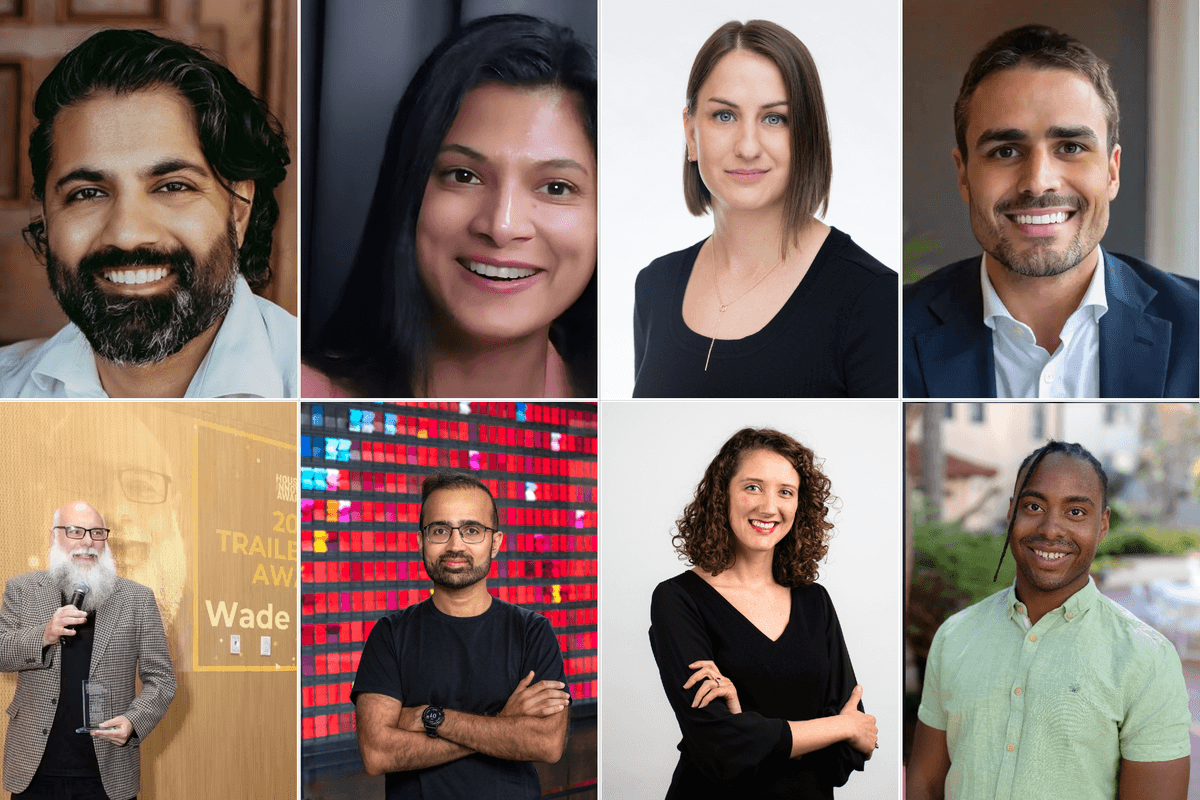
Don't miss these June events—from lightning pitches to a female-focused AI summit. Photo by Scott Halleran/Getty Images

Editor's note: From lightning pitches to a female-focused AI summit and energy conferences, there's still plenty to do as Houston settles into the summer. Here are the Houston business and innovation events you can't miss in June and how to register. Please note: this article might be updated to add more events.


June 3 – Founders Live Houston 

Watch five Houston founders present their 99-second pitches at Founders Live Houston. Competing teams include AyeDu (Vinita Gupta), Omniscale (Tony Hernandez-Ferman), AnswerPath (Chris Mullins), Katana.video (Sam Bhattacharyya) and TraceWrap (Laketta B.).

This event is Tuesday, May 3, at 5:30 p.m. at the Ion. Register here.

June 4 – Center for Human Performance Research & Networking Event

Rice University and Houston Methodist's Center for Human Performance will host an event to support its work in the study of exercise physiology, injury prevention and rehabilitation. The organizations will share more information on seed grant opportunities, and the event will feature presentations from Rice and Houston Methodist leaders, networking sessions and a poster showcase.

This event is Wednesday, June 4, from 3-5:30 p.m. at the BioScience Research Collaborative at Rice University. Register here.

June 12 – Transition on Tap

Meet and hear lighting pitches from eight of Greentown Labs’ newest startup members. Attendees can network with entrepreneurs, investors, corporate leaders, philanthropists, students and other climate champions. Georgina Campbell Flatter, CEO of Greentown Labs, and Victor Martinez, Greentown's memberships manager, will also speak.

This event is Thursday, June 12, from 5:30-7:30 p.m. at Greentown Houston. Register here.

June 16-18 — Energy Drone & Robotics Summit

This three-day summit, the largest of its kind, will connect 1,500-plus leaders in the global energy/industrial robotics, drone and data sectors. Attendees will glean the latest ideas, use cases, best practices, tech and trends from a wide variety of robotics and drone industry experts.

This event begins June 16 at Woodlands Waterway Marriott. Register here.

June 17 – SGSF’s #SUPERGirlsInSTEM Summit, The Intersection of AI & Workforce

SUPERGirls SHINE Foundation is hosting a one-day summit for women ages 18-24 focused on the evolving intersection of AI and the STEM workforce. The conference will feature keynote speakers, panel discussions and hands-on workshops.

This event is Tuesday, June 17, from 9 a.m.-1 p.m. at the Ion. Register here.

June 18 – 2025 Obsidi BNXT: Juneteenth Tech Forum

Obsidi.com, an online platform launched by the Black Professionals in Tech Network (BPTN), will host a forum for high-performing Black and allied tech executives. The event offers networking opportunities, keynotes and panels that feature executives from Echelon Health Partners, Hewlett-Packard Enterprise, SAP, Intuit and more.

The event is Wednesday, June 18, at NRG Center. Register here.

June 24 — Houston Methodist Leadership Speaker Series

Head to the Houston Methodist Tech Hub at Ion to hear the latest installment of the Houston Methodist Leadership Speaker Series. Trent Fulin, vice president and CEO at Houston Methodist Cypress Hospital, will discuss the new 105-acre campus and its first 100 days of patient care, followed by a Q&A.

This event is Tuesday, June 23, from 4:45-6 p.m. Register here.

June 25-26 – Carbon Capture Technology Expo and  Hydrogen Technology Conference & Expo North America

Tackling climate change is one of the biggest global challenges that requires immediate action, and many industrial sectors are now looking to new technology to help meet net-zero emission targets. The Carbon Capture Technology Expo is North America's leading event for carbon capture, utilization and storage. The expo offers opportunities to network with industry frontrunners and best-in-class solution providers.

This event begins June 25 at NRG Center. Click here to register. It is co-located with the Hydrogen Technology Conference & Expo North America. Expo passes are free.

June 26 – NASA Tech Talk

Every fourth Thursday of the month, NASA experts, including longtime engineer Montgomery Goforth, present on technology development challenges NASA’s Johnson Space Center and the larger aerospace community are facing and how Houston’s innovation community can leverage them. Stick around after for drinks and networking at Second Draught.

This event is Thursday, June 26, from 6-7 p.m. at the Ion. Register here.

Ad Placement 300x100
Ad Placement 300x600

CultureMap Emails are Awesome

Houston-area lab grows with focus on mobile diagnostics and predictive medicine

mobile medicine

When it comes to healthcare, access can be a matter of life and death. And for patients in skilled nursing facilities, assisted living or even their own homes, the ability to get timely diagnostic testing is not just a convenience, it’s a necessity.

That’s the problem Principle Health Systems (PHS) set out to solve.

Founded in 2016 in Clear Lake, Texas, PHS began as a conventional laboratory but quickly pivoted to mobile diagnostics, offering everything from core blood work and genetic testing to advanced imaging like ultrasounds, echocardiograms, and X-rays.

“We were approached by a group in a local skilled nursing facility to provide services, and we determined pretty quickly there was a massive need in this area,” says James Dieter, founder, chairman and CEO of PHS. “Turnaround time is imperative. These facilities have an incredibly sick population, and of course, they lack mobility to get the care that they need.”

What makes PHS unique is not only what they do, but where they do it. While they operate one of the largest labs serving skilled nursing facilities in the state, their mobile teams go wherever patients are, whether that’s a nursing home, a private residence or even a correctional facility.

Diagnostics, Dieter says, are at the heart of medical decision-making.

“Seventy to 80 percent of all medical decisions are made from diagnostic results in lab and imaging,” he says. “The diagnostic drives the doctor’s or the provider’s next move. When we recognized a massive slowdown in lab results, we had to innovate to do it faster.”

Innovation at PHS isn’t just about speed; it’s about accessibility and precision.

Chris Light, COO, explains: “For stat testing, we use bedside point-of-care instruments. Our phlebotomists take those into the facilities, test at the bedside, and get results within minutes, rather than waiting days for results to come back from a core lab.”

Scaling a mobile operation across multiple states isn’t simple, but PHS has expanded into nine states, including Texas, Oklahoma, Kansas, Missouri and Arizona. Their model relies on licensed mobile phlebotomists, X-ray technologists and sonographers, all trained to provide high-level care outside traditional hospital settings.

The financial impact for patients is significant. Instead of ambulance rides and ER visits costing thousands, PHS services often cost just a fraction, sometimes only tens or hundreds of dollars.

“Traditionally, without mobile diagnostics, the patient would be loaded into a transportation vehicle, typically an ambulance, and taken to a hospital,” Dieter says. “Our approach is a fraction of the cost but brings care directly to the patients.”

The company has also embraced predictive and personalized medicine, offering genetic tests that guide medication decisions and laboratory tests that predict cognitive decline from conditions like Alzheimer's and Parkinson’s.

“We actively look for complementary services to improve patient outcomes,” Dieter says. “Precision medicine and predictive testing have been a great value-add for our providers.”

Looking to the future, PHS sees mobile healthcare as part of a larger trend toward home-based care.

“There’s an aging population that still lives at home with caretakers,” Dieter explains. “We go into the home every day, whether it’s an apartment, a standalone home, or assisted living. The goal is to meet patients where they are and reduce the need for hospitalization.”

Light highlighted another layer of innovation: predictive guidance.

“We host a lot of data, and labs and imaging drive most treatment decisions,” Light says. “We’re exploring how to deploy diagnostics immediately based on results, eliminating hours of delay and keeping patients healthier longer.”

Ultimately, innovation at PHS isn’t just about technology; it’s about equity.

“There’s an 11-year life expectancy gap between major metro areas and rural Texas,” Dieter says. “Our innovation has been leveling the field, so everyone has access to high-quality diagnostics and care, regardless of where they live.”

Aegis Aerospace appoints Houston space leader as new president

moving up

Houston-based Aegis Aerospace's current chief strategy officer, Matt Ondler, will take on the additional role of president on Jan. 1. Ondler will succeed Bill Hollister, who is retiring.

“Matt's vision, experience, and understanding of our evolving markets position us to build on our foundation and pursue new frontiers,” Stephanie Murphy, CEO of Aegis Aerospace, said in a news release.

Hollister guided Aegis Aerospace through expansion and innovation in his three years as president, and will continue to serve in the role of chief technology officer (CTO) for six months and focus on the company's technical and intellectual property frameworks.

"Bill has played an instrumental role in shaping the success and growth of our company, and his contributions leave an indelible mark on both our culture and our achievements," Murphy said in a news release.

Ondler has a background in space hardware development and strategic leadership in government and commercial sectors. Ondler founded subsea robots and software company Houston Mechatronics, Inc., now known as Nauticus Robotics, and also served as president, CTO and CSO during a five-year tenure at Axiom Space. He held various roles in his 25 years at NASA and was also named to the Texas Aerospace Research and Space Economy Consortium Executive Committee last year.

"I am confident that with Matt at the helm as president and Bill supporting us as CTO, we will continue to build on our strong foundation and further elevate our impact in the space industry," Murphy said in a news release. "Matt's vision, experience, and understanding of our evolving markets position us to build on our foundation and pursue new frontiers."

Rice University launches new center to study roots of Alzheimer’s and Parkinson’s

neuro research

Rice University launched its new Amyloid Mechanism and Disease Center last month, which aims to uncover the molecular origins of Alzheimer’s, Parkinson’s and other amyloid-related diseases.

The center will bring together Rice faculty in chemistry, biophysics, cell biology and biochemistry to study how protein aggregates called amyloids form, spread and harm brain cells. It will serve as the neuroscience branch of the Rice Brain Institute, which was also recently established.

The team will work to ultimately increase its understanding of amyloid processes and will collaborate with the Texas Medical Center to turn lab discoveries into real progress for patients. It will hold its launch event on Jan. 21, 2026, and hopes to eventually be a launchpad for future external research funding.

The new hub will be led by Pernilla Wittung-Stafshed, a Rice biophysicist and the Charles W. Duncan Jr.-Welch Chair in Chemistry.

“To make a real difference, we have to go all the way and find a cure,” Wittung-Stafshede said in a news release. “At Rice, with the Amyloid Mechanism and Disease Center as a catalyst, we have the people and ideas to open new doors toward solutions.”

Wittung-Stafshede, who was recruited to Rice through a Cancer Prevention and Research Institute of Texas grant this summer, has led pioneering work on how metal-binding proteins impact neurodegenerative disorders, including Alzheimer’s and Parkinson’s diseases. Her most recent study, published in Advanced Science, suggests a new way of understanding how amyloids may harm cells and consume the brain’s energy molecule, ATP.

According to Alzheimer’s Disease International, neurodegenerative disease cases could reach around 78 million by 2030 and 139 million by 2050. Wittung-Stafshede’s father died of dementia several years ago.

“This is close to my heart,” Wittung-Stafshede added in the news release. “Neurodegenerative diseases such as dementia, Alzheimer’s and Parkinson’s are on the rise as people live longer, and age is the largest risk factor. It affects everyone.”