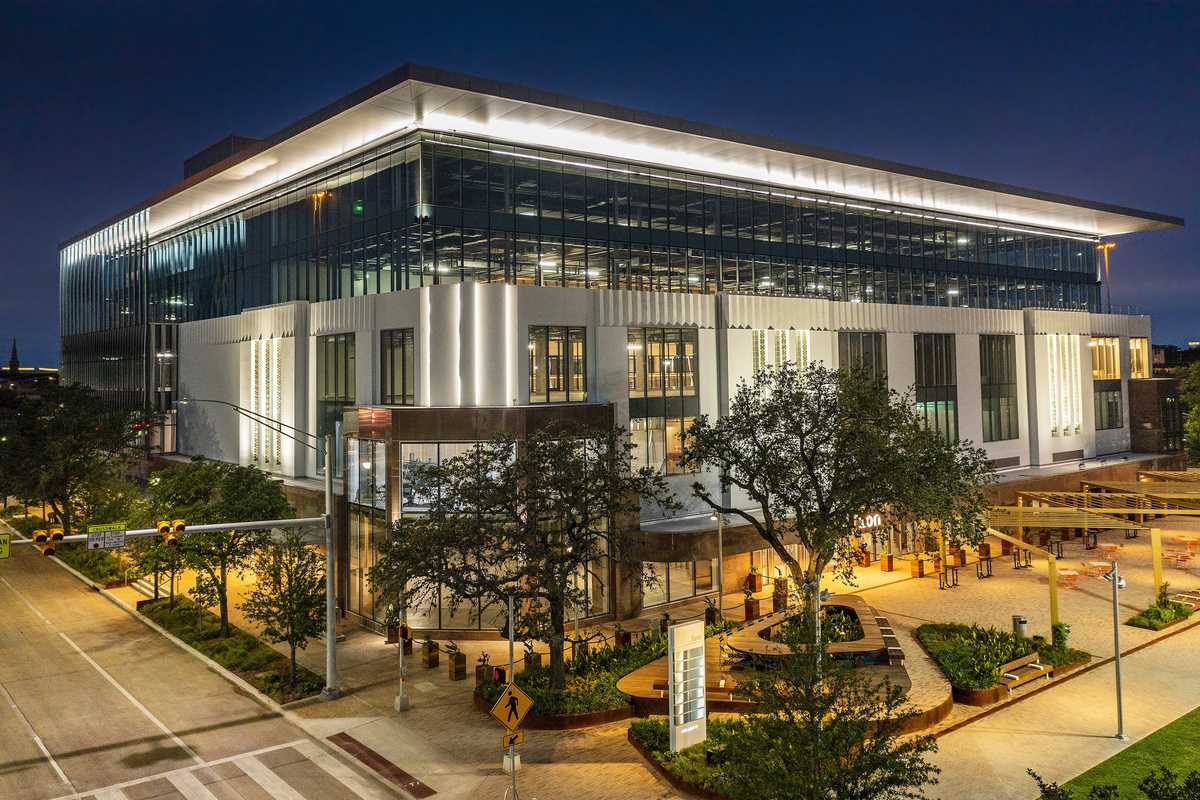
Sage Geosystems is the No. 3 most innovative startup in Texas. Photo via sagegeosystems.com

Three Houston companies claimed spots on LexisNexis's 10 Most Innovative Startups in Texas report, with two working in the geothermal energy space.

Sage Geosystems claimed the No. 3 spot on the list, and Fervo Energy followed closely behind at No. 5. Fintech unicorn HighRadius rounded out the list of Houston companies at No. 8.

LexisNexis Intellectual Property Solutions compiled the report. It was based on each company's Patent Asset Index, a proprietary metric from LexisNexis that identifies the strength and value of each company’s patent assets based on factors such as patent quality, geographic scope and size of the portfolio.

Houston tied with Austin, each with three companies represented on the list. Caris Life Sciences, a biotechnology company based in Dallas, claimed the top spot with a Patent Asset Index more than 5 times that of its next competitor, Apptronik, an Austin-based AI-powered humanoid robotics company.

“Texas has always been fertile ground for bold entrepreneurs, and these innovative startups carry that tradition forward with strong businesses based on outstanding patent assets,” Marco Richter, senior director of IP analytics and strategy for LexisNexis Intellectual Property Solutions, said in a release. “These companies have proven their innovation by creating the most valuable patent portfolios in a state that’s known for game-changing inventions and cutting-edge technologies.We are pleased to recognize Texas’ most innovative startups for turning their ideas into patented innovations and look forward to watching them scale, disrupt, and thrive on the foundation they’ve laid today.”

This year's list reflects a range in location and industry. Here's the full list of LexisNexis' 10 Most Innovative Startups in Texas, ranked by patent portfolios.

  1. Caris (Dallas)
  2. Apptronik (Austin)
  3. Sage Geosystems (Houston)
  4. HiddenLayer (Austin)
  5. Fervo Energy (Houston)
  6. Plus One Robotics (San Antonio)
  7. Diligent Robotics (Austin)
  8. HighRadius (Houston)
  9. LTK (Dallas)
  10. Eagle Eye Networks (Austin)

Sage Geosystems has partnered on major geothermal projects with the United States Department of Defense's Defense Innovation Unit, the U.S. Air Force and Meta Platforms. Sage's 3-megawatt commercial EarthStore geothermal energy storage facility in Christine, Texas, was expected to be completed by the end of last year.

Fervo Energy fully contracted its flagship 500 MW geothermal development, Cape Station, this spring. Cape Station is currently one of the world’s largest enhanced geothermal systems (EGS) developments, and the station will begin to deliver electricity to the grid in 2026. The company was recently named North American Company of the Year by research and consulting firm Cleantech Group and came in at No. 6 on Time magazine and Statista’s list of America’s Top GreenTech Companies of 2025. It's now considered a unicorn, meaning its valuation as a private company has surpassed $1 billion.

Meanwhile, HighRadius announced earlier this year that it plans to release a fully autonomous finance platform for the "office of the CFO" by 2027. The company reached unicorn status in 2020.

---

This article originally appeared on Energy Capital HTX.

Ad Placement 300x100
Ad Placement 300x600

CultureMap Emails are Awesome

Austin company to bring AI-powered school to The Woodlands

AI education

Austin-based Alpha School, which operates AI-powered private schools, is opening its first Houston-area location in The Woodlands.

The 8,000-square-foot school, scheduled to be ready for the 2026-27 academic year, initially will serve students in kindergarten through eighth grade. Alpha says the school will offer “open workshop spaces and innovative classrooms that support personalized instruction, core academics, leadership development, and real-world life skills.”

Alpha sets aside two hours each school day for the AI-driven, self-paced study of core subjects like math, reading and science. The rest of each school day consists of life-skills workshops focusing on topics such as leadership and financial literacy.

Alpha’s school in The Woodlands has begun accepting applications for the 2026-27 school year. Annual tuition costs $40,000.

“The Woodlands is one of the most dynamic, forward-thinking communities in Texas, and Alpha is proud to bring

an innovative educational model that complements its strong academic foundation,” says Rachel Goodlad, head

of expansion for Alpha.

Founded in 2014, Alpha School combines adaptive technology-driven instruction with immersive life-skills workshops. Its model emphasizes mastery-based learning in core subjects alongside development of communication, critical thinking, financial literacy and leadership skills. It operates more than 15 schools across the country.

Elsewhere in Texas, Alpha operates schools in Austin, Brownsville, Fort Worth and Plano. Alpha also operates 12 Texas Sports Academy campuses in Texas, including locations in Houston, Pearland and Richmond, along with a NextGen Academy esports school in Austin, a school for gifted students in Georgetown, and lower-cost Nova Academy campuses in Austin and Bastrop.

Alpha has fans and critics. While supporters tout students’ high achievement rates, detractors complain about the high tuition and the AI-influenced depersonalization of education.

“Students and our country need to be in relationship with other human beings,” Randi Weingarten, president of the American Federation of Teachers, a teachers union, tells The New York Times. “When you have a school that is strictly AI, it is violating that core precept of the human endeavor and of education.”

Alpha co-founder MacKenzie Price, a podcaster and social media influencer, doesn’t share Weingarten’s views.

“Parents and teachers: We need to embrace this change,” Price wrote after President Trump signed an executive order promoting AI in schools.

The Times notes that Alpha doesn’t employ AI as a tutor or a supplement. Rather, the newspaper says, AI is “the school’s primary educational driver to move students through academic content.”

Houston researcher secures $1.7M to develop drug for aggressive form of breast cancer

cancer research

A University of Houston researcher has joined a $3.2 million effort to develop a new drug designed to attack a cancer-driving protein commonly found in triple-negative breast cancer.

Triple-negative breast cancer (TNBC) is one of the most difficult-to-treat forms of cancer and accounts for 10 percent to 15 percent of all breast cancer cases. The disease gets its name because tumors associated with it test negative for estrogen receptors, progesterone receptors and excess HER2 protein, making it difficult to target. Due to this, TNBC is often treated with general chemotherapy, which can come with negative side effects and drug resistance, according to UH.

UH College of Pharmacy research associate professor Wei Wang is developing a drug that can target the disease more specifically. The drug will target MDM2, a protein often overproduced in TNBC that also contributes to faster tumor growth.

Wang is working on a team led by Wei Li, director of the University of Tennessee Health Science Center College of Pharmacy’s Drug Discovery Center. She has received $1.7 million to support the research.

Wang and UH professor of pharmacology and toxicology Ruiwen Zhang have discovered a compound that can break down MDM2. In early laboratory models, the compound has shown the ability to shrink tumors.

Wang and Zhang will focus on understanding how the treatment works and monitoring its effectiveness in models that closely mirror human disease.

“We will study how the drug targets MDM2 and evaluate the most promising drug candidates to determine effective dosing, understand how the drug behaves in the body, compare it with existing treatments and assess early safety,” Wang said in a news release.

Li’s team at the University of Tennessee will be working on the chemistry and drug design end of the project.

“This work could lead to an entirely new class of therapies for triple-negative breast cancer,” Li added in the release. “We’re hopeful that by directly removing the MDM2 protein from cancer cells, we can help more patients respond to treatment regardless of their tumor type.”