Rapper 50 Cent really means business. 50 Cent/Twitter

Rap star and Newstonian 50 Cent is giving back to area schools in need of help. The recently relocated rapper/producer/entrepreneur/rodeo wine bidder is teaming up with the Houston Independent School District and Horizon United Group to bolster entrepreneurship programs at Kashmere, Worthing, and Wheatley high schools.

He has funded the project with a $600,000 donation, Mayor Sylvester Turner announced on May 17.

Dubbed the G-Unity Business Lab, the new program will encourage students to engage in MBA-level lessons that represent the full lifecycle of a product or concept, from idea creation, to market branding, to even running a company, a press release notes.

Starting fall 2021, selected students from Kashmere, Worthing, and Wheatley high schools will work with HISD educators, Houston business leaders, and the G-Unity Foundation to complete an after-school course.

The curriculum and concepts align with the core values preached by 50 Cent (nee Curtis Jackson) in his book, Hustle Harder, Hustle Smarter.

Utilizing a Shark Tank- styled competition, student work will be judged by 50 Cent, Al Kashani, president of Horizon United Group, and other community leaders. Winners will receive seed money to begin their businesses that are incubated in Houston.

"It's great to be giving back to this community that's already given me so much," said 50 Cent in a statement. "These young kids can do great things if they just have the right skills and tools. This program is going to help get them there."

Turner noted that the plan lines up with his initiative to create jobs. "I am deeply grateful to Curtis "50 Cent" Jackson for investing in Houston ISD students," he said in a release. "This program will have a big impact on the lives of students and their families. It will provide a platform to help young people grow their skillset by learning how to be future entrepreneurs, scientists, engineers, and business leaders."

------

This article originally ran on CultureMap.
Ad Placement 300x100
Ad Placement 300x600

CultureMap Emails are Awesome

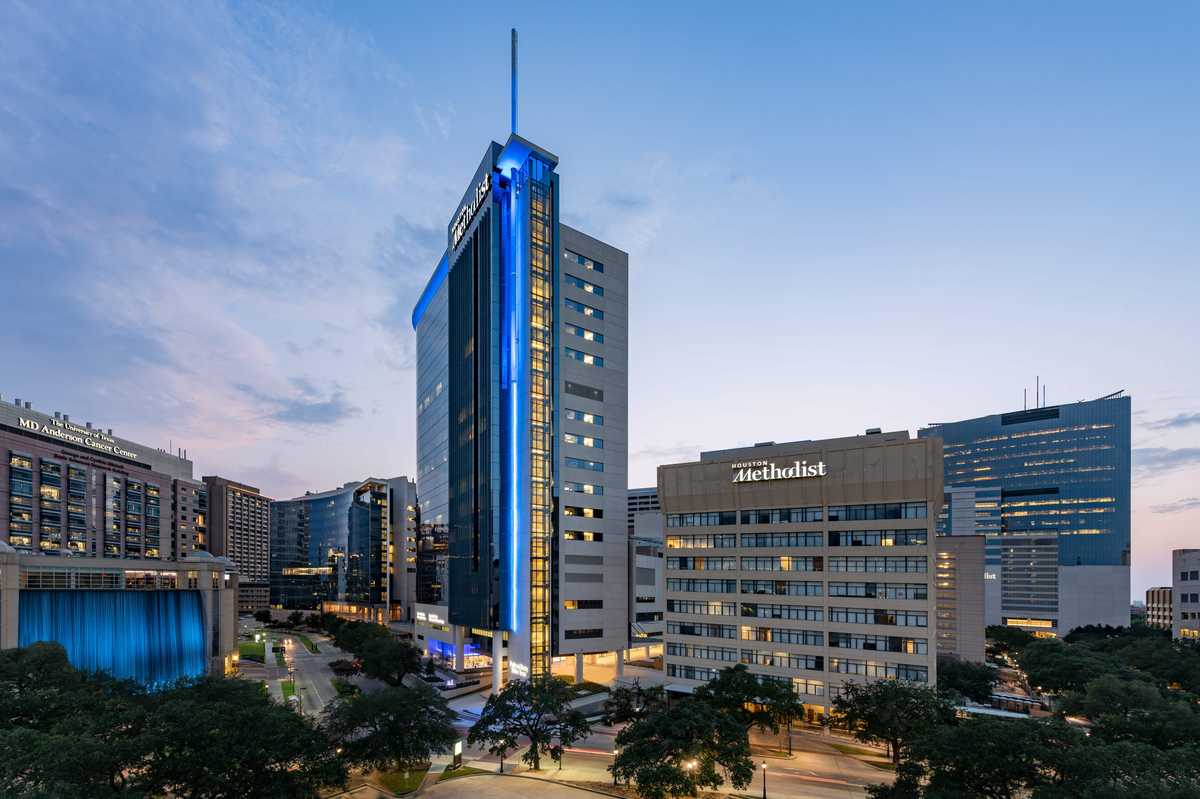
$5B Austin medical center, anchored by MD Anderson, to break ground this fall

moving forward

Construction on the $1 billion first phase of the AI-native University of Texas Dell Medical Center in Austin—which will feature a hospital operated by Houston’s UT MD Anderson Cancer Center—is set to start this fall.

The UT System Board of Regents approved funding for first-phase construction on Aug. 12.

The medical center—now expected to cost $5 billion, up from the initial $2.9 billion estimate—will span about 2.5 million square feet. It will include 300 to 500 patient beds, outpatient facilities, an emergency department and specialized care for cancer patients.

MD Anderson will bring its world-renowned oncology programs to the center’s integrated health care model, Dr. Claudia Lucchinetti, senior vice president of medical affairs at UT Austin and dean of the university’s Dell Medical School, tells Health Leaders.

Earlier this year, Austin tech billionaire Michael Dell and his wife, Susan, pledged $750 million for development of the medical center. The medical center, scheduled for completion in December 2030, will be a cornerstone of the new 300-acre UT Dell Campus for Advanced Research, a medical education and research hub.

“Through this new campus and medical center, Texas will lead America in health care innovation,” Gov. Greg Abbott said when the research campus was announced in April. “The next generation of medical breakthroughs will take place in Central Texas.”

The medical center will fold AI tools and other technology into the infrastructure, rather than having them added after it’s built. Among other capabilities, the technology will monitor real-time medical data, automate data entry, and help health care professionals quickly predict and identify risks to patients, according to Health Leaders.

“We are not just building a new medical center,” Lucchinetti says. “We are building a fundamentally new model of health. It’s not just a new facility. It’s not just a new collaboration. It is a convergence of capabilities that rarely come together at the same time.”

Rice lands $15M U.S. Army award to launch next-gen wireless research center

defense funding

The U.S. Army Research Office has awarded Rice University $15 million to establish a new center for next-generation sensing and communications.

The five-year research center—dubbed the Center for Large Aperture Secure Sensing, Imaging and Communications (CLASSIC)—will unite researchers from universities and national laboratories to develop advanced antenna technologies for future wireless systems. Edward Knightly, the Sheafor-Lindsay Professor of Electrical and Computer Engineering at Rice, will lead the center that “combines expertise in wireless networking, antennas, radar, artificial intelligence, circuits and physics to address growing demands on wireless systems,” according to Rice.

“The challenges we’re tackling require advances that span physics, hardware, communications and computing," Knightly said in a news release. “By combining those strengths in a single center, we can accelerate the development and demonstration of technologies that would not be possible through individual efforts alone.”

Joining Knightly will be Ashutosh Sabharwal of Rice, Sensen Li of the University of Texas at Austin, Hou-Tong Chen of Los Alamos National Laboratory, Danijela Cabric of UCLA, Josep M. Jornet and Tommaso Melodia of Northeastern University, Daniel M. Mittleman of Brown University, and Willie Padilla of Duke University.

Industry partners include Booz Allen Hamilton, Intel, Keysight, Lockheed Martin, MITRE, Northrop Grumman, Qualcomm and Raytheon.

CLASSIC researchers will investigate how large-scale antenna arrays (ELSAAs) can expand the capabilities of wireless systems where technology is limited.

ELSAAs use thousands of coordinated antenna elements to direct radio waves. Researchers aim to develop ways to use the technology to help maintain steady communication when signals are blocked or disrupted and to detect and generate detailed images of concealed objects.

Along with ELSAAs, the center will work to develop sensing techniques for threat detection, study wireless jamming and build resilient high-speed wireless networks. Researchers will ultimately validate the technology in labs and via drone-based field trials.

CLASSIC will also work on developing an AI-driven modeling framework that will simulate complex electromagnetic environments in real time.

“This award demonstrates Rice’s leadership in tackling complex national research challenges through collaboration across disciplines and institutions,” David Sholl, executive vice president for research at Rice, added in the release.