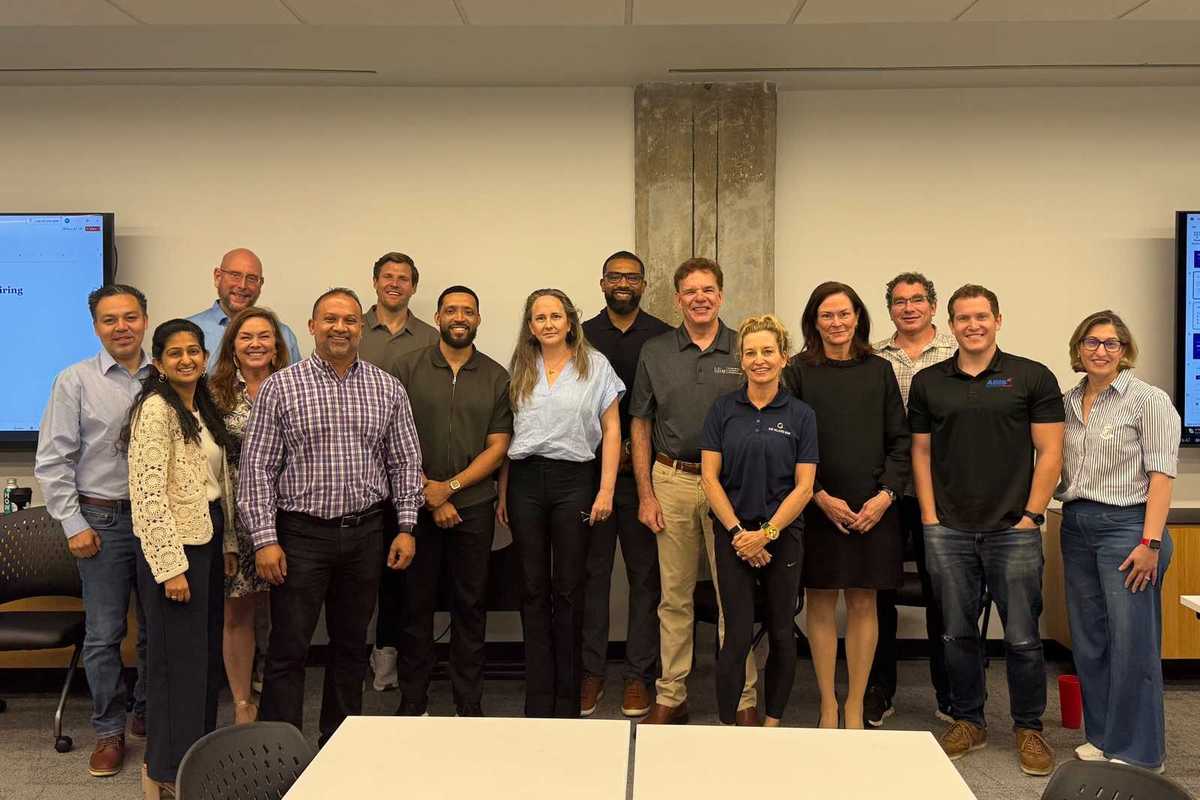
EO Houston/Facebook

Scaling a business from early traction into true growth is one of the most exciting — and punishing — chapters of entrepreneurship. Houston founders know this better than most. Our city is built on ambition: fast-moving industries, talent from around the world, and opportunities that expand as large as the Texas sky.

But as many entrepreneurs eventually learn, scaling isn’t simply “more of what worked.” It requires new systems, new thinking, and often, a new version of the founder. Even the most capable founders eventually face decisions, pressures, and turning points that only other entrepreneurs can truly understand.

Entrepreneurs’ Organization, a global peer-to-peer network of more than 18,000 business owners across 220 chapters in 75+ countries, exists for exactly this stage. One of the largest chapters in the organization, EO Houston brings that global community to life locally, offering founders the connection, learning, and accountability needed to grow sustainably and to grow up as leaders.

A community where founders learn at the highest level
The real value of EO emerges in the lived experiences of other entrepreneurs. When Houston-area founders talk about the moments growth nearly broke their companies, a universal theme appears: you can’t do it alone.

EO Houston member Robert De Los Santos of Sky High Party Rentals learned this the hard way when rapid post-COVID growth made expansion feel limitless — until it wasn’t.

“After COVID, we doubled every year and assumed inventory was the limit. In 2023 we overbought, only to realize demand had peaked. That taught us a hard truth: growth in one city has ceilings. Expanding into Austin and Dallas — the Texas Triangle — gave us new markets to put our inventory to work while we figured out how to penetrate Houston better. The challenge shifted from a strategy of ‘buy more units for demand’ to learning how to tackle the challenges of ‘leading across cities.’”

Founders often enter EO exhausted from trying to maintain control as things grow more complex. Many discover, like Jarred King of Summit Firms, that scaling requires the difficult shift from doing everything to building the team that can.

“We grew quickly because of my network, relationships, and hustle… but I was doing all the work,” King says. “I realized at that point you have to delegate — not just busy work, but important decisions to your key team, as well as set up really effective SOPs.”

“The uncomfortable truth is that you are no longer the best person for most jobs in your company," agrees Darren Randle of Houston Tents & Events. "Your inability to delegate or hire people smarter than you in key leadership and management level roles will become the single biggest drag on the entire business. You have to accept that your original 'hustle' is now a scalability risk."

Making hard decisions, such as walking away from customers or contracts, can feel like less of a sting when you know others have also been faced with tough choices. Aaron Gillaspie of West U's My Salon Suite recalls, “You can’t be everything to everyone, it’s ok to say no, and just understand some customers aren’t the right fit. It’s a two way street and both must win.”

Perspective is perhaps the most important reality check that members find at EO.

“Bigger volume will not make problems go away — you just got to get used to walking the tightrope," says Roger Pombrol of Emerald Standard. "Develop a system for good balance and do not freak out. Scared is no way to live your life. It’s ok if you fall. Your family will still love you. Money is just money. Love is love. The world tries to make you conflate them, but don’t."

Actionable insights from entrepreneurs who’ve already scaled
Conversations like these are happening every month inside EO Forum Meeting. Each EO chapter is divided into several small Forums. These confidential, committed group of 7–10 entrepreneurs who meet to share the real five percent of what they’re experiencing. It’s not advice, but experience — shared candidly, respectfully, and with the kind of vulnerability that leads to breakthroughs.

What makes Forum so impactful is the honesty it draws out. Entrepreneurs are often surrounded by employees, partners, and even family members who rely on them for answers, but seldom do they have a group where vulnerability is not only welcomed, but expected.

Learning experiences that match your ambition
EO supports that growth far beyond peer groups. Through the organization’s global partnerships with institutions like Harvard, Oxford, and INSEAD, Houston members gain access to executive-level learning experiences designed specifically for entrepreneurs.

These programs help founders step out of the day-to-day and think strategically about competitive advantage, innovation, and organizational leadership. Paired with ongoing learning through EO Jumpstart, Nano Learning, and its global library of member-created content, founders stay informed, challenged, and ahead of emerging trends.

And through global communities — ranging from EO Women and EO Under 35 to industry-specific groups — Houston members tap into expertise that spans continents and sectors. Whether someone is navigating M&A, exploring international expansion, or integrating new technologies, the right perspectives are always within reach.

What truly distinguishes EO Houston, however, is its culture. Houston’s entrepreneurial landscape is uniquely diverse and resilient, filled with founders who are hungry to build, innovate, and elevate the city’s business community. EO Houston amplifies that spirit, creating relationships that are as supportive as they are strategic. Many members describe the chapter not simply as a network, but as a catalyst for becoming better leaders, better thinkers, and — just as importantly — better human beings.

Your next level starts here
For entrepreneurs who are ready to scale—beyond their first million, beyond their current comfort zone, and toward a future that requires sharper leadership and stronger community—EO Houston offers an unmatched platform. It is a place where ambitious founders grow faster, think bigger, and gain the confidence to take bold next steps.

If you’re ready to elevate your business and your leadership alongside people who understand the journey, EO Houston is ready to welcome you. Your next level starts with the peers who can help you reach it. Learn more and become a member here.

Ad Placement 300x100
Ad Placement 300x600

CultureMap Emails are Awesome

​Planned UT Austin med center, anchored by MD Anderson, gets $100M gift​

med funding

The University of Texas at Austin’s planned multibillion-dollar medical center, which will include a hospital run by Houston’s University of Texas MD Anderson Cancer Center, just received a $100 million boost from a billionaire husband-and-wife duo.

Tench Coxe, a former venture capitalist who’s a major shareholder in chipmaking giant Nvidia, and Simone Coxe, co-founder and former CEO of the Blanc & Otus PR firm, contributed the $100 million—one of the largest gifts in UT history. The Coxes live in Austin.

“Great medical care changes lives,” says Simone Coxe, “and we want more people to have access to it.”

The University of Texas System announced the medical center project in 2023 and cited an estimated price tag of $2.5 billion. UT initially said the medical center would be built on the site of the Frank Erwin Center, a sports and entertainment venue on the UT Austin campus that was demolished in 2024. The 20-acre site, north of downtown and the state Capitol, is near Dell Seton Medical Center, UT Dell Medical School and UT Health Austin.

Now, UT officials are considering a bigger, still-unidentified site near the Domain mixed-use district in North Austin, although they haven’t ruled out the Erwin Center site. The Domain development is near St. David’s North Medical Center.

As originally planned, the medical center would house a cancer center built and operated by MD Anderson and a specialty hospital built and operated by UT Austin. Construction on the two hospitals is scheduled to start this year and be completed in 2030. According to a 2025 bid notice for contractors, each hospital is expected to encompass about 1.5 million square feet, meaning the medical center would span about 3 million square feet.

Features of the MD Anderson hospital will include:

  • Inpatient care
  • Outpatient clinics
  • Surgery suites
  • Radiation, chemotherapy, cell, and proton treatments
  • Diagnostic imaging
  • Clinical drug trials

UT says the new medical center will fuse the university’s academic and research capabilities with the medical and research capabilities of MD Anderson and Dell Medical School.

UT officials say priorities for spending the Coxes’ gift include:

  • Recruiting world-class medical professionals and scientists
  • Supporting construction
  • Investing in technology
  • Expanding community programs that promote healthy living and access to care

Tench says the opportunity to contribute to building an institution from the ground up helped prompt the donation. He and others say that thanks to MD Anderson’s participation, the medical center will bring world-renowned cancer care to the Austin area.

“We have a close friend who had to travel to Houston for care she should have been able to get here at home. … Supporting the vision for the UT medical center is exactly the opportunity Austin needed,” he says.

The rate of patients who leave the Austin area to seek care for serious medical issues runs as high as 25 percent, according to UT.

New Rice Brain Institute partners with TMC to award inaugural grants

brain trust

The recently founded Rice Brain Institute has named the first four projects to receive research awards through the Rice and TMC Neuro Collaboration Seed Grant Program.

The new grant program brings together Rice faculty with clinicians and scientists at The University of Texas Medical Branch, Baylor College of Medicine, UTHealth Houston and The University of Texas MD Anderson Cancer Center. The program will support pilot projects that address neurological disease, mental health and brain injury.

The first round of awards was selected from a competitive pool of 40 proposals, and will support projects that reflect Rice Brain Institute’s research agenda.

“These awards are meant to help teams test bold ideas and build the collaborations needed to sustain long-term research programs in brain health,” Behnaam Aazhang, Rice Brain Institute director and co-director of the Rice Neuroengineering Initiative, said in a news release.

The seed funding has been awarded to the following principal investigators:

  • Kevin McHugh, associate professor of bioengineering and chemistry at Rice, and Peter Kan, professor and chair of neurosurgery at the UTMB. McHugh and Kan are developing an injectable material designed to seal off fragile, abnormal blood vessels that can cause life-threatening bleeding in the brain.
  • Jerzy Szablowski, assistant professor of bioengineering at Rice, and Jochen Meyer, assistant professor of neurology at Baylor. Szablowski and Meyer are leading a nonsurgical, ultrasound approach to deliver gene-based therapies to deep brain regions involved in seizures to control epilepsy without implanted electrodes or invasive procedures.
  • Juliane Sempionatto, assistant professor of electrical and computer engineering at Rice, and Aaron Gusdon, associate professor of neurosurgery at UTHealth Houston. Sempionatto and Gusdon are leading efforts to create a blood test that can identify patients at high risk for delayed brain injury following aneurysm-related hemorrhage, which could lead to earlier intervention and improved outcomes.
  • Christina Tringides, assistant professor of materials science and nanoengineering at Rice, and Sujit Prabhu, professor of neurosurgery at MD Anderson, who are working to reduce the risk of long-term speech and language impairment during brain tumor removal by combining advanced brain recordings, imaging and noninvasive stimulation.

The grants were facilitated by Rice’s Educational and Research Initiatives for Collaborative Health (ENRICH) Office. Rice says that the unique split-funding model of these grants could help structure future collaborations between the university and the TMC.

The Rice Brain Institute launched this fall and aims to use engineering, natural sciences and social sciences to research the brain and reduce the burden of neurodegenerative, neurodevelopmental and mental health disorders. Last month, the university's Shepherd School of Music also launched the Music, Mind and Body Lab, an interdisciplinary hub that brings artists and scientists together to study the "intersection of the arts, neuroscience and the medical humanities." Read more here.

Your data center is either closer than you think or much farther away

houston voices

A new study shows why some facilities cluster in cities for speed and access, while others move to rural regions in search of scale and lower costs. Based on research by Tommy Pan Fang (Rice Business) and Shane Greenstein (Harvard).

Key findings:

  • Third-party colocation centers are physical facilities in close proximity to firms that use them, while cloud providers operate large data centers from a distance and sell access to virtualized computing resources as on‑demand services over the internet.
  • Hospitals and financial firms often require urban third-party centers for low latency and regulatory compliance, while batch processing and many AI workloads can operate more efficiently from lower-cost cloud hubs.
  • For policymakers trying to attract data centers, access to reliable power, water and high-capacity internet matter more than tax incentives.

Recent outages and the surge in AI-driven computing have made data center siting decisions more consequential than ever, especially as energy and water constraints tighten. Communities invest public dollars on the promise of jobs and growth, while firms weigh long-term commitments to land, power and connectivity.

Against that backdrop, a critical question comes into focus: Where do data centers get built — and what actually drives those decisions?

A new study by Tommy Pan Fang (Rice Business) and Shane Greenstein (Harvard Business School) provides the first large-scale statistical analysis of data center location strategies across the United States. It offers policymakers and firms a clearer starting point for understanding how different types of data centers respond to economic and strategic incentives.

Forthcoming in the journal Strategy Science, the study examines two major types of infrastructure: third-party colocation centers that lease server space to multiple firms, and hyperscale cloud centers owned by providers like Amazon, Google and Microsoft.

Two Models, Two Location Strategies

The study draws on pre-pandemic data from 2018 and 2019, a period of relative geographic stability in supply and demand. This window gives researchers a clean baseline before remote work, AI demand and new infrastructure pressures began reshaping internet traffic patterns.

The findings show that data centers follow a bifurcated geography. Third-party centers cluster in dense urban markets, where buyers prioritize proximity to customers despite higher land and operating costs. Cloud providers, by contrast, concentrate massive sites in a small number of lower-density regions, where electricity, land and construction are cheaper and economies of scale are easier to achieve.

Third-party data centers, in other words, follow demand. They locate in urban markets where firms in finance, healthcare and IT value low latency, secure storage, and compliance with regulatory standards.

Using county-level data, the researchers modeled how population density, industry mix and operating costs predict where new centers enter. Every U.S. metro with more than 700,000 residents had at least one third-party provider, while many mid-sized cities had none.

ImageThis pattern challenges common assumptions. Third-party facilities are more distributed across urban America than prevailing narratives suggest.

Customer proximity matters because some sectors cannot absorb delay. In critical operations, even slight pauses can have real consequences. For hospital systems, lag can affect performance and risk exposure. And in high-frequency trading, milliseconds can determine whether value is captured or lost in a transaction.

“For industries where speed is everything, being too far from the physical infrastructure can meaningfully affect performance and risk,” Pan Fang says. “Proximity isn’t optional for sectors that can’t absorb delay.”

The Economics of Distance

For cloud providers, the picture looks very different. Their decisions follow a logic shaped primarily by cost and scale. Because cloud services can be delivered from afar, firms tend to build enormous sites in low-density regions where power is cheap and land is abundant.

These facilities can draw hundreds of megawatts of electricity and operate with far fewer employees than urban centers. “The cloud can serve almost anywhere,” Pan Fang says, “so location is a question of cost before geography.”

The study finds that cloud infrastructure clusters around network backbones and energy economics, not talent pools. Well-known hubs like Ashburn, Virginia — often called “Data Center Alley” — reflect this logic, having benefited from early network infrastructure that made them natural convergence points for digital traffic.

Local governments often try to lure data centers with tax incentives, betting they will create high-tech jobs. But the study suggests other factors matter more to cloud providers, including construction costs, network connectivity and access to reliable, affordable electricity.

When cloud centers need a local presence, distance can sometimes become a constraint. Providers often address this by working alongside third-party operators. “Third-party centers can complement cloud firms when they need a foothold closer to customers,” Pan Fang says.

That hybrid pattern — massive regional hubs complementing strategic colocation — may define the next phase of data center growth.

Looking ahead, shifts in remote work, climate resilience, energy prices and AI-driven computing may reshape where new facilities go. Some workloads may move closer to users, while others may consolidate into large rural hubs. Emerging data-sovereignty rules could also redirect investment beyond the United States.

“The cloud feels weightless,” Pan Fang says, “but it rests on real choices about land, power and proximity.”

---

This article originally appeared on Rice Business Wisdom. Written by Scott Pett.

Pan Fang and Greenstein (2025). “Where the Cloud Rests: The Economic Geography of Data Centers,” forthcoming in Strategy Science.