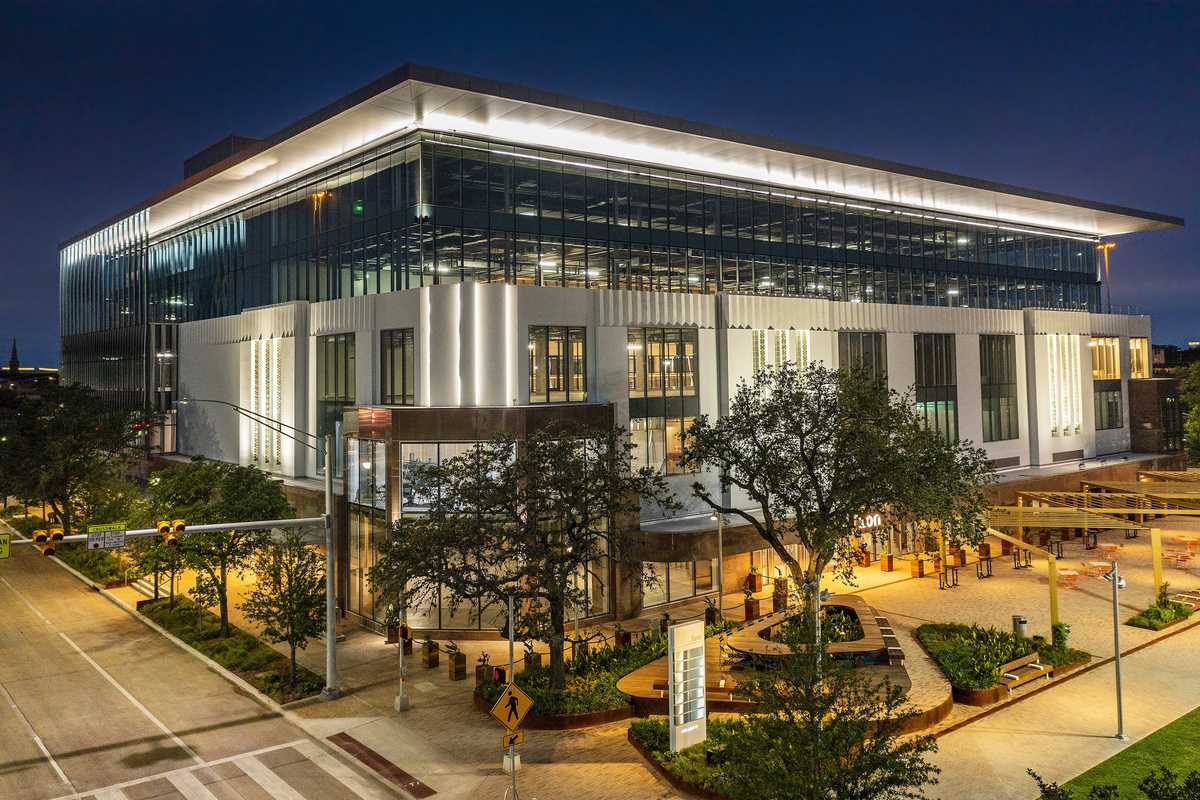
Motif Neurotech is developing minimally invasive bioelectronics to treat psychiatric conditions. Photo via motifneuro.tech

Houston-based Motif Neurotech has received FDA approval to move forward with its first clinical trial for its innovative way to fight treatment-resistant depression and other mental health disorders.

The company has developed a brain-computer interface technology based on research from Rice University. The blueberry-sized, wirelessly powered implantable device known as the Digitally-programmable Over-brain Therapeutic (DOT) stimulator delivers electrical stimulation to brain circuits linked to depression. The DOT stimulator sits in the skull above the dura without touching the brain and is considered an alternative to transcranial magnetic stimulation, which requires multiple treatment sessions and can cause headaches.

“The goal for this technology is that it would be the mental health equivalent of a continuous glucose monitor for diabetes,” Jacob Robinson, a Rice University professor of electrical computer engineering and bioengineering and CEO of Motif Neurotech, said in a news release. “What has been really special for me personally on this journey is to be able to work all the way from a concept through the process of research and development funded by the federal government at Rice, and take that into a product that is going to affect people’s lives for the better.”

Eligible adults whose depression has not improved after trying multiple therapies can take part in the study. The clinical trial will be conducted in collaboration with Baylor College of Medicine, Brain Health Consultants (Houston), UT Health Houston, Massachusetts General Brigham, Emory Healthcare, University of Iowa, University of Utah Health and New York University, according to Rice.

Motif also announced that it was one of the first teams selected for ARPA-H’s EVIDENT initiative, which recently awarded up to $139.4 million to spur new, effective therapies for behavioral health. Through the initiative, Motif will collect additional data alongside its clinical trial.

“The idea with this funding is to support a number of teams who have rapid-acting interventions for a mental health condition and to collect additional data to help determine with greater precision whether a treatment is working, how it is working and which patients are benefitting most from which course of treatment,” Robinson added in the release.

Motif Neurotech was spun out of Robinson’s and Professor Kaiyuan Yang’s labs at Rice, along with collaborators and co-founders Dr. Sameer Sheth at Baylor College of Medicine and Dr. Sunil Sheth at the University of Texas Health Science Center at Houston. It was founded through the Rice Biotech Launch Pad. The company closed its Series A round with an oversubscribed $18.75 million last year.

Ad Placement 300x100
Ad Placement 300x600

CultureMap Emails are Awesome

Houston scientist wins prestigious Pew Scholar award for brain cancer research

standout scholar

Christina Tringides, an assistant professor of materials science and nanoengineering at Rice University, is one of 21 scientists to win a prestigious Pew Biomedical Scholar award.

She is the first faculty member from Rice to win the distinction, which provides $300,000 over four years for advances in biomedicine, according to the university. The awards are granted to researchers who are in the first few years at the assistant professor level.

In Tringides’ case, the funding will support her innovative new method of modeling glioblastoma, a common and extremely aggressive form of brain cancer. Thanks to producing its own blood supply, glioblastoma spreads quickly, weaving tendrils of blighted tissue throughout the brain. Because of this, surgery is difficult and conventional therapies ineffective.

Understanding the way glioblastoma spreads is crucial to the search for a cure. Tringides is using hydrogels that mimic the brain’s extracellular matrix. Using cultures and a microscopic labyrinth, her team can see how the cancer spreads, bonds with neurons and changes cell wall activity. Essentially, Tringides has devised an intelligence test for tumors in hopes of learning how to outsmart them.

“As cancer crawls through the maze, we can look at how it is interacting with the neurons more and more, and measure how electrical activity is changing as a result,” she said in a news release from Rice.

Examining how cancer cells grow can reveal which conditional changes slow them down. Finding ways to alter the structure of brain matter in a way that makes it inhospitable to the cancer could lead to therapies that would impede growth or even reverse it. Using her custom-made ersatz brain maze makes it easier to observe changes than it would be in a patient’s brain.

“Imaging synapses is time-intensive ⎯ it can involve large data files that are hard to visualize, but if we know that the only place where we might have a synapse is this tiny 1-by-4-by-10 micron channel, it makes it much faster and reliable to image them,” Tringides said.

Born in Ames, Iowa, Tringides received her doctorate in biophysics from Harvard before joining Rice in 2024 through a Cancer Prevention and Research Institute of Texas (CPRIT) recruitment award.

Her research was also one of the first four projects to receive research awards through the Rice Brain Institute and TMC Neuro Collaboration Seed Grant Program.

Texas residents earn 11th highest income in U.S., says 2026 study

Money Matters

A new WalletHub study comparing income disparities across America has ranked Texas residents No. 11 on the list of states with the highest earning residents in the nation.

The report, "States Where People Have the Highest Income (2026)," analyzed U.S. Census Bureau income data in all 50 states and the District of Columbia. The report evaluated the average annual income of the top five percent, the median annual household income, and the average annual income of the bottom 20 percent of residents in every state, all adjusted for the cost of living.

The report's data revealed the top five percent of Texans, the highest earners, make $520,378 on average yearly after adjusting for the cost of living. That's the seventh-highest income among the top five percent of earners nationwide.

Meanwhile, the median annual income of a Texas household is just under $76,000. The bottom 20 percent of Texas residents make $17,651 a year, the report found.

For additional context, the latest data from the Federal Reserve shows an American household's median yearly income is about $83,700. WalletHub analyst Chip Lupo also found that the highest earning 10 percent of individuals in the U.S. earn over 12 times more than those in the lowest-earning 10 percent, based on the latest Census data.

"By measuring the income of various percentiles against a state's median income, we can better identify where income disparities are more prevalent, which could help us better understand why residents of certain states struggle more to make ends meet," said Lupo.

Virginia is the state where residents earn the highest income in the U.S., WalletHub said. Based on the report's findings, the top five percent of Virginians make $545,097 on average per year after adjusting for the cost of living. The median annual income of a Virginia household comes out to $95,339, and the bottom 20 percent of residents make $19,671 annually on average.

Conversely, West Virginia is the state where people have the lowest income in the U.S. A West Virginia household makes a median annual income of $56,610, the third-lowest nationally, and the bottom 20 percent of residents make $13,260 on average per year, which is the fifth-lowest in the nation. The top five percent of West Virginians make $372,218 on average per year.

The top 10 states where residents have the highest income are:

  • No. 1 – Virginia
  • No. 2 – New York
  • No. 3 – New Jersey
  • No. 4 – Washington
  • No. 5 – Connecticut
  • No. 6 – Utah
  • No. 7 – Colorado
  • No. 8 – Minnesota
  • No. 9 – Illinois
  • No. 10 – Massachusetts

---

This article originally appeared on CultureMap.com.

23 Houston companies rank among America’s most future-ready businesses

future focused

By one measure, Spring-based tech giant Hewlett Packard Enterprises reigns as the most future-ready Houston-area company on the S&P 500 stock index.

HPE sits at No. 72 in a first-time ranking of the best S&P 500 companies for the future. Including HPE, 23 Houston-area companies appear on the list.

Published by The Wall Street Journal, the ranking was created by Bendable Labs for the WSJ Leadership Institute. It evaluates how S&P 500 companies stack up in six areas: AI readiness, innovation, talent readiness, financial fitness, resilience and agility. To be ranked, a company had to be part of the S&P 500 as of Dec. 31.

Among the six categories, HPE ranked highest for innovation (No. 30) among local companies. The WSJ didn’t say why HPE scored so well for innovation. However, the company stands out in this category thanks to:

  • Creation of the El Capitan and Frontier supercomputing systems
  • Research into photonic computing and quantum networking
  • Last year’s $14 billion acquisition of Juniper Networks, giving HPE an edge in AI-native networking
  • Establishment of the everything-as-a-service GreenLake hybrid cloud platform for data centers, colocation facilities and edge computing environments

In an interview with the Six Five podcast at HPE Discover 2025 in Las Vegas, CEO Antonio Neri said the company’s strategy is “basically founded on innovation, and that innovation drives shareholder value over the long term.”

While HPE fared well in the innovation category, it ranked toward the bottom for financial fitness. What’s behind the No. 430 ranking in the financial category? HPE’s low score likely reflects a debt-heavy acquisition strategy coupled with a historically low-margin hardware business.

Here’s the full list of the 23 Houston-area companies included in the ranking of the best companies for the future:

  • No. 72 Hewlett Packard Enterprise
  • No. 105 SLB
  • No. 120 Baker Hughes
  • No. 125 ConocoPhillips
  • No. 158 NRG Energy
  • No. 176 Targa Resources
  • No. 185 Chevron
  • No. 195 Halliburton
  • No. 223 Coterra Energy
  • No. 229 Waste Management
  • No. 235 Exxon Mobil
  • No. 250 Kinder Morgan
  • No. 257 Quanta Services
  • No. 276 CenterPoint Energy
  • No. 285 Sysco
  • No. 313 Occidental Petroleum
  • No. 318 Camden Property Trust
  • No. 333 EOG Resources
  • No. 365 LyondellBasell Industries
  • No. 373 Comfort Systems USA
  • No. 401 Crown Castle
  • No. 408 Phillips 66
  • No. 500 APA