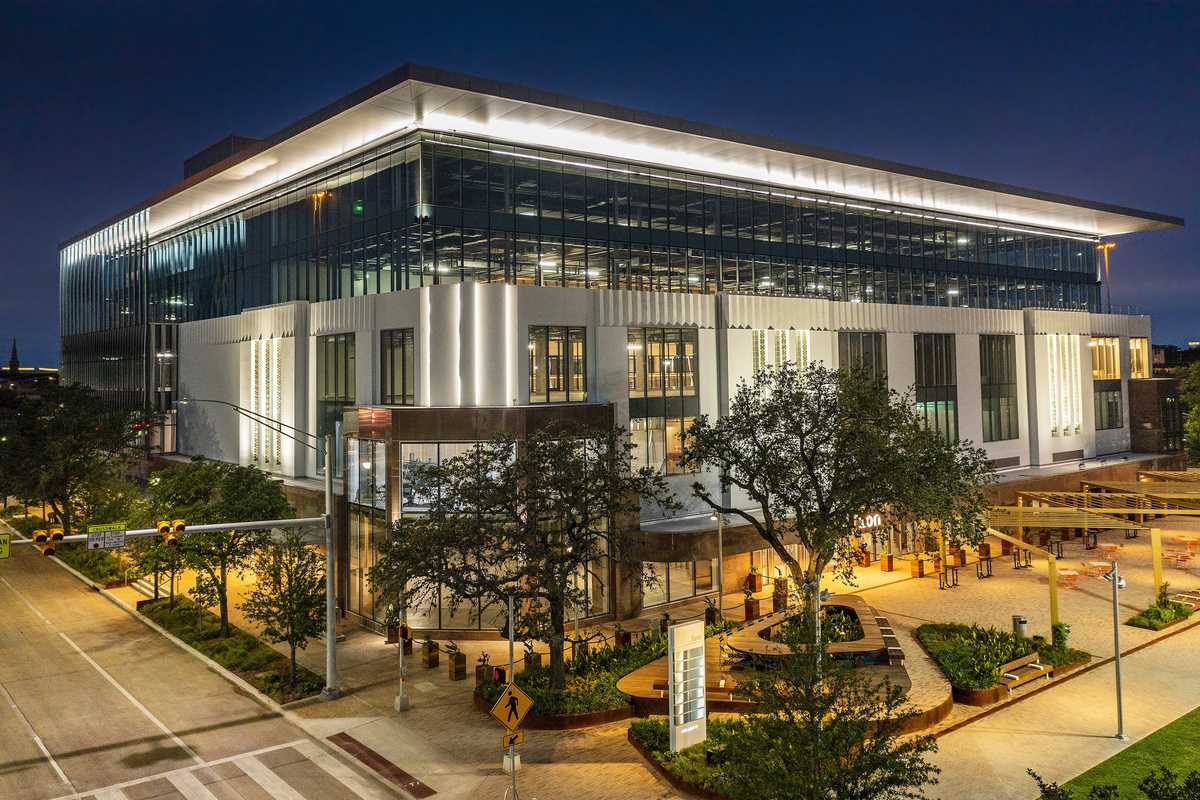
The Texas Brain Economy Summit will be June 9-10 at Helix Park. Photo via braincapitalhtx.com.

The Center for Houston’s Future and UTMB are bringing the Texas Brain Economy Summit back to Houston this summer to continue to position the region as a global leader in brain health.

The summit, held June 9-10 at the Texas Medical Center's Helix Park, will bring together more than 500 executives, researchers, policymakers and innovators from around the world to discuss the global brain economy.

Attendees can expect to hear from leaders of global institutions, including the World Economic Forum, U.S. Chamber of Commerce, McKinsey Health Institute, Global Brain Economy Initiative, Davos Alzheimer’s Collaborative, Business Collaborative for Brain Health (UsAgainstAlzheimer’s), Rice University, Memorial Hermann, MD Anderson and many others.

Day 1 of the conference will focus on "Enabling Human Flourishing & Economic Growth." Day 2 will focus on "Scaling Innovation & AI Solutions in the Brain Economy."

Keynotes will be delivered by:

  • Lexi Branson, vice president of health policy at the U.S. Chamber of Commerce
  • Kana Enomoto, director of the McKinsey Health Institute
  • Megan Henshall, founder of Google Experience Institute (Xi)
  • Ryan Howard, co-lead of Google Experience Institute (Xi)
  • Dr. Hani Jneid, John Sealy Distinguished Centennial Chair in Cardiology and vice president of cardiovascular operations at UTMB
  • Steve Kean, president and CEO of the Greater Houston Partnership
  • Dan Patrick, Lieutenant Governor of Texas
  • Jochen Reiser, president of UTMB
  • Thomas Seitz, senior partner of the McKinsey Health Institute

Other significant speakers include:

  • Rym Ayadi, founder and president of the Euro-Mediterranean Economists Association (EMEA) and co-founder of the Brain Capital Alliance
  • Arthur Evans, CEO and executive vice president of the American Psychological Association
  • David Gow, president and CEO of the Center for Houston’s Future (Gow is the founder and chairman of Gow Media, InnovationMap's parent company)
  • Bill McKeon, president and CEO of the Texas Medical Center
  • Jeff Merritt, head of urban transformation at the World Economic Forum
  • Joanne Pike, president and CEO of the Alzheimer’s Association
  • George Vradenburg, founding chairman of Davos Alzheimer’s Collaborative and co-founder, chairman and CEO of Us Against Alzheimer’s

The event is supported through Project Metis, which was launched by the Center for Houston’s Future last year. Led by Rice Brain Institute, The University of Texas Medical Branch's Moody Brain Health Institute and Memorial Hermann’s comprehensive neurology care department, the initiative to advance the understanding, prevention and treatment of the brain. It was developed on the heels of Texas voters overwhelmingly approving a ballot measure to launch the $3 billion, state-funded Dementia Prevention and Research Institute of Texas (DPRIT).

“Texas voters, by approving the state-funded Dementia Prevention Institute, have shown a strong commitment to brain health, as scientific advances continue daily. [Project Metis] aims to harness the Houston region’s unique strengths: its concentration of leading medical and academic institutions, a vibrant innovation ecosystem, and a history of entrepreneurial leadership in health and life sciences,” Gow said at the time.

Learn more about The Texas Brain Economy Summit and purchase tickets here.

Ad Placement 300x100
Ad Placement 300x600

CultureMap Emails are Awesome

Texas solar power poised to surpass coal for the first time in 2026

Powering Texas

Solar power promises to shine even brighter in Texas this year.

A new forecast from the U.S. Energy Information Administration (EIA) indicates that for the first time, annual power generation from utility-scale solar will surpass annual power generation from coal across the territory covered by the Electric Reliability Council of Texas (ERCOT).

Solar generation is expected to reach 78 billion kilowatt-hours in 2026 in the ERCOT grid, compared with 60 billion kilowatt-hours for coal, the EIA forecast says. The ERCOT grid supplies power to about 90 percent of Texas, including the Houston area.

“Utility-scale solar generation has been increasing steadily in ERCOT as solar capacity additions help meet rapid electricity demand growth,” the forecast says.

Although natural gas remains the dominant source of electricity generation in ERCOT, accounting for an average 44 percent of electricity generation from 2021 to 2025, solar’s share of the generation mix rose from four percent to 12 percent. During the same period, coal’s share dropped from 19 percent to 13 percent.

EIA predicts about 40 percent of U.S. solar capacity, or 14 billion kilowatt-hours, added in 2026 will come from Texas.

Although EIA expects annual solar generation to exceed annual coal generation in 2026, solar surpassed coal in ERCOT on a monthly basis for the first time in March 2025, when solar generation totaled 4.33 billion kilowatt-hours and coal’s totaled 4.16 billion kilowatt-hours. Solar generation continued to exceed that of coal until August of that year.

“In 2026, we estimate that solar exceeded coal for the first time in March, and we forecast generation from solar installations in ERCOT will continue to exceed that from coal until December, when coal generation exceeds solar,” says EIA. “We expect solar generation to exceed that of coal for every month in 2027 except January and December.”

For 2027, EIA forecasts annual solar generation of 99 billion kilowatt-hours in the ERCOT grid, compared with 66 billion kilowatt-hours of annual coal generation.

In April, ERCOT projected almost 368 billion kilowatt-hours of demand in ERCOT’s territory by 2032. ERCOT’s all-time peak demand hit 85.5 billion kilowatt-hours in August 2023.

“Texas is experiencing exceptional growth and development, which is reshaping how large load demand is identified, verified, and incorporated into long-term planning,” ERCOT President and CEO Pablo Vegas said. “As a result of a changing landscape, we believe this forecast to be higher than expected … load growth.”

---

This article first appeared on EnergyCapitalHTX.com.

Intuitive Machines strikes $49.3M deal to expand lunar communications network

space deal

Houston-based Intuitive Machines is bulking up its space-to-ground data network with the acquisition of United Kingdom-based Goonhilly Earth Station and its U.S. arm, COMSAT.

The $49.3 million cash-and-stock deal would add 44 antennas to Intuitive Machines’ network. The acquisition is expected to close in the third quarter.

Intuitive Machines, a space infrastructure and services company, designs, builds, and operates spacecraft and data networks for lunar and deep-space missions. Goonhilly operates a satellite Earth station in Cornwall, England.

Intuitive Machines says Goonhilly’s and COMSAT’s civil, commercial, and government customers will complement its current customer base and broaden its reach into related sectors.

“Customers have been clear that they want a single, integrated, and resilient solution for their communications and [position, navigation, and timing] needs as they accelerate missions at an unprecedented pace,” Steve Altemus, co‑founder and CEO of Intuitive Machines, said in a news release.

Kenn Herskind, executive chairman of Goonhilly, says the acquisition “will allow us to scale that capability globally and directly support the next era of lunar exploration. Together, we will be creating a commercial lunar communications network that is interoperable, resilient, and ready to support Artemis and international missions.”

Modular nuclear reactor co. NuScale Power moves into Houston market

New to Hou

The nuclear energy renaissance continues in Texas with an announcement by NuScale Power. The Oregon-based provider of proprietary and innovative advanced small modular reactor (SMR) nuclear technology announced in April it would be opening office space in Houston’s CityCentre.

“Opening this space in Houston underscores our commitment to meeting rising energy demand with safe, scalable nuclear technology,” John Hopkins, NuScale president and CEO, said in a news release. “This move expands our presence in a key market for partners, prospective customers, and stakeholders in addition to positioning us for the future as we focus on the near-term deployment of our industry-leading technology. Texas is leading the way in embracing advanced nuclear for grid resilience and industrial decarbonization, and we’re proud to expand our footprint and capabilities in this important region.”

Interest in nuclear power has been growing in recent years thanks to tensions with oil-rich nations, concerns about man-made climate change from fossil fuels, and the rapidly increasing power needs of data centers. Both Dow and Texas A&M University have announced expanded nuclear power projects in the last year, with an eye of changing the face of Texas’s energy industry through smaller, safer fission reactors.

Enter NuScale, founded in 2007 from technology developed at the University of Oregon. Their modular SMR technology generates 77 megawatts and is one of the only small modular reactors (SMR) to receive design approval from the U.S. Nuclear Regulatory Commission (NRC). These advances have led to runaway success for NuScale, whose stock has risen by more than 1,670 percent since the start of 2024.

The new operations campus in CityCentre is expected to facilitate the movement, installation and coordination of NuScale technology into the various energy systems. Typically, SMRs are used for off-grid installations, desalination operations, mining facilities and similar areas that lack infrastructure. However, the modularity means that they can be easily deployed to a variety of areas.

It comes none too soon. ERCOT projects that Texas data centers alone will require 77,965 megawatts by 2030.

---

This article first appeared on EnergyCapitalHTX.com.