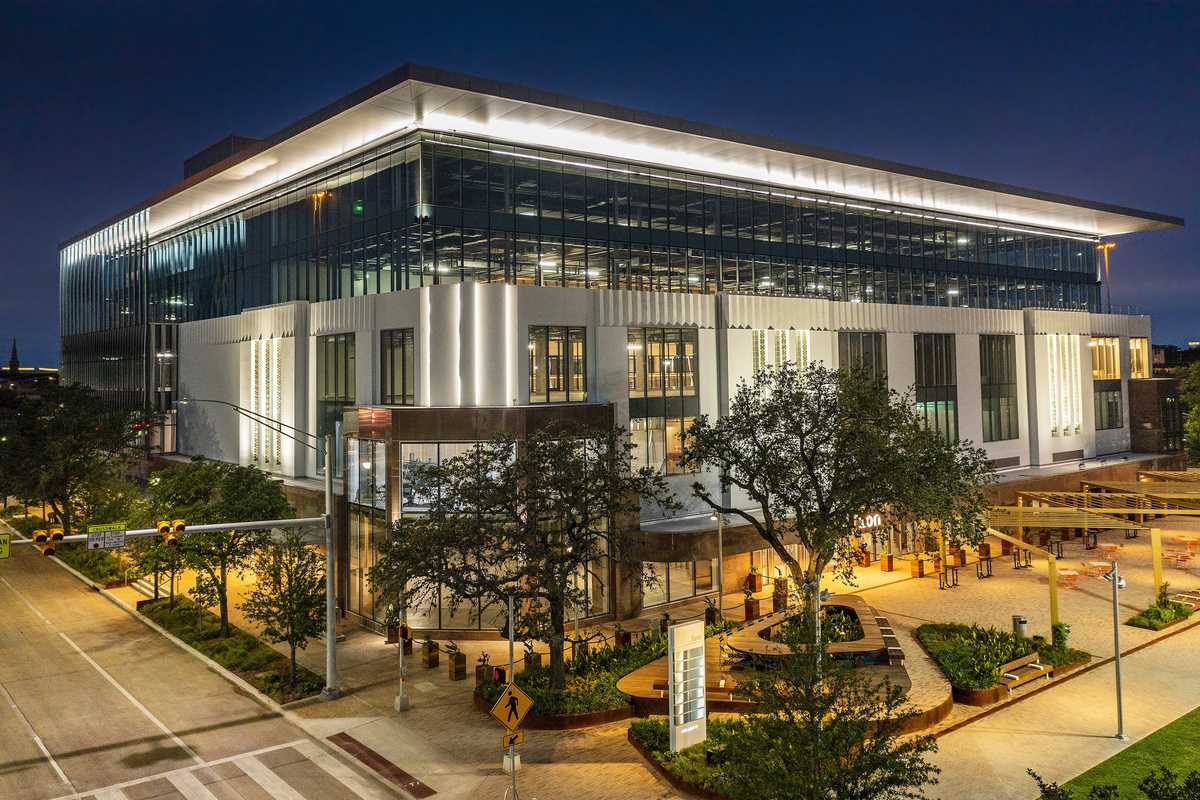
Houstonians are concerned about data centers' high energy demands and the area’s power grid reliability, according to a new report. Photo courtesy UH.

A new report out of the University of Houston shows that area residents remain wary of the long-term effects of operating data centers.

The recent survey from the University of Houston’s latest SPACE City Panel, conducted by the Center for Public Policy at the Hobby School of Public Affairs, shows that while 85 percent of Houston-area residents use AI, nearly 63 percent oppose the construction of AI data centers within 1 mile of their homes.

Respondents’ concerns centered around data centers’ high energy demand and the area’s power grid reliability. According to the survey, 32 percent of residents who oppose local data center projects would be more likely to support the centers if they relied on renewable energy over fossil fuels.

“Respondents understand that AI can bring economic and educational benefits, but they are also concerned about the physical infrastructure needed to fuel AI, especially data centers,” Soran Mohtadi, post-doctoral fellow at the Hobby School and a researcher on the report, said in a news release. “This physical infrastructure demands more electricity and water, leading to environmental impacts.”

Experts estimate that 6.5 gigawatts of data center capacity will be added to the Texas grid by 2030. And Houston’s data center capacity is predicted to more than double by 2028.

The Electric Reliability Council of Texas also projects electricity demand could reach 218 gigawatts by 2031, which would be more than double the record peak set in August 2023. Data centers are expected to account for 86 gigawatts of that new demand.

Survey respondents also said they are concerned about the state's future water supply, given the large amounts of water that data centers need to stay cool.

In terms of who’s responsible for that issue, 57.6 percent of respondents said they put the onus on Texas lawmakers, while 31.5 percent say tech companies should be responsible.

Additionally, more than 75 percent of respondents believed that data center developers and technology companies—not residents—should bear the cost of infrastructure upgrades to support data centers.

“Every decision legislators make has implications on residents’ everyday lives and local infrastructure now and in the future,” Maria P. Perez Arguelles, lead researcher on the report and research assistant professor at the Hobby School, added in the news release. “This issue is going to become more important in years to come, so this is just the beginning.”

Read the full report here.

Ad Placement 300x100
Ad Placement 300x600

CultureMap Emails are Awesome

Houston-born Cemvita makes breakthrough in sustainable fuel production

clean fuels

Houston-based biotech company Cemvita announced that it recently reached a critical milestone in the development of its FermOil product, which can be used to create Sustainable Aviation Fuel (SAF) and other renewable fuels at industrial scale.

The company shared in a news release that it completed a 75,000-liter industrial fermentation run at Belgium's Bio Base Europe Pilot Plant.

The campaign achieved target technical metrics for the production of FermOil, Cemvita’s renewable natural oil (RNO). FermOil is produced from industrial crude glycerin, an industrial byproduct, as opposed to traditional sugar-based feedstocks used in many bio-oil fermentation processes. It's designed to be a drop-in feedstock for creating SAFs.

Cemvita had previously advanced its FermOil production process through multiple scale-up stages before successfully reaching the 75,000-liter demonstration campaign, according to the company.

“This is not just a fermentation milestone,” Moji Karimi, CEO at Cemvita, said in the release. “It is a blueprint for how existing industrial infrastructure can evolve into circular bioeconomy infrastructure. Every biodiesel plant generating crude glycerin is a potential platform for renewable natural oil production.”

The milestone also supports the deployment of Cemvita’s industrial biomanufacturing platform, FermWorks, which integrates with existing energy and industrial infrastructure to turn waste carbon streams into SAFs and other materials. According to the release, Cemvita plans to move forward with commercial deployment discussions with partners in Brazil, Europe and in the UK. Cemvita already has a partnership with the Brazilian sustainable research institution REMA.

“We are proud to support innovative companies like Cemvita in scaling breakthrough industrial biotechnology solutions,” Hendrik Waegeman, head of business operations at Bio Base Europe Pilot Plant, added in the release. “Successfully operating at the 75,000-liter scale using a feedstock such as crude glycerin highlights both the maturity of the technology and the quality of the scale-up execution achieved by the Cemvita team.”

---

This article originally appeared on our sister site, EnergyCapitalHTX.com.

Eli Lilly scoops up Houston biotech startup in $300 million deal

big pharma deal

Pharmaceutical giant Eli Lilly has acquired Houston biotech startup CrossBridge Bio, which develops antibody-drug conjugates for cancer, in a deal worth up to $300 million. The deal was celebrated by TMC Venture Fund and the University of Texas Health Science Center at Houston last week.

CrossBridge, founded in 2023, is developing ADCs based on research by Kyoji Tsuchikama and Zhiqiang An, both of UT Health Houston. Tsuchikama is an associate professor of medicinal chemistry and a globally recognized ADC pioneer, and An is a professor of molecular science and vice president of drug discovery.

Antibody-drug conjugates (ADCs) are a potent combination of targeted therapy and chemotherapy that kills cancer cells while saving healthy tissue.

Clinical trials for CrossBridge’s primary ADC candidate, CBB-120, are expected to start this year, pending approval from the U.S. Food and Drug Administration (FDA).

“I’m proud of how well our team has executed and advanced our platform in such a short time since the company’s founding,” Michael Torres, co-founder and CEO of CrossBridge, said in a news release. “By becoming a part of Lilly, a leader in patient-focused therapeutic development, we are well-positioned to further accelerate the clinical potential of this approach.”

Under the Lilly deal, CrossBridge shareholders were expected to receive an upfront payment along with a follow-up payment based on the achievement of certain milestones.

In 2024, CrossBridge closed a $10 million seed round. Among the investors in CrossBridge are the Texas Medical Center Venture Fund, CE-Ventures, Alexandria Venture Investments, Portal Innovations, Linden Lake Labs, and the Cancer Prevention and Research Institute of Texas (CPRIT). It was formed in TMC Innovation’s Accelerator for Cancer Therapeutics program."Built within the TMC ecosystem, CrossBridge Bio grew with the support, funding, and resources that helped shape its trajectory. TMC led the company's early financing and watched it evolve from its earliest days to its acquisition by Eli Lilly," William McKeon, president and CEO of the Texas Medical Center, shared in a LinkedIn post. "[This is a] strong reminder that breakthrough science and the right early backing can change what’s possible."

7 Houston neighbors named to U.S. News' best places to live in 2026

Living Well

Several Houston suburbs have been crowned the best places to live in the U.S. for 2026, according to U.S. News & World Report. Sugar Land is the highest-ranked city in the Houston metro, and it ranks as the 10th best place to live in the country.

The annual list of Best Places to Live in the U.S. is designed to help readers make the most informed decisions when choosing where to settle down, using data from sources such as the U.S. Census Bureau, Department of Commerce, the Federal Reserve and the Bureau for Economic Analysis, as well as state and local sources.

For the 2026-2027 rankings, U.S. News featured 250 U.S. cities and ranked them across four livability indexes — quality of life, value, desirability, and job market — weighted by importance based on survey results of approximately 500 Americans. The rankings were also broken down state-by-state, as well as the best big, medium, and small cities overall.

Sugar Land is the No. 4 best places to live in Texas, and it soared into the No. 10 spot overall in the nation after ranking 16th last year. Sugar Land also ranks as the fourth-best mid-sized city to live in America for 2026-2027.

According to U.S. News, Sugar Land's median household income is far higher than the national average. Residents make $140,511 per year, while the average American household income is only $83,181.

Additionally, the $431,815 median home value in Sugar Land is also far greater than the $359,870 national average.

After ranking in the top 10 in the 2025 report, League City and Pearland now both rank outside the national top 10 for 2026. League City slipped from No. 6 to No. 13 this year, while Pearland dropped from No. 3 nationwide to No. 16.

These three Houston suburbs also boast highly desirable job markets for potential newcomers or current residents that want to start or change their career.

Houston proper, however, remains outside of the top 250 and is the 327th best place to live in the U.S., and it's the 60th best place to live in Texas.

Other cities in the greater Houston area that ranked among the top 100 include:

  • No. 28 – The Woodlands
  • No. 38 – Katy
  • No. 61 – Missouri City
  • No. 82 – Spring

The Lone Star State had a "strong showing" in the overall top 10 thanks to its "high affordability scores," a release said. Besides Sugar Land, three more popular Texas suburbs made the cut: Leander (No. 8) outside Austin and Dallas-Fort Worth suburbs Flower Mound (No. 3) and Frisco (No. 9).

"As prices of everyday goods continue to rise, consumers are considering affordability as a top priority when choosing a place to live," said U.S. News consumer lending analyst Erika Giovanetti. "While U.S. News’ consumer survey indicated that quality of life and affordability were close in importance, cost-of-living concerns resulted in many Americans putting what they can afford above their aspirations."

---

This article originally appeared on CultureMap.com.