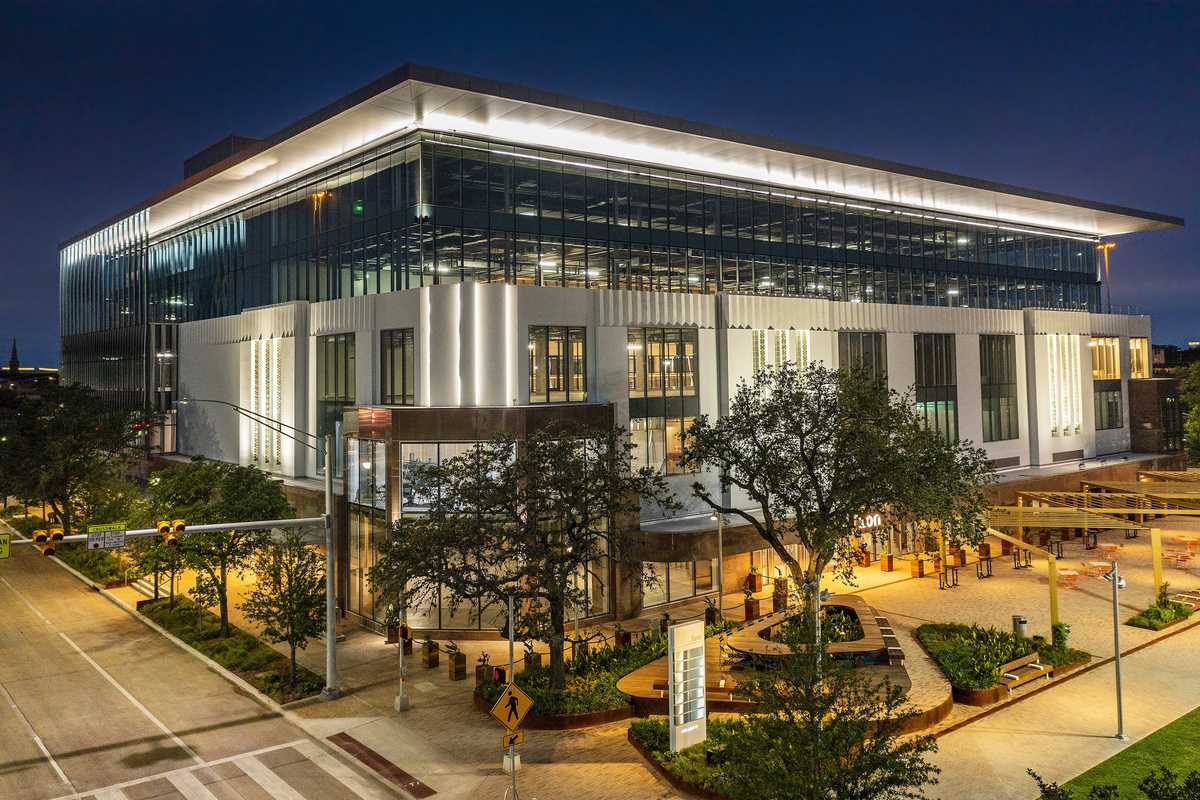
Cybersecurity is not just an IT issue, it's a matter of public safety and economic resilience. Getty images

Texas has always been a state that thinks in terms of scale. Big energy, big ambitions and now, big action in cybersecurity.

With the creation of the Texas Cyber Command under the Department of Information Resources, the state is recognizing what many of us in the industry have long understood: cybersecurity is not just an IT issue, it's a matter of public safety and economic resilience. Protecting municipal systems, schools, and critical energy infrastructure from cyber threats is no longer optional. It is essential.

For these efforts to succeed, Texas must invest as much in people as it does in technology. Without a capable, well-trained workforce to carry out the mission, even the strongest cyber strategies will struggle to hold the line.

The scope of the threat

Cyberattacks are not theoretical. In the last year alone, several cities in Texas experienced major ransomware attacks. One incident in Fort Worth took down core city systems, affecting everything from email access to permitting operations. The ripple effects were significant.

The energy sector is also under constant pressure. As a cornerstone of both the Texas and national economy, the it is a high-value target. Hackers are probing systems that manage oil, gas, and renewable energy infrastructure, looking for weaknesses that could be exploited to steal data or disrupt operations.

Texas has responded by centralizing its cyber incident response capabilities. The Texas Cyber Command is a smart step forward. It brings coordination and focus to an increasingly complex landscape. But its effectiveness will depend entirely on the professionals tasked with doing the work. And that’s where the challenge lies.

The workforce gap

Across the U.S., there are an estimated 400,000 unfilled cybersecurity positions. In Texas, more than 40,000 roles remain vacant, according to CyberSeek. These are not just numbers in a report. They represent a growing vulnerability with gaps in frontline defenses against real and persistent threats.

We cannot afford to rely solely on traditional pathways to fill this gap. Four-year degree programs are important, but they are not designed to scale fast enough or flexibly enough to meet today’s needs. Instead, we need to broaden our view of what a cybersecurity talent pipeline looks like and who it includes.

There needs to be an expanded focus on practical, skills-based training that takes high-aptitude individuals, including those from non-traditional backgrounds, and prepares them for success in cybersecurity careers through rigorous hands-on training that reflects the demands of real-world cyber roles. With the right structure and support, people from all walks of life are already proving they can become capable defenders of our digital infrastructure.

The same entrepreneurial spirit that drives innovation in other sectors can be applied to cybersecurity workforce development. We don’t have to wait years to grow the next generation of defenders. We can do it now, with the right focus and investment.

Texas has taken a critical first step by creating the Cyber Command, but if we want to build lasting resilience, we need to address the workforce bottleneck head-on. Cybersecurity needs more than tech…it needs talent.

---

Dean Gefen is theCEO, NukuDo, a San Antonio-based cybersecurity workforce development and staffing company.

Ad Placement 300x100
Ad Placement 300x600

CultureMap Emails are Awesome

Houston scientists develop breakthrough AI-driven process to design, decode genetic circuits

biotech breakthrough

Researchers at Rice University have developed an innovative process that uses artificial intelligence to better understand complex genetic circuits.

A study, published in the journal Nature, shows how the new technique, known as “Combining Long- and Short-range Sequencing to Investigate Genetic Complexity,” or CLASSIC, can generate and test millions of DNA designs at the same time, which, according to Rice.

The work was led by Rice’s Caleb Bashor, deputy director for the Rice Synthetic Biology Institute and member of the Ken Kennedy Institute. Bashor has been working with Kshitij Rai and Ronan O’Connell, co-first authors on the study, on the CLASSIC for over four years, according to a news release.

“Our work is the first demonstration that you can use AI for designing these circuits,” Bashor said in the release.

Genetic circuits program cells to perform specific functions. Finding the circuit that matches a desired function or performance "can be like looking for a needle in a haystack," Bashor explained. This work looked to find a solution to this long-standing challenge in synthetic biology.

First, the team developed a library of proof-of-concept genetic circuits. It then pooled the circuits and inserted them into human cells. Next, they used long-read and short-read DNA sequencing to create "a master map" that linked each circuit to how it performed.

The data was then used to train AI and machine learning models to analyze circuits and make accurate predictions for how untested circuits might perform.

“We end up with measurements for a lot of the possible designs but not all of them, and that is where building the (machine learning) model comes in,” O’Connell explained in the release. “We use the data to train a model that can understand this landscape and predict things we were not able to generate data on.”

Ultimately, the researchers believe the circuit characterization and AI-driven understanding can speed up synthetic biology, lead to faster development of biotechnology and potentially support more cell-based therapy breakthroughs by shedding new light on how gene circuits behave, according to Rice.

“We think AI/ML-driven design is the future of synthetic biology,” Bashor added in the release. “As we collect more data using CLASSIC, we can train more complex models to make predictions for how to design even more sophisticated and useful cellular biotechnology.”

The team at Rice also worked with Pankaj Mehta’s group in the department of physics at Boston University and Todd Treangen’s group in Rice’s computer science department. Research was supported by the National Institutes of Health, Office of Naval Research, the Robert J. Kleberg Jr. and Helen C. Kleberg Foundation, the American Heart Association, National Library of Medicine, the National Science Foundation, Rice’s Ken Kennedy Institute and the Rice Institute of Synthetic Biology.

James Collins, a biomedical engineer at MIT who helped establish synthetic biology as a field, added that CLASSIC is a new, defining milestone.

“Twenty-five years ago, those early circuits showed that we could program living cells, but they were built one at a time, each requiring months of tuning,” said Collins, who was one of the inventors of the toggle switch. “Bashor and colleagues have now delivered a transformative leap: CLASSIC brings high-throughput engineering to gene circuit design, allowing exploration of combinatorial spaces that were previously out of reach. Their platform doesn’t just accelerate the design-build-test-learn cycle; it redefines its scale, marking a new era of data-driven synthetic biology.”

Axiom Space wins NASA contract for fifth private mission, lands $350M in financing

ready for takeoff

Editor's note: This story has been updated to include information about Axiom's recent funding.

Axiom Space, a Houston-based space infrastructure company that’s developing the first commercial space station, has forged a deal with NASA to carry out the fifth civilian-staffed mission to the International Space Station.

Axiom Mission 5 is scheduled to launch in January 2027, at the earliest, from NASA’s Kennedy Space Center in Florida. The crew of non-government astronauts is expected to spend up to 14 days docked at the International Space Station (ISS). Various science and research activities will take place during the mission.

The crew for the upcoming mission hasn’t been announced. Previous Axiom missions were commanded by retired NASA astronauts Michael López-Alegría, the company’s chief astronaut, and Peggy Whitson, the company’s vice president of human spaceflight.

“All four previous [Axiom] missions have expanded the global community of space explorers, diversifying scientific investigations in microgravity, and providing significant insight that is benefiting the development of our next-generation space station, Axiom Station,” Jonathan Cirtain, president and CEO of Axiom, said in a news release.

As part of Axiom’s new contract with NASA, Voyager Technologies will provide payload services for Axiom’s fifth mission. Voyager, a defense, national security, and space technology company, recently announced a four-year, $24.5 million contract with NASA’s Johnson Space Center in Houston to provide mission management services for the ISS.

Axiom also announced today, Feb. 12, that it has secured $350 million in a financing round led by Type One Ventures and Qatar Investment Authority.

The company shared in a news release that the funding will support the continued development of its commercial space station, known as Axiom Station, and the production of its Axiom Extravehicular Mobility Unit (AxEMU) under its NASA spacesuit contract.

NASA awarded Axiom a contract in January 2020 to create Axiom Station. The project is currently underway.

"Axiom Space isn’t just building hardware, it’s building the backbone of humanity’s next era in orbit," Tarek Waked, Founding General Partner at Type One Ventures, said in a news release. "Their rare combination of execution, government trust, and global partnerships positions them as the clear successor-architect for life after the ISS. This is how the United States continues to lead in space.”

Houston edtech company closes oversubscribed $3M seed round

fresh funding

Houston-based edtech company TrueLeap Inc. closed an oversubscribed seed round last month.

The $3.3 million round was led by Joe Swinbank Family Limited Partnership, a venture capital firm based in Houston. Gamper Ventures, another Houston firm, also participated with additional strategic partners.

TrueLeap reports that the funding will support the large-scale rollout of its "edge AI, integrated learning systems and last-mile broadband across underserved communities."

“The last mile is where most digital transformation efforts break down,” Sandip Bordoloi, CEO and president of TrueLeap, said in a news release. “TrueLeap was built to operate where bandwidth is limited, power is unreliable, and institutions need real systems—not pilots. This round allows us to scale infrastructure that actually works on the ground.”

True Leap works to address the digital divide in education through its AI-powered education, workforce systems and digital services that are designed for underserved and low-connectivity communities.

The company has created infrastructure in Africa, India and rural America. Just this week, it announced an agreement with the City of Kinshasa in the Democratic Republic of Congo to deploy a digital twin platform for its public education system that will allow provincial leaders to manage enrollment, staffing, infrastructure and performance with live data.

“What sets TrueLeap apart is their infrastructure mindset,” Joe Swinbank, General Partner at Joe Swinbank Family Limited Partnership, added in the news release. “They are building the physical and digital rails that allow entire ecosystems to function. The convergence of edge compute, connectivity, and services makes this a compelling global infrastructure opportunity.”

TrueLeap was founded by Bordoloi and Sunny Zhang and developed out of Born Global Ventures, a Houston venture studio focused on advancing immigrant-founded technology. It closed an oversubscribed pre-seed in 2024.