Early detection. It sounds simple enough: identify a problem before it has the chance to become a bigger one.
But in practice, early detection is much more difficult to navigate, especially in education, when it comes to identifying the reasons behind a student's academic struggles.
That’s why co-founders Alapati “Al” Ware and Estela Montanez launched Progress Report, a Houston-built K-12 learning-intelligence platform designed to go beyond identifying that a student is struggling.
The platform recently began its pilot program with 35 educators and more than 200 students in Texas and Arizona.
“It’s a micro-learning school that works with children with disabilities, primarily dyslexia and nonverbal students,” Ware tells InnovationMap.
The platform is also being used by homeschool parents, home teachers and Houston educators, including those at SWPS College & Career Preparatory Academy, a Houston charter school.
Ware says Progress Report was designed to fill a gap he and Montanez saw in existing edtech. Some platforms cater almost entirely to students, leaving teachers with little insight into if and how a child is learning. Others focus heavily on district data, where “the student is just a number,” leaving teachers to navigate disconnected tools.
“Our goal was [to] focus purely on the teacher because the teacher is the backbone,” Ware says.
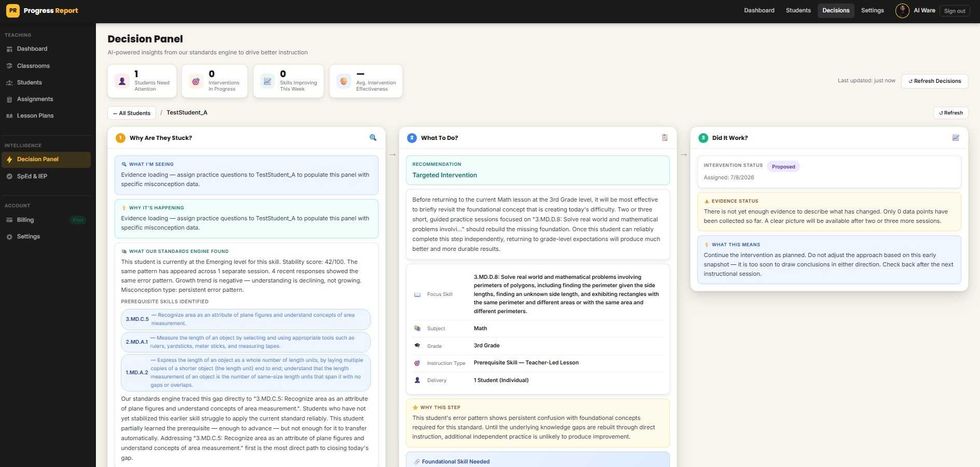
Progress Report traces student performance to learning gaps and prerequisite skills, helping educators understand not only where a student is struggling, but what may be causing it.
The platform then helps teachers build individualized instruction for general education students, students with special education and Individualized Education Program (IEP) needs, and Spanish-speaking learners—all within one educator-controlled system.
The goal is to reduce the guesswork and hours of manual work educators can spend developing individualized lesson plans.
 Progress Report helps idenitify learning gaps and common roadblocks for each student. Image courtesy Progress Report
For Ware and Montanez, the mission is also personal.
The concept dates back to around 2023, when the co-founders first had to navigate and address their children’s educational needs.
Ware, Progress Report’s CEO and CTO with a background in edtech, built the platform end-to-end after watching his daughter, who had an IEP related to speech, struggle to get the support she needed.
Montanez, the company’s COO, brought another perspective. Her son is on the autism spectrum. She now leads Progress Report’s operations, partnerships and pilot execution while helping carry its focus on bilingual families from Puerto Rico to Houston.
Together, they began researching ways to personalize their children’s learning and help them progress academically. Montanez’s son went on to become an AP student and high school athlete, while Ware’s daughter began reading more than two grade levels above her grade, they tell InnovationMap.
But Progress Report isn’t designed simply to give a struggling student more work.
Take a student who appears to have difficulty with math.
The problem may not actually be math, the founders share. The student could understand the calculations but struggle to comprehend complex words used in a math problem.
Progress Report is designed to trace those performance patterns back to learning gaps, prerequisite skills or other instructional barriers. From there, it can recommend a next instructional step while leaving the educator in control.
The same concept applies to accommodations.
The system can read IEPs, 504 Plans, Present Levels of Academic Achievement and Functional Performance (PLAAFPs), evaluations and other special education records. Approved IEP goals can then be mapped into the student’s learning graph, while accommodations can carry over into lesson planning and question delivery.
The founders say that approach separates Progress Report from simply adding another artificial intelligence chatbot to a classroom. And still, they believe teachers have to remain at the center.
Teachers, in fact, helped build Progress Report.
The founders began meeting with Houston-area educators months before the pilot. Their feedback helped shape the platform before testing began.
“We’ve been building alongside these educators,” Ware says.
Parents are another piece.
Progress Report can give parents access to their child’s learning record so they can see learning gaps as they develop. Teachers can also see information on work being completed at home when the parent and educator are working together.
After the pilot wraps, Ware and Montanez plan to introduce a $29.99 monthly subscription for homeschool parents, teachers and other educators. They say the price was intentionally kept relatively low to help make the tools more accessible.
They are also exploring ways to work with organizations that could help families who can’t afford the platform.
Moving forward, the goal is considerably bigger.
Over the next five years, Ware and Montanez want Progress Report to become what they describe as a “gold standard” in every state. They know getting there will require building relationships with educators, technology leaders, policymakers and school board members.
For now, they’re starting with a few hundred students and a question that sounds simple but can be remarkably difficult to answer: Why is this student struggling?
If Progress Report works the way its founders envision, teachers and parents will have a clearer answer.



 Progress Report helps idenitify learning gaps and common roadblocks for each student. Image courtesy Progress Report