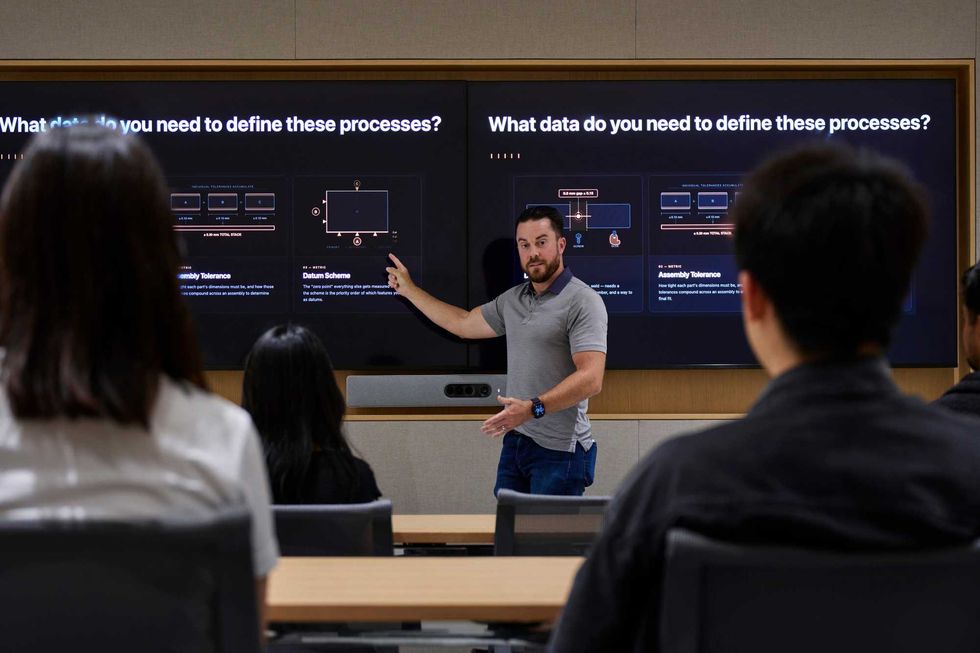
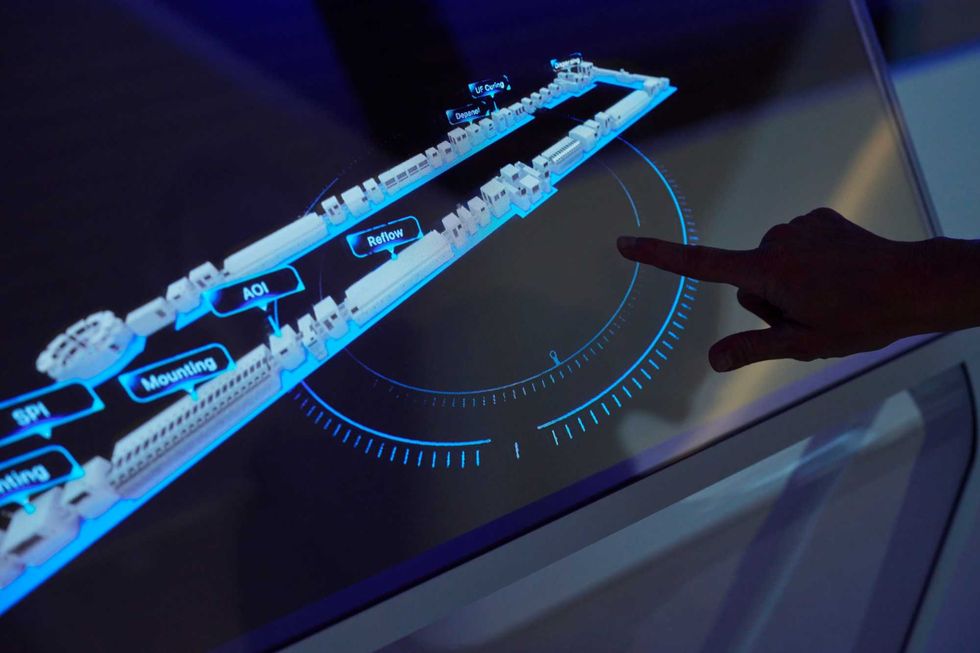
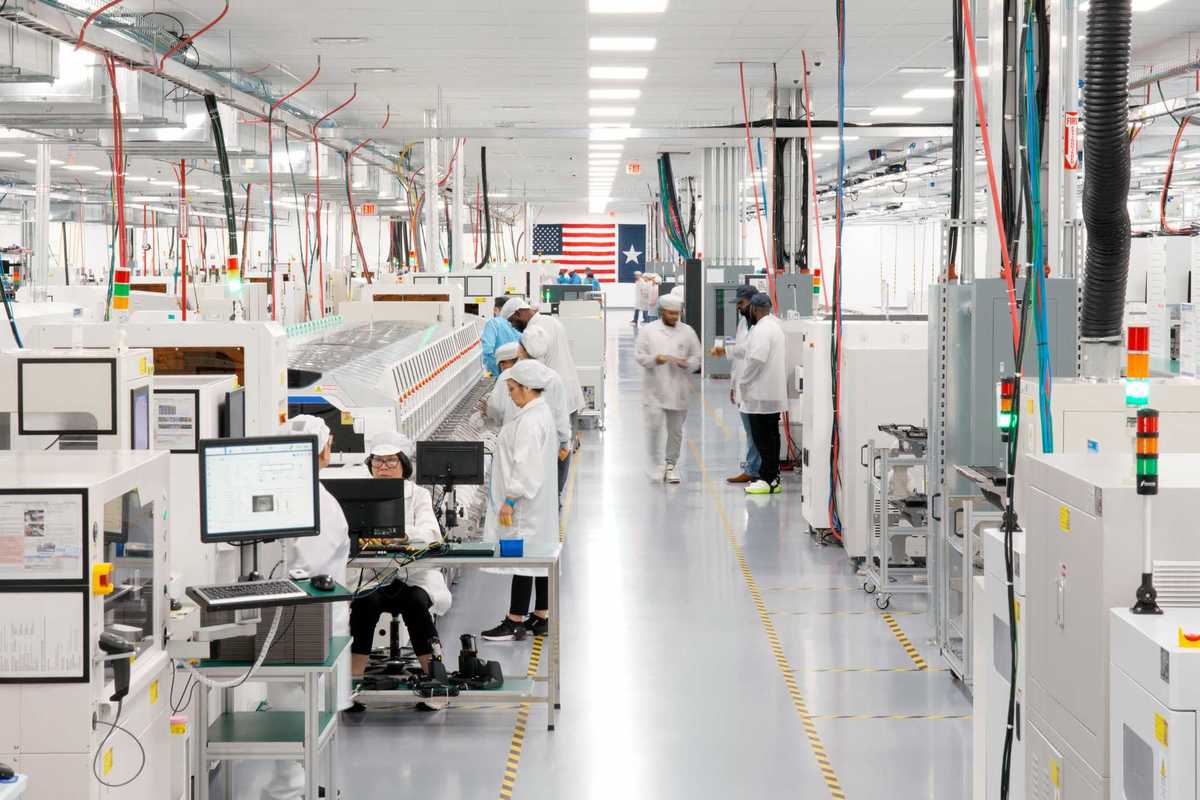
Apple's Advanced Manufacturing Center. Photos courtesy Apple

Cupertino, California-based Apple Inc. unveiled its Advanced Manufacturing Center in the Houston area last week, marking the completion of the second of three facilities the tech giant plans to launch in the city by the end of this year.

The 20,000-square-foot training center will welcome small- and medium-sized businesses for free training and educational sessions to "help accelerate smart manufacturing across America," according to a release from Apple. Apple opened a similar Apple Manufacturing Academy in Detroit last year.

The AMC is part of Apple's 500,000-square-foot site in northwest Harris County. It also features a massive manufacturing site for Apple’s advanced AI servers and Mac mini. The facility was originally slated to open in 2026, but Apple began producing its advanced AI servers ahead of schedule in 2025.

The company said it plans to begin manufacturing its Mac mini at the site this year. The move will bring production of the compact desktop computer to the U.S. for the first time.

“In less than nine months, we have invested hundreds of millions of dollars into this Houston facility. We stood up a factory, started production, and shipped the first advanced AI servers off the line. Today, we’re thrilled to open our new Advanced Manufacturing Center, a place where businesses, workers, and students can learn the same innovative processes that we use to make Apple’s most groundbreaking products. And we’re pleased to begin Mac mini production later this year,” Tim Cook, Apple’s CEO, said in the news release. “We believe in American workers and American ingenuity, and we are moving at an incredible pace because we want to build more than great products. We want to build the future of American manufacturing.”
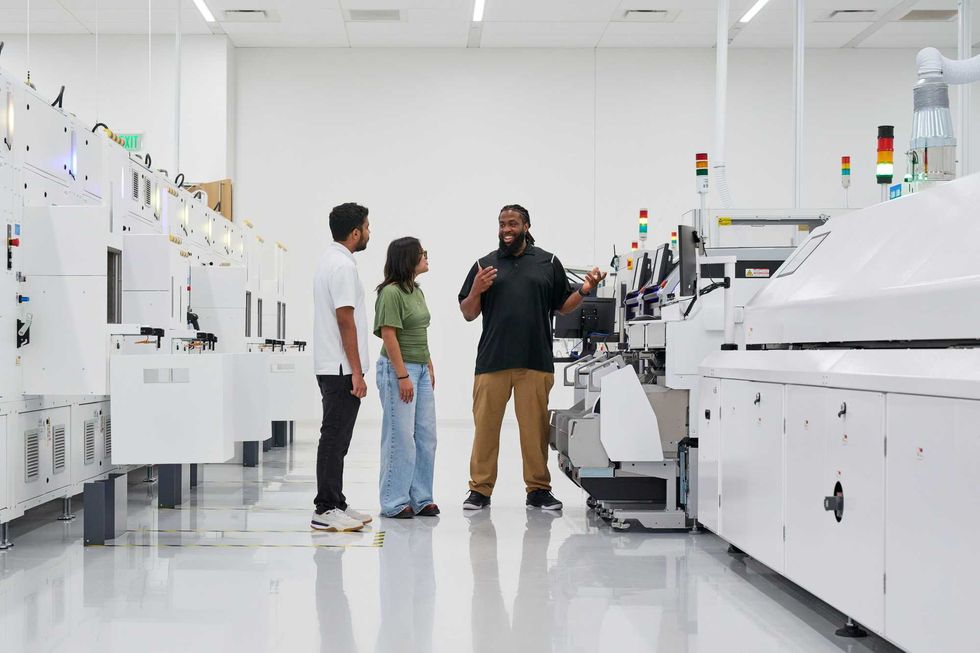
Apple's Advanced Manufacturing Center. Photos courtesy Apple
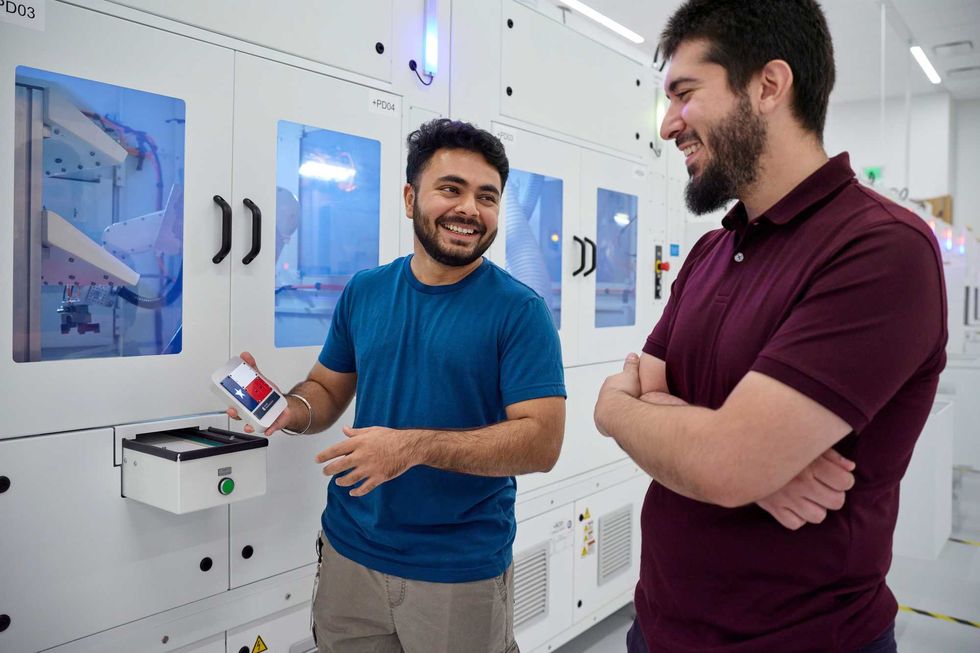
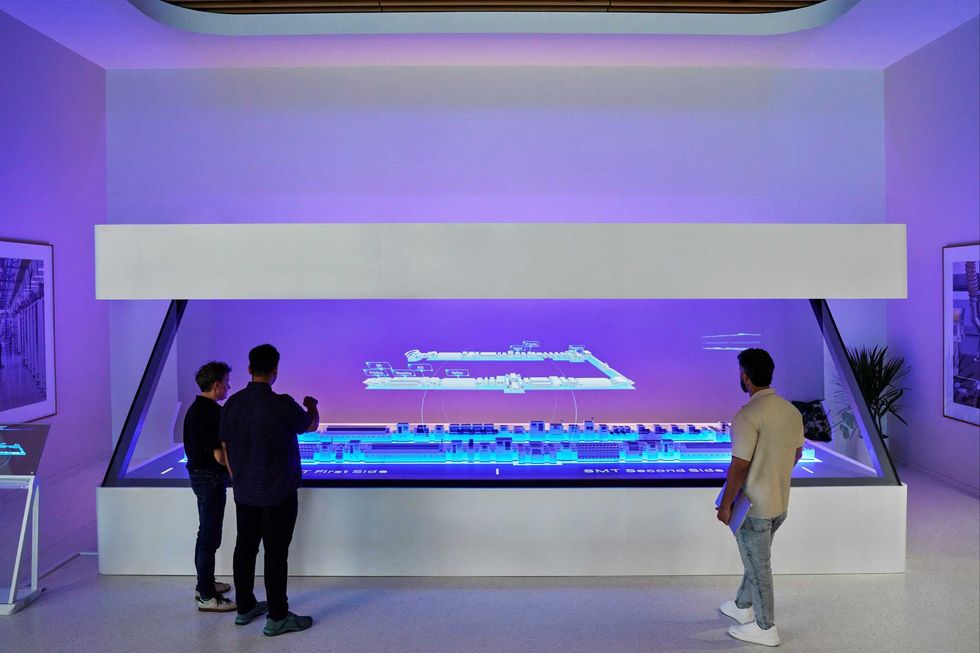
Apple's Houston expansion is part of a $600 billion commitment the company made to the U.S. in 2025.

The company originally announced plans in February 2025 to open a 250,000-square-foot Houston factory, but doubled the facility's planned size about a year later. Apple has reported that the factory will employ thousands of workers.

“Houston is grateful to Apple for this significant investment in our city. The Advanced Manufacturing Center will create local jobs and will continue improving the quality of life of Houston residents," Houston Mayor John Whitmire added in the release. "The AMC also recognizes our city as a growing technology hub and solidifies Houston’s leadership in the manufacturing sector of the United States.”

The opening comes on the heels of New Jersey-based pharmaceutical giant Bristol Myers Squibb Co. officially naming Houston home of its new $2.3 billion, state-of-the-art manufacturing site. Read more here.

Apple is bringing the production of its Mac mini to Houston. Getty Images

Tech giant Apple doubles down on Houston with new production facility

coming soon

Tech giant Apple announced that it will double the size of its Houston manufacturing footprint as it brings production of its Mac mini to the U.S. for the first time.

The company plans to begin production of its compact desktop computer at a new factory at Apple’s Houston manufacturing site later this year. The move is expected to create thousands of jobs in the Houston area, according to Apple.

Last year, the Cupertino, California-based company announced it would open a 250,000-square-foot factory to produce servers for its data centers in the Houston area. The facility was originally slated to open in 2026, but Apple reports it began production ahead of schedule in 2025.

The addition of the Mac mini operations at the site will bring the footprint to about 500,000 square feet, the Houston Chronicle reports. The New York Times previously reported that Taiwanese electronics manufacturer Foxconn would be involved in the Houston factory.

Apple also announced plans to open a 20,000-square-foot Advanced Manufacturing Center in Houston later this year. The project is currently under construction and will "provide hands-on training in advanced manufacturing techniques to students, supplier employees, and American businesses of all sizes," according to the announcement. Apple opened a similar Apple Manufacturing Academy in Detroit last year.

Apple doubles down on Houston with new production facility, training center Photo courtesy Apple.

“Apple is deeply committed to the future of American manufacturing, and we’re proud to significantly expand our footprint in Houston with the production of Mac mini starting later this year,” Tim Cook, Apple’s CEO, said in the news release. “We began shipping advanced AI servers from Houston ahead of schedule, and we’re excited to accelerate that work even further.”

Apple's Houston expansion is part of a $600 billion commitment the company made to the U.S. in 2025.

Ad Placement 300x100
Ad Placement 300x600

CultureMap Emails are Awesome

10+ can't-miss Houston business and innovation events for October

where to be

Editor's note: Healthcare and energy conferences headline this month's slate of innovation events in Houston. But there's also time for family-friendly gatherings and pickleball socials. Here’s what not to miss in October and how to register. Please note: this article may be updated to add more events.

Oct. 2 — Joy in Medicine Initiative Symposium

The Houston Methodist Joy in Medicine Initiative Symposium will explore the power of connection in enhancing professional fulfillment for clinicians and healthcare teams, this year with the theme of "Forging New Paths: Leadership, Connection & Innovation to Sustain Joy in Medicine." Hear from Dr. Shlomit Schall, Houston Methodist Physician Organization president and CEO and chief physician executive; Houston Methodist CEO Marc Boom; and Dr. Albert Wu, from Johns Hopkins, author of Therefore, Let us Rejoice: Sustaining Joy in Medicine. Stick around for a networking happy hour.

This event is Friday, Oct. 2, from 8:30 a.m.-4:30 p.m. at Thompson Houston on Allen Parkway. Find more information here.

Oct. 6-7 — Hydrogen Americas Summit and Exhibition

Hydrogen Americas delivers an unparalleled opportunity to explore how hydrogen integrates with CCUS and other energy solutions under the new U.S. and Americas energy paradigm. This event moves to Houston in 2026, providing unmatched access to industry leaders and opportunities. The summit will include CCUS-dedicated sessions integrated directly into the conference programming, providing deeper insights into carbon capture, utilization and storage. Look forward to networking opportunities to connect with global suppliers, regional developers and key policymakers.

This event begins Oct. 6 at George R. Brown Convention Center. Register here.

Oct. 6-7 — Annual Energy Summit — Energy, Risk, and Geopolitics

The 10th annual energy summit is co-hosted by Baker Botts and the Center for Energy Studies at Rice University's Baker Institute. This year's summit, “Energy, Risk, and Geopolitics,” will explore how a changing geopolitical landscape and shifts in supply chain risks are impacting investment, innovation and market dynamics. The two-day program will include discussions spanning petroleum and LNG markets, critical minerals, electricity reliability, AI and power demand.

This event begins Oct. 6 at 7:30 am at James A Baker III Hall. The event will also be livestreamed. Register here.

Oct. 7 – Rockets Get You to Orbit. Culture Gets You to Stay

The Ion will host a morning discussion exploring humanity’s future in space. The event will feature Rick Tumlinson, author of Why Space? The Purpose of People; Scott Solomon, author of Becoming Martian; and David Alexander and Alexander Regier of Rice University’s new Space Humanities Initiative. The conversations will be moderated by EarthLight Foundation Director Junaid Mian.

This event is Wednesday, Oct. 7, from 8:30-11 a.m. at the Ion. Register here.

Oct. 8 — Greentown Labs’ Fall Pickleball Social

Greentown Labs hosts its fall social at Pickle Lab HTX this month. Enjoy friendly matches, networking and light bites. All skill sets are welcome.

This event is Thursday, Oct. 8, from 5:30-7:30 p.m. at Pickle Lab HTX. Register here.

Oct. 10 – Ion Family Tech Festival

Bring the whole family out to the second Ion Family Tech Festival. Kids will get to participate in hands-on STEAM workshops and learn more about STEAM-related careers.

This event is Saturday, Oct. 10, from 9 a.m.-12 p.m. at the Ion. Register here.

Oct. 13 – Mercury Fund Day at the Ion

Don’t miss the latest installment of Mercury Fund Day at the Ion, previously known as Software Day. The recurring monthly event features office hours (by application), a keynote and networking opportunities.

This event is Tuesday, Oct. 13, from 3:30-7 p.m. at the Ion. Register here.

Oct. 14 — Future of Global Energy Conference

This October, the sixth annual Future of Global Energy Conference kicks off, convening influential leaders from across energy, technology, finance and public policy who will come together to explore the forces defining the next era of global energy and Houston’s role in shaping it. Ryan Lance, Executive Chairman of ConocoPhillips and 2027 Chair of the Greater Houston Partnership’s Board of Directors, is the keynote speaker for this year’s conference, bringing a global perspective on rising demand, market volatility and Houston’s role in the next era of energy growth.

This event takes place Oct. 14 at the Marriott Marquis. Register here.

Oct. 17 — Energy Day 2026

Energy Day Houston is the nation’s largest free, family-friendly STEM festival. It features over 50 interactive exhibits and live demonstrations focused on traditional and emerging energy career paths to power up your curiosity.

This event begins at 11 a.m. on Oct. 17 at Sam Houston Park. Get details here.

Oct. 22 — Rice360 Innovation for Healthcare Access Conference

Researchers and innovators from Rice University, the Texas Medical Center, non-profit organizations, healthcare providers and others will come together to explore gaps in healthcare at the Innovation for Healthcare Access Conference. The event will feature speakers, workshops and case study presentations and will focus on innovations for the health of women and children in underserved rural and urban communities across Texas.

This event is Thursday, Oct. 22, from 8 a.m.-5 p.m. at the Rice University BioScience Research Collaborative (BRC). Register here.

Oct. 28-29 – TiECon 2026

TiE Houston, TiE Dallas and TiE Austin are joining forces to host TiEcon Texas 2026 at the Ion this month. The event will focus on how automation, artificial intelligence and emerging technologies are reshaping Texas industries, the economy and daily life. The conference will feature keynotes, panels, fireside chats and the TiE Hatch Pitch Competition.

This event starts Thursday, Oct. 29, at the Ion. Register here.

UH secures $5M in philanthropic gifts to bolster engineering, nursing

major gifts

The University of Houston has received two significant philanthropic gifts to advance innovation and healthcare, the college announced this month.

Manmohan Singh Kalsi and Marie-Luise Schubert Kalsi granted $4 million to UH’s Cullen College of Engineering to support endowed and current funds for graduate fellowships and industry interest in the mechanical and aerospace fields.

The gift is the Department of Mechanical and Aerospace Engineering’s largest donation in years, according to UH, and will establish two endowed professorships to attract and retain leading faculty. It will also create the Kalsi Faculty Research Fund, which aims to take emerging research to the next level.

Additionally, UH says it will also bring industry experts to campus to present and collaborate with students via the forthcoming Kalsi Seminar Series.

Manmohan Kalsi earned both his master’s degree and Ph.D. in mechanical engineering from UH. He went on to found Sugar Land-based Kalsi Engineering in 1978, which pioneered hydrodynamic rotary sealing technology and valve technology for nuclear power plants. In 2014, he established an endowed professorship within Cullen College in honor of the late UH professor Gabriel Fazekas.

"This gift provides a tremendous boost to our department's strategic momentum,” Karolos Grigoriadis, chair of the Department of Mechanical and Aerospace Engineering, said in a news release. “By simultaneously supporting faculty, graduate researchers and collaborative seminars, the Kalsis are strengthening every part of our research enterprise and creating new opportunities for discovery, collaboration and student mentorship.”

Meanwhile, Houston’s The Hamill Foundation also gave a $1 million gift to UH’s Andy and Barbara Gessner College of Nursing. The funds will establish The Hamill Foundation Endowed Professorship in Community Care Nursing, to support a faculty member focused on community-based nursing education, partnerships, research, and outreach to underserved communities in Houston.

Additionally, the funding will go toward efforts to address nurse shortages through the newly established UH Health program. The Hamill Foundation has donated $6 million previously to UH through the years, but the latest $1 million is the largest single investment from the foundation to date.

“The Hamill Foundation continues to help us raise the bar for nursing education and address the nursing shortage,” Kathryn Tart, founding dean and professor at Gessner College and Humana Endowed Dean's Chair in Nursing, said in a news release. “The enduring commitment and generosity of The Hamill Foundation allow us to answer the call and educate generations of competent and caring nursing professionals.”

Both of the recent gifts help fund UH’s $1 billion Can’t Stop Houston: The Centennial Campaign. As of September, the university had raised more than $881 million. UH turns 100 years old in March 2027.

SpaceX's supersized Starship rocket launches into orbit for first time

Out in Space

SpaceX launched its enormous Starship into orbit for the first time Monday, September 28, and successfully delivered the most advanced Starlink satellites yet, but cut the flight short to ensure safety.

The spacecraft reentered over the Pacific and splashed down north of Hawaii three hours after blasting off from Texas. The company had been aiming for a 10-hour flight, spanning six full laps around Earth, to prove its readiness for NASA’s Artemis moon program.

Starship tipped over and erupted in flames upon splashdown, a dramatic end to the mission.

Elon Musk's Starship almost didn't make it to orbit when one of its engines shut down prematurely. But with everything else working well and the bad engine no longer needed, flight controllers decided, after several tense minutes, to proceed as planned.

“Starship is orbital,” Mission Control announced to cheers.

NASA Administrator Jared Isaacman congratulated SpaceX on reaching orbit and “managing every step in a safe, responsible and especially inspirational way.”

Rocket carries 26 of Musk's most advanced Starlink satellites

Musk’s showpiece rocket — the biggest and most powerful ever built — carried 26 of the latest Starlinks to join the 11,000 older models already providing internet service. They popped out of the spacecraft one by one, drawing more cheers from the SpaceX crowd at the Starbase launch site.

The decision to end the flight early came soon afterward. SpaceX said hours later in an online update that the decision was made “out of an abundance of caution” because of the early engine trouble.

It was Starship’s 14th full-scale launch from Texas’ southern tip in three years. Earlier test flights ventured no farther than the Indian Ocean halfway around the world, often crashing in flames and briefly skimming space.

This time, the intent was for SpaceX to circle the globe from an altitude of 170 miles (275 kilometers) — not just once but six times over almost 10 hours, ending with a Pacific splashdown near Chile. While Starship achieved the proper orbit, zipping along at 17,500 mph (28,000 kph), flight controllers opted to play it safe and bring it back several hours sooner, after just a couple of laps.

The first-stage booster was never meant to return to the Starbase launch site either, dropping instead into the Gulf of Mexico within minutes of the morning liftoff.

SpaceX wants to ensure that everything works before flying Starship back to Starbase. If the spacecraft breaks apart over land and rains debris onto people, “our popularity would diminish very rapidly,” Musk said at a business summit earlier this month. “That’s why we’re being extremely cautious here.”

Depending on the findings from Monday's orbital debut, the next Starship could return to the launch pad, where giant mechanical arms would grab the hovering spacecraft. If the catch works — Musk gives it even or slightly better odds — then SpaceX will refly the spacecraft by year’s end or early next year.

The 407-foot (124-meter) rocket was designed from the start to be fully reusable, a key to lowering launch costs. SpaceX managed to salvage the last Starship from the Indian Ocean in July. Engineers modified the newly launched Starship’s heat shield based on hands-on inspections of the recovered spacecraft, which is being tugged back to Starbase.

SpaceX wants Starship to be certified for orbital flight

SpaceX is pressing hard to certify Starship for orbital flight, a vital step toward moon and Mars travel.

NASA’s Artemis III mission is coming up as soon as next summer, a triple-launch docking exercise in orbit around Earth between an Orion capsule full of astronauts and competing lunar landers. Jeff Bezos’ Blue Moon would blast off first, followed by Orion — which would close in for a linkup — and then Musk’s Starship for a docking with Orion once Blue Moon is unleashed.

The next mission, Artemis IV, is slated for no sooner than 2028 and would have astronauts landing on the moon in either Blue Moon or Starship, whichever is ready first. Subsequent moonshots will alternate between the two billionaires’ landers.

Musk originally developed Starship for Mars, intending to launch scores of them with the red planet’s first settlers. For now, he plans to focus on the moon and use Starship to haul satellites into orbit by the truckload, phasing out the company’s frailer Falcon 9 rocket within several years. A second Starship launch site is nearing completion at Florida’s Kennedy Space Center and a third is planned for Louisiana.