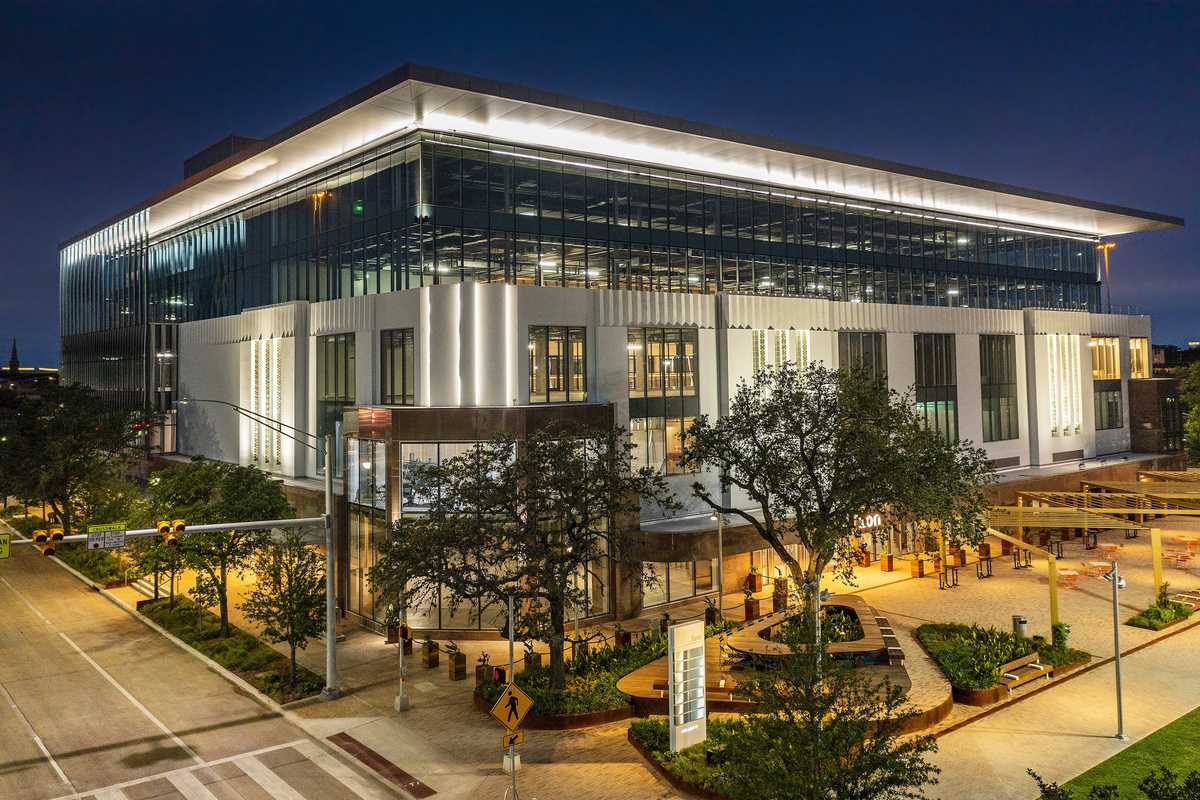
Houston Methodist will name its forthcoming 26-story hospital facility the Brockman Centennial Tower. Rendering courtesy Houston Methodist

Houston Methodist has received the largest gift in the health system's history to establish new funds for neurological, neuroscience, and women’s health research and treatment.

The $110 million gift comes from Houston-based The Brockman Medical Research Foundation, which supports education and research in the science, medicine and healthcare fields. In response, Houston Methodist announced that it will name its forthcoming 26-story hospital facility the Brockman Centennial Tower.

The tower’s entrance will be named the Anna Margaret Bellows Centennial Hall to honor Anna Margaret Bellows, a young camper who died during the Camp Mystic flooding last summer.

“This extraordinary gift accelerates discovery and transforms how care is delivered,” Dr. Marc Boom, president and CEO of Houston Methodist, said in a news release. “We are grateful to The Brockman Medical Research Foundation for its incredible generosity and vision that will help change the lives of generations of patients. Naming Centennial Tower in recognition of this gift reflects the scale of this commitment and its impact on the future of neuroscience, neurological care and women’s health.”

The gift will be divided into two parts:

  • $100 million will go toward creating an innovation fund within the Houston Methodist Academic Institute and the Houston Methodist Neurological Institute
  • $10 million will be devoted to Houston Methodist's Department of Obstetrics and Gynecology

“This tremendous gift will accelerate translational research that broadens our understanding of neurological and other diseases,” Dr. Jenny Chang, president and CEO of the Houston Methodist Academic Institute, added in the release. “It will allow us to leverage state-of-the-art platforms to detect, diagnose and deliver therapeutics, keeping patient care at the center of our mission.”

The Brockman Centennial Tower is expected to open next year in the Texas Medical Center. Spanning more than 1 million square feet, it will house 400 patient beds, an expanded emergency department, new operating rooms and a rooftop garden. It will be connected to Houston Methodist's flagship Paula and Joseph C. “Rusty” Walter III Tower, which opened in 2018. The Centennial Tower was estimated to cost $1.4 billion when announced in 2022.

In addition to the news of the Brockman gift, Houston Methodist also announced this month that it has launched the Houston Methodist Center for Cell and Gene Therapy and tapped an internationally recognized scientist as its leader.

The new center is focused on discovering and developing innovative and cost-effective therapies for a variety of congenital and acquired diseases, including cancer, HIV and cardiovascular disease.

Dr. Malcolm Brenner has been named as the center's inaugural leader and will assume the role starting in October. He will work alongside scientists and support staff from Baylor College of Medicine and Texas Children's Hospital.

Brenner is a professor of pediatrics, medicine, molecular and human genetics and translational biology at Baylor College of Medicine. He is known for making early advances in using bone marrow transplantation as a form of cell therapy and in engineered immune-cell treatments for cancer and infections, according to a release from Houston Methodist.

“Malcolm Brenner is a pioneer in the field of cell and gene therapy and is uniquely qualified to lead Houston Methodist’s research efforts in this field,” Chang added. “His vision and leadership will play a pivotal role in advancing our work in this space.”

Ad Placement 300x100
Ad Placement 300x600

CultureMap Emails are Awesome

European spacecraft developer expands to Houston with U.S. business, new lab

houston hq

European aerospace manufacturer The Exploration Company has established its first U.S. entity and named Space City as its headquarters.

The company announced earlier this month that it has launched TEC Federal to support U.S. government customers and agencies, and to scale The Exploration Company's engineering operations in the country.

Mark Kirasich serves as president of TEC Federal. Kirasich most recently served as the senior director of human spaceflight at Blue Origin after a nearly 40-year career at NASA.

The Exploration Company is developing the reusable Nyx space vehicle. Nyx is designed to take off from any heavy launcher in the world. It will then dock at space stations, retrieve up to 3,000 kilograms of cargo, splash down and return the cargo to Earth. The company aims to make Nyx fully reusable for up to 10 missions, making it a more affordable and sustainable option for aerospace missions.

The Exploration Company completed a successful drop test of the spacecraft in May in the Mojave Desert. The company says Nyx is slated to perform its first flight demonstration in 2028.

In addition to launching the Houston business, The Exploration Company also opened its new Rapid Innovation Lab near Houston's NASA Johnson Space Center on Space Park Drive.

The Exploration Company opened its Rapid Innovation Lab earlier this month. Photo via LinkedIn

The Rapid Innovation Lab features a full-scale mockup of the future Nyx crew capsule as well as ongoing development and testing of the Nyx cargo capsule, according to the company.

The Exploration Company says the new lab will allow its engineers, designers, and operators to prototype and test crew interfaces. It will also support partnerships with NASA personnel and astronauts.

“Houston gives us direct access to the people and expertise that have built and operated human spaceflight systems for decades. We’re excited to invest and expand around that— engineers, operators, and astronauts working together and moving quickly towards building a crew capsule.” Hélène Huby, founder and CEO of The Exploration Company, said in a blog post.

According to The Houston Chronicle, The Exploration Company has about 30 employees in the Houston area.

The company was founded in 2021 by Huby, a French rocket scientist, and has raised more than $350 million in venture capital. It operates out of Germany, France, Luxembourg, Spain and Italy, with offices in the U.S. and the United Arab Emirates. It is also developing a reusable, high-thrust rocket engine known as Storm.

UH lands $4M NIH grant to study early signs of autoimmune disease

NIH funding

The University of Houston recently received a $4 million National Institutes of Health grant to support a 10-year longitudinal study to identify the earliest biological markers of autoimmune disease.

Led by Chandra Mohan, the Hugh Roy and Lillie Cranz Cullen Endowed Professor of Biomedical Engineering, the study aims to examine what causes Systemic Autoimmune Rheumatic Diseases (SARDs) and to identify targets for future treatments. The study will be carried out in collaboration with Dr. Karen Costenbader at Harvard Medical School, Boston.

SARDs include conditions like rheumatoid arthritis, systemic lupus erythematosus, Sjögren’s syndrome and systemic sclerosis—all are considered chronic diseases currently without a cure. Autoimmune diseases affect over 30 million people globally, according to UH.

SARDs occur when the body’s immune system attacks healthy, non-threatening tissues and organs. According to UH, in these diseases, the body often attacks nuclear antigens, creating anti-nuclear autoantibodies, which can be early detection signs for SARDs in more than 50 percent of patients, Mohan says.

Researchers will study blood samples and environmental exposure over the 10 years to better understand anti-nuclear autoantibodies.

“Collectively, these studies will help identify the genetic, environmental and cellular factors that are operative at the two steps of SARD development, namely the emergence of anti-nuclear autoantibodies and disease onset,” Mohan said in a news release. “ More importantly, these studies will highlight functional molecular pathways and mechanisms that may be operative at each step."

Mohan predicts that looking at SARDs’ shared characteristics, rather than each disease individually, could help identify more treatment methods.

“Individual SARDs have been examined in silos without an attempt to discern shared underlying features at the molecular level,” he added in the release. “Current understanding of the initial (and likely shared) origins of SARDs is only rudimentary but urgently needed to develop means for prevention and treatment.”

Earlier this year, UH also received an $11 million NIH grant to conduct a first-of-its-kind study of early language development in children ages 18 to 24 months. Read more here.