
The new Amyloid Mechanism and Disease Center will serve as the neuroscience branch of Rice’s Brain Institute. Photo via Unsplash.

Rice University launched its new Amyloid Mechanism and Disease Center last month, which aims to uncover the molecular origins of Alzheimer’s, Parkinson’s and other amyloid-related diseases.

The center will bring together Rice faculty in chemistry, biophysics, cell biology and biochemistry to study how protein aggregates called amyloids form, spread and harm brain cells. It will serve as the neuroscience branch of the Rice Brain Institute, which was also recently established.

The team will work to ultimately increase its understanding of amyloid processes and will collaborate with the Texas Medical Center to turn lab discoveries into real progress for patients. It will hold its launch event on Jan. 21, 2026, and hopes to eventually be a launchpad for future external research funding.

The new hub will be led by Pernilla Wittung-Stafshed, a Rice biophysicist and the Charles W. Duncan Jr.-Welch Chair in Chemistry.

“To make a real difference, we have to go all the way and find a cure,” Wittung-Stafshede said in a news release. “At Rice, with the Amyloid Mechanism and Disease Center as a catalyst, we have the people and ideas to open new doors toward solutions.”

Wittung-Stafshede, who was recruited to Rice through a Cancer Prevention and Research Institute of Texas grant this summer, has led pioneering work on how metal-binding proteins impact neurodegenerative disorders, including Alzheimer’s and Parkinson’s diseases. Her most recent study, published in Advanced Science, suggests a new way of understanding how amyloids may harm cells and consume the brain’s energy molecule, ATP.

According to Alzheimer’s Disease International, neurodegenerative disease cases could reach around 78 million by 2030 and 139 million by 2050. Wittung-Stafshede’s father died of dementia several years ago.

“This is close to my heart,” Wittung-Stafshede added in the news release. “Neurodegenerative diseases such as dementia, Alzheimer’s and Parkinson’s are on the rise as people live longer, and age is the largest risk factor. It affects everyone.”
Ad Placement 300x100
Ad Placement 300x600

CultureMap Emails are Awesome

MD Anderson receives $10M gift to launch pancreatic cancer program

med funding

The University of Texas MD Anderson Cancer Center will be getting a significant boost in the fight against pancreatic cancer thanks to a recent gift from longtime supporters Zelma and William Reid. The medical system announced this month that a $10 million donation would help it establish a new Pancreatic Cancer High-Risk Interception Program.

“Philanthropic investments like this create opportunities to accelerate discoveries and pursue bold approaches to some of the most challenging cancers we face,” said Dr. Jeffrey E. Lee, president ad interim of UT MD Anderson, said in a news release. “We are deeply grateful to Zelma and Bill Reid for their generosity and enduring commitment. Their support will help advance innovative research aimed at intercepting pancreatic cancer earlier, when we have the greatest opportunity to improve outcomes for patients.”

Pancreatic cancer is one of the most deadly types of cancer. Despite being relatively rare, it ranks third in total deaths from cancer in the United States. Less than 10 percent of patients diagnosed with pancreatic cancer are still alive five years later.

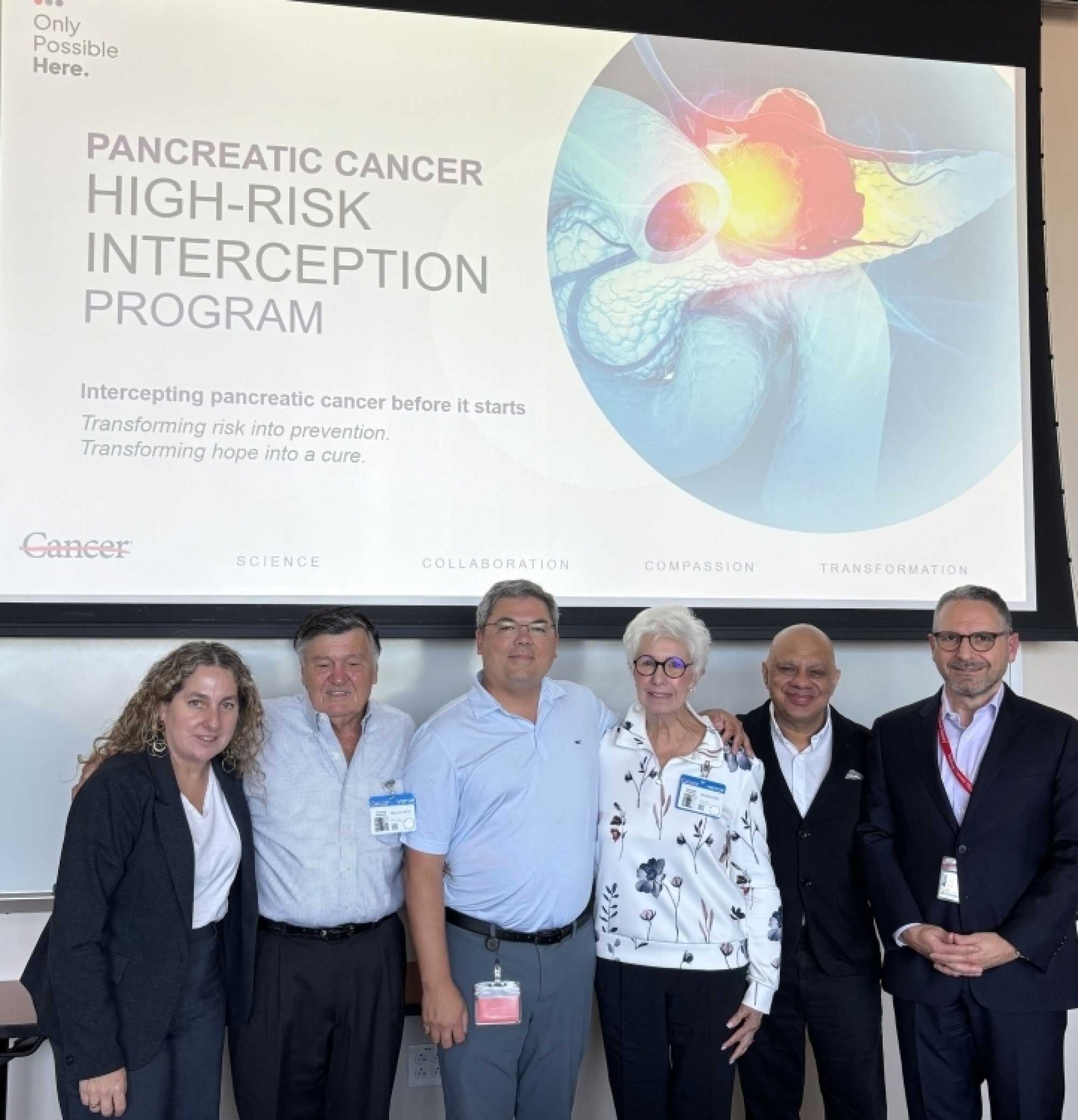
Dr. Florencia McAllister, William Reid, Dr. Michael P. Kim, Zelma Reid, Dr. Manoop S. Bhutani, and Dr. Matthew H.G. Katz. Photo courtesy MD Anderson

The problem is often detection. The pancreas is located deep in the upper abdomen among many other organs, which can make spotting tumors difficult. Some blood tests can indicate pancreatic cancer, but it is usually not diagnosed until it spreads.

The new Pancreatic Cancer High-Risk Interception Program hopes to assemble new diagnostic techniques and patient screening tools to increase early detection. MD Anderson’s Dr. Michael P. Kim, associate professor of surgical oncology; Dr. Manoop S. Bhutani, professor of gastroenterology and hepatology; and Dr. Florencia McAllister, professor of gastrointestinal medical oncology and genetics, will lead the new program.

The team will rely on advanced imaging, molecular diagnostics, AI-driven assessment, and DNA testing to both create an at-risk patient population profile and hopefully help detect the cancer in its earliest stages. For instance, some of these tools will be able to monitor pancreatic cysts without invasive surgery.

“The ultimate goal is to intercept pancreatic cancer development or to initiate treatment earlier in the disease process, when patients have the best chance for successful outcomes,” Kim added in the release. “This gift will allow us to expand our research efforts, strengthen collaborations across disciplines and accelerate promising strategies to identify and intercept pancreatic cancer before it becomes life-threatening. We are incredibly thankful to the Reids for making this work possible.”

Axiom Space inks partnership to grow semiconductor crystals in orbit

space deal

Down in Webster, Texas, and high above the Earth, Axiom Space and Kansas-based Nitride Global Inc. will grow the next generation of semiconductor crystals in microgravity thanks to a new memorandum of understanding (MOU) signed earlier this month.

“Signing this MOU with Nitride Global reflects the growing commercial interest in producing advanced semiconductor materials in space,” Lucie Low, chief science officer for Axiom Space, said in a news release. “Their leadership in aluminium nitride (AlN) crystal growth and advanced packaging technologies, combined with Axiom Space’s capabilities in orbital infrastructure and mission integration, position us to demonstrate real commercial value in low-Earth orbit (LEO).”

This latest partnership builds on existing collaboration between Axiom and NitrideGlobal and NASA Ames Research Center.

Aluminium nitride crystals are part of the cutting-edge generation of semiconductors essential to emerging high-voltage transistors and also used in various medical technologies. Because of their high thermal stability, they can be used in a variety of environments and applications that have revolutionized everything from electric cars to the grids the cars run on.

However, the crystals are challenging to grow on Earth and face defects and size limitations due to gravity. Growing them in space can enhance their performance, according to NitrideGlobal. Microgravity allows them to grow more uniformly and with fewer defects, potentially resulting in larger, purer and more reliable crystals.

That’s where Axiom Space comes in. The company is developing Axiom Station, a successor to the International Space Station, where new research and manufacturing can be carried out.

“This MOU marks a pivotal milestone in our close partnership with Axiom Space that started as part of the NASA Small Business Innovation Research (SBIR) for AlN growth in space and is now expanding to usher the development of an innovation ecosystem,” Mahyar Khosravi, CEO of Nitride Global Inc., added in the release. “With Axiom Space’s leadership in the in-space manufacturing sector, this partnership will aim to deliver a platform for commercially viable manufacturing of [ultrawide bandgap materials] that will enable the next generation of semiconductor & microelectronics for terrestrial and planetary exploration uses.”

Houston's IAH lands on list of 15 most expensive U.S. airports

Travel Woes

Hold on to those carry-on bags: George Bush Intercontinental Airport is checking in as one of the 15 most expensive airports in the U.S., a new study has revealed.

The analysis from digital commerce and marketing platform ConsumerVoice.org compared the average domestic flight costs at the 50 largest U.S. airports, ranking them from highest to lowest. Flight price data was sourced from the U.S. Department of Transportation’s Bureau of Transportation Statistics (BTS) during the first and second quarters of 2026 and compared with the same period in 2025.

Washington Dulles International Airport in Virginia tops the list as the priciest major airport in the U.S, with domestic flights at IAD costing $534.34 on average. Charlotte Douglas International Airport in North Carolina comes in second place with an average fare cost of $527.79.

IAH lands at No. 13 nationwide, and it's the second most expensive in Texas, the findings show. The typical domestic flight from IAH costs $482.02, and they aren't getting any cheaper. Flights out of IAH are nine percent more expensive than they were a year ago, the report found. The average domestic flight cost $37.80 less in 2025.

Houstonians not only need to be prepared to spend a little extra money when booking their tickets; they'll also need to pack their patience, as IAH also ranks among the worst airports for flight delays and cancellations.

Travelers on a budget can save more on flights out of William P. Hobby Airport, if they're willing to make the drive. Travelers can save about 13 percent on their flights by flying through HOU instead of IAH, but there are other costs to take into consideration.

"Ground transportation, gas, and parking can eat into the difference, so factor these in when choosing the most economical departure airport," the report said.

HOU ranked as the No. 31 most expensive airport on the list with domestic flights coming in at $417.78 on average. Average fares at HOU are also nine percent more expensive than they were last year.

The top 10 priciest major airports in the U.S. are:

  • No. 1 – Washington Dulles International Airport
  • No. 2 – Charlotte Douglas International Airport
  • No. 3 – Detroit metro Wayne County Airport
  • No. 4 – Salt Lake City International
  • No. 5 – Minneapolis-St. Paul International
  • No. 6 – San Francisco International
  • No. 7 – John F. Kennedy International
  • No. 8 – Newark Liberty International
  • No. 9 – Dallas/Fort Worth International
  • No. 10 – Hartsfield-Jackson Atlanta International
---

This article originally appeared on CultureMap.com.