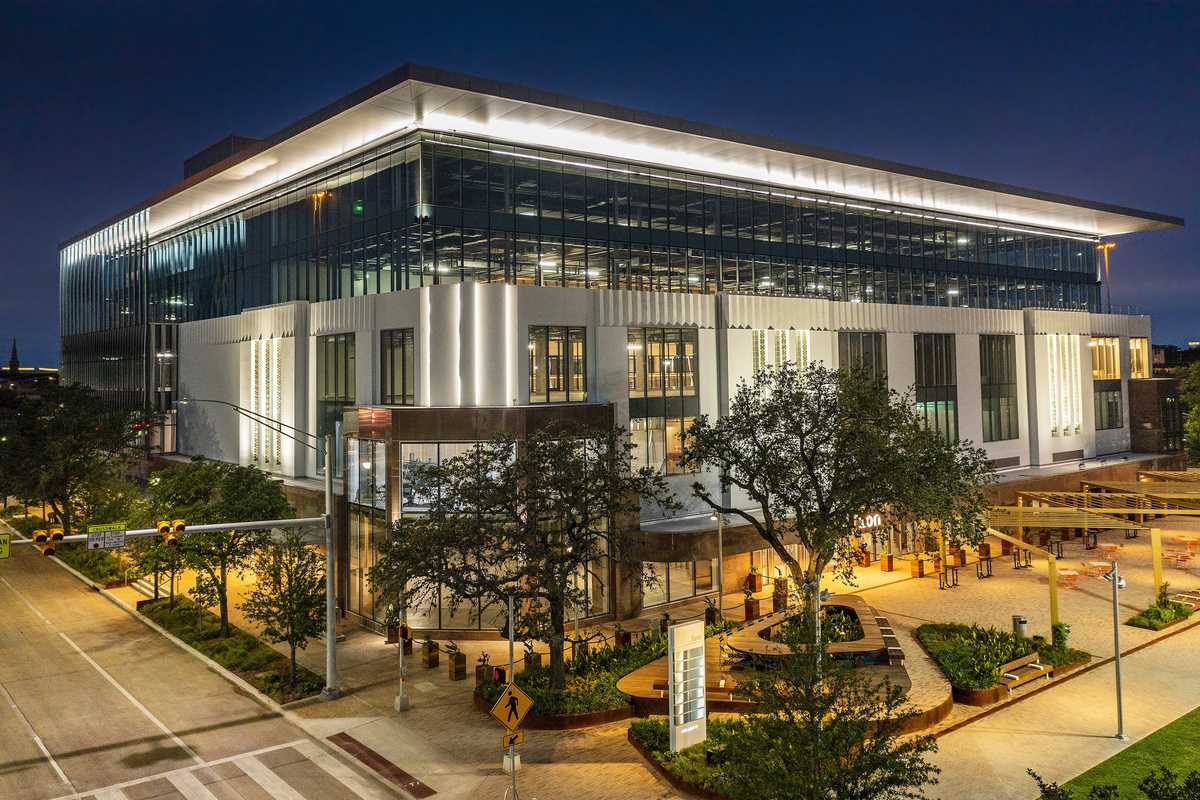
Texas A&M will work with DARPA to test fully automated and semi-automated helicopters to combat wildfires in the state. Image by Colie Wertz. Courtesy DARPA.

Texas A&M University's George H.W. Bush Combat Development Complex will receive $59.8 million to develop a way for autonomous helicopters to fight to wildfires in the state.

The funds appropriated from the Texas legislature will go toward acquiring up to four UH-60 Blackhawk helicopters and developing their autonomous configuration, as well as to facilities, tools and equipment for research, testing and integration of firefighting capabilities over the next two years, according to a release from Texas A&M.

The BCDC was also selected to work with the Defense Advanced Research Projects Agency (DARPA) on its Aircrew Labor In-cockpit Automation System (ALIAS), which works to reduce risks for pilots and aircraft in high-risk missions.

"Working together with Texas, we have an opportunity to use autonomous helicopters to completely change the conversation around wildfires from containing them to extinguishing them,” Stuart Young, DARPA program manager for ALIAS, said in a release from DARPA.

The BCDC program will incorporate DARPA's automation toolkit, known as MATRIX, which has already demonstrated fully autonomous flight capabilities on approximately 20 aircraft platforms. MATRIX, which was developed by California-based Sikorsky Aircraft, was previously tested in proof-of-concept demonstrations of autonomous fire suppression in California and Connecticut earlier this year, according to DARPA.

“I am proud we are working with DARPA in a manner that will benefit Texas, the Department of Defense, and commercial industry,” retired Maj. Gen. Tim Green, director of the BCDC, said in the release. “Wildland firefighting will be the first mission application fully developed to take advantage of over a decade of work by DARPA on its Aircrew Labor In-cockpit Automation System (ALIAS).”

The BDC will test fully automated and semi-automated ALIAS-equipped aircraft on highly complex firefighting tasks. The complex will also work with Texas A&M University–Corpus Christi’s Autonomy Research Institute, the Texas Division of Emergency Management, the Texas A&M Engineering Extension Service, the Texas A&M Forest Service and the Texas A&M Engineering Experiment Station on the project.

John Diem, director of the innovation proving grounds at BCDC, will serve as principal investigator for the project.

“Advancing system capabilities through the last stages of technology maturation, operational testing, and concept development is always hugely exciting and rewarding,” Diem added in the release. “The best part of my career has been seeing systems I tested move into the hands of warfighters. Now, I’m proud to help ensure ALIAS is safe and effective in protecting life and property – and we will do that through realistic and challenging testing.”

Ad Placement 300x100
Ad Placement 300x600

CultureMap Emails are Awesome

Texas booms as No. 3 best state to start a business right now

Innovation Starts Here

High employment growth and advantageous entrepreneurship rates have led Texas into a triumphant No. 3 spot in WalletHub's ranking of "Best and Worst States to Start a Business" for 2026.

Texas bounced back into the No. 3 spot nationally for the first time since 2023. After dropping into 8th place in 2024, the state hustled into No. 4 last year.

Ever year, WalletHub compares all 50 states based on their business environment, costs, and access to financial resources to determine the best places for starting a business. The study analyzes 25 relevant metrics to determine the rankings, such as labor costs, office space affordability, financial accessibility, the number of startups per capita, and more.

When about half of all new businesses don't last more than five years, finding the right environment for a startup is vital for long-term success, the report says.

Here's how Texas ranked across the three main categories in the study:

  • No. 1 – Business environment
  • No. 11 – Access to resources
  • No. 34 – Business costs

The state boasts the 10th highest entrepreneurship rates nationwide, and it has the 11th-highest share of fast-growing firms. WalletHub also noted that more than half (53 percent) of all Texas businesses are located in "strong clusters," which suggests they are more likely to be successful long-term.

"Clusters are interconnected businesses that specialize in the same field, and 'strong clusters' are ones that are in the top 25 percent of all regions for their particular specialization," the report said. "If businesses fit into one of these clusters, they will have an easier time getting the materials they need, and can tap into an existing customer base. To some degree, it might mean more competition, though."

Texas business owners should also keep their eye on Houston, which was recently ranked the 7th best U.S. city for starting a new business, and it was dubbed one of the top-10 tech hubs in North America. Workers in Texas are the "third-most engaged" in the country, the study added, a promising attribute for employers searching for the right place to begin their next business venture.

"Business owners in Texas benefit from favorable conditions, as the state has the third-highest growth in working-age population and the third-highest employment growth in the country, too," the report said.

The top 10 best states for starting a business in 2026 are:

  • No. 1 – Florida
  • No. 2 – Utah
  • No. 3 – Texas
  • No. 4 – Oklahoma
  • No. 5 – Idaho
  • No. 6 – Mississippi
  • No. 7 – Georgia
  • No. 8 – Indiana
  • No. 9 – Nevada
  • No. 10 – California
---

This article originally appeared on CultureMap.com.

Houston lab-test startup seeks $1M for nationwide expansion

Testing Access

Health care industry veteran Jim Gebhart knew there had to be a better way for patients to access lab services, especially those with high health insurance deductibles or no insurance at all.

“This challenge became deeply personal when a close family member developed a serious illness, and we struggled to secure prompt appointments,” Gebhart tells InnovationMap. “It’s incredibly frustrating when a loved one cannot receive timely care simply because of provider shortages or the limited capacity of traditional clinics.”

Driven by the desire to knock down lab-test barriers, Gebhart founded Houston-based TheLabCafe.com in 2024. The platform provides access to low-cost medical tests without requiring patients to carry health insurance. TheLabCafe serves patients in six states: Texas, Georgia, Louisiana, Nevada, New Mexico and Oklahoma. Gebhart, the startup’s CEO, says that by the end of March, LabCafe will be offering services in 20 more states and the District of Columbia.

Gebhart has spent more than 30 years in the lab industry. His career includes stints at Austin-based Clinical Pathology Laboratories, Ohio’s Cleveland Clinic Laboratories and Secaucus, New Jersey-based Quest Diagnostics.

“Since nearly 80 percent of disease diagnoses rely on laboratory testing, I decided to leverage my background to create a more accessible, self-directed process for individuals to order blood and urine tests on their own terms — when and where they need them,” says Gebhart.

So far, Gebhart is self-funding the startup. But he plans to seek $700,000 to $1 million in outside investments in late 2026 to support the nationwide expansion and the introduction of more services.

TheLabCafe contracts with labs for an array of tests, such as cholesterol, hepatitis, metabolic, testosterone, thyroid and sexually transmitted infection (STI) tests. A cholesterol test obtained through TheLabCafe might cost $29, compared with a typical cost of perhaps $39 to $59 without insurance.

A health care professional reviews every test, both when the test is ordered and when the results are delivered, often within 24 hours. After receiving test results, a patient can schedule a virtual visit with a health care professional to go over the findings and learn potential treatment options.

Gebhart says TheLabCafe particularly benefits uninsured patients, including those in Texas. Among the states, Texas has the highest rate of uninsured residents. U.S. Census Bureau data shows 21.6 percent of adults and 13.6 percent of children in Texas lacked health insurance in 2024.

“Uninsured patients often pay the highest prices in the health care system,” Gebhart explains. “We address this by offering straightforward pricing and convenient access to testing without requiring insurance.”

“Our rates are intentionally set to remain affordable, helping individuals take a proactive approach to their health,” he adds. “Regular testing enables people to identify potential health issues early and track their progress as they make lifestyle changes. Ultimately, you can’t measure improvement without data — and laboratory results provide that data.”

Houston geothermal startup secures $97M Series B for next-gen power

fresh funding

Houston-based geothermal energy startup Sage Geosystems has closed its Series B fundraising round and plans to use the money to launch its first commercial next-generation geothermal power generation facility.

Ormat Technologies and Carbon Direct Capital co-led the $97 million round, according to a press release from Sage. Existing investors Exa, Nabors, alfa8, Arch Meredith, Abilene Partners, Cubit Capital and Ignis H2 Energy also participated, as well as new investors SiteGround Capital and The UC Berkeley Foundation’s Climate Solutions Fund.

The new geothermal power generation facility will be located at one of Ormat Technologies' existing power plants. The Nevada-based company has geothermal power projects in the U.S. and numerous other countries around the world. The facility will use Sage’s proprietary pressure geothermal technology, which extracts geothermal heat energy from hot dry rock, an abundant geothermal resource.

“Pressure geothermal is designed to be commercial, scalable and deployable almost anywhere,” Cindy Taff, CEO of Sage Geosystems, said in the news release. “This Series B allows us to prove that at commercial scale, reflecting strong conviction from partners who understand both the urgency of energy demand and the criticality of firm power.”

Sage reports that partnering with the Ormat facility will allow it to market and scale up its pressure geothermal technology at a faster rate.

“This investment builds on the strong foundation we’ve established through our commercial agreement and reinforces Ormat’s commitment to accelerating geothermal development,” Doron Blachar, CEO of Ormat Technologies, added in the release. “Sage’s technical expertise and innovative approach are well aligned with Ormat’s strategy to move faster from concept to commercialization. We’re pleased to take this natural next step in a partnership we believe strongly in.”

In 2024, Sage agreed to deliver up to 150 megawatts of new geothermal baseload power to Meta, the parent company of Facebook. At the time, the companies reported that the project's first phase would aim to be operating in 2027.

The company also raised a $17 million Series A, led by Chesapeake Energy Corp., in 2024.

---

This article originally appeared on our sister site, EnergyCapitalHTX.com.