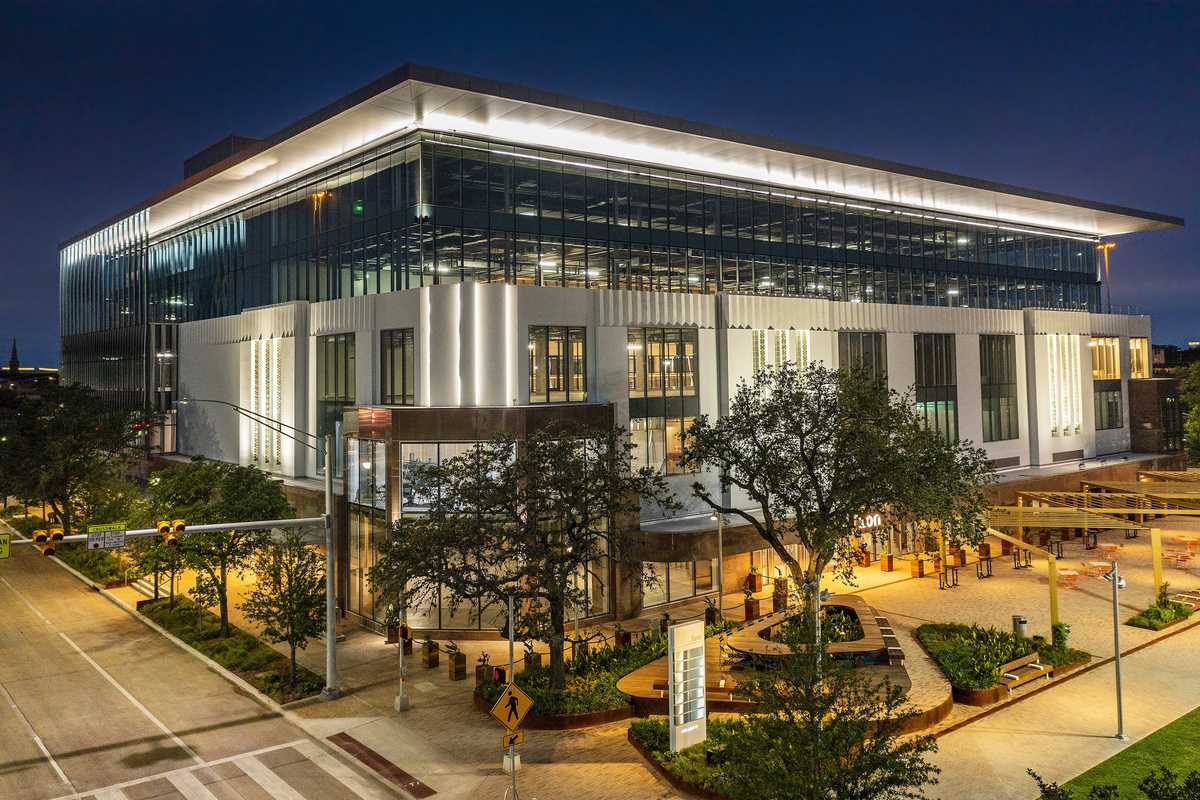
Nexalin develops non-invasive devices that help reset networks in the brain associated with symptoms of anxiety and insomnia. Photo via Getty Images.

A Houston-based company is taking a medicine-free approach to target brain neurologically associated with mental illness.

Nexalin Technology’s patented, FDA-cleared frequency-based waveform targets key centers of the midbrain to support the normalization of neurochemicals through a process known as Transcranial Alternating Current Stimulation (tACS). Delivered via a non-invasive device, the treatment gently stimulates the hypothalamus and midbrain, helping to “reset networks associated with symptoms” of anxiety and insomnia. Early clinical evidence suggests this approach can promote healthier brain function and improved sleep.

Through its recently appointed scientific advisory board (SAB), Nexalin also aims to target Alzheimer’s disease with a clinical development pipeline supported by published data and internal data from studies involving its proprietary DIFS technology. Nexalin’s Gen-2 SYNC and Gen-3 Halo headset delivers the DIFS, which is a waveform that can penetrate deep brain structures implicated in cognitive decline and mental illness.

The board includes experts in neurology, neuroimaging and neurodegenerative diseases with Dr. Mingxiong Huang, Dr. David Owens, and Dr. Abe Scheer coming on board. Nexalin plans to initiate new Alzheimer’s-focused clinical studies in the Q3 2025 by incorporating cognitive testing, imaging biomarkers, and guided metrics to assess treatment efficacy and neural activation.

“I am excited to work alongside Nexalin’s leadership and fellow SAB members to help guide the next generation of non-invasive neuromodulation therapies,” Huang said in a news release. “The intersection of neuroimaging, brain stimulation, and clinical science holds enormous potential for treating neurodegenerative disease.”

Recently, Nexalin’s proprietary neurostimulation device moved forward with a clinical trial that evaluated its treatment of anxiety disorders and chronic insomnia in Brazil. The first of Nexalin’s Gen-2 15-milliamp neurostimulation devices was shipped to São Paulo, Brazil, and the study will be conducted at the Instituto de Psiquiatria University Hospital (IPq-HCFMUSP). The shipments aim to support the launch of a Phase II clinical trial in adult patients suffering from anxiety and insomnia. The Nexalin Gen-2 15-milliamp neurostimulation device has also been approved in China, Brazil and Oman. Its Gen 1 device first received FDA clearance in 2003, according to the company's website.

The company also enrolled the first patients in its clinical trial at the University of California, San Diego, in collaboration with the VA San Diego Healthcare System for its Nexalin HALO, which looks to treat mild traumatic brain injury and post-traumatic stress disorder in military personnel and the civilian population.

Nexalin previously raised $5 million through a

public stock offering.

Ad Placement 300x100
Ad Placement 300x600

CultureMap Emails are Awesome

5 Houston-area companies named among world's most innovative for 2026

In The Spotlight

Led by Conroe-based Hertha Metals, five organizations in the Houston area earned praise on Fast Company’s list of the World’s Most Innovative Companies of 2026.

Hertha Metals ranked No. 1 in the manufacturing category.

Last year, Hertha unveiled a single-step process for steelmaking that it says is cheaper, more energy-efficient and just as scalable as traditional steel manufacturing. It started testing the process in 2024 at a one-metric-ton-per-day pilot plant.

At the same time, Hertha announced more than $17 million in venture capital funding from investors such as Breakthrough Energy, Clean Energy Ventures, Khosla Ventures, and Pear VC.

“We’re not just reinventing steelmaking; we’re redefining what’s possible in materials, manufacturing, and national resilience,” Laureen Meroueh, founder and CEO of Hertha, said at the time.

Meroueh was also recently named to Inc. Magazine's 2026 Female Founders 500 list.

Hertha, founded in 2022, says traditional steelmaking relies on an outdated, coal-based multistep process that is costly, and contributes up to 9 percent of industrial energy use and 10 percent of global carbon emissions.

By contrast, Hertha’s method converts low-grade iron ore into molten steel or high-purity iron in one step. The company says its process is 30 percent more energy-efficient than traditional steelmaking and costs less than producing steel in China.

Last year, Hertha said it planned to break ground in 2026 on a plant capable of producing more than 9,000 metric tons of steel per year. In its next phase, the company plans to operate at 500,000 metric tons of steel production per year.

Here are Fast Company’s rankings for the four other Houston-area organizations:

  • Houston-based Vaulted Deep, No. 3 in catchall “other” category.
  • XGS Energy, No. 7 in the energy category. XGS’ proprietary solid-state geothermal system uses thermally conductive materials to deliver affordable energy anywhere hot rock is located. While Fast Company lists Houston as XGS’ headquarters, and the company has a major presence in the city, XGS is based in Palo Alto, California.
  • Houston-based residential real estate brokerage Epique Realty, No. 10 in the business services category. Epique, which bills itself as the industry’s first AI brokerage, provides a free AI toolkit for real estate agents to enhance marketing, streamline content creation, and improve engagement with clients and prospects.
  • Texas A&M University’s Nanostructured Materials Lab in College Station. The lab studies nano-structured materials to make materials lighter for the aerospace industry, improve energy storage, and enable the creation of “smart” textiles.
---

This article first appeared on our sister site, EnergyCapitalHTX.com.

UH lands $11.8M for first-of-its-kind early language development study

speech funding

Researchers at the University of Houston have secured an $11.8 million grant from the National Institutes of Health to conduct a first-of-its-kind study of early language development.

Led by Elena Grigorenko, the Hugh Roy and Lillie Cranz Cullen Distinguished Professor of Psychology, and research professor Jack Fletcher, the study will follow 3,600 children aged 18 to 24 months to uncover how language skills develop at this critical stage and why some children experience delays that can influence later growth.

The NIH funding will also support the development of the new national Clinical Research Center on Developmental Language Disorders at UH, which aims to bring experts from psychology, education, health and measurement sciences to study how children learn language.

“This will be the first national study to estimate how common late talking is using a large, representative sample of Houston toddlers,” Grigorenko said in a news release. “By following these children as they grow, we hope to better understand the developmental pathways that can lead to conditions such as developmental language disorder and autism.”

UH’s team will partner with the pediatric clinic network at Texas Children’s Hospital, where children will be screened for early language development, allowing researchers to identify those who show signs of delayed speech. Next, researchers will follow the cohort through early childhood to examine how language abilities evolve and how early delays may lead to later challenges.

The Clinical Research Center on Developmental Language Disorders will be the 14th national research center established at UH, and will include researchers from multiple UH departments, as well as partners at Baylor College of Medicine and the Texas Center for Learning Disorders.

“This level of investment from the National Institutes of Health reflects the significance of this work to address a complex challenge affecting children, families and communities,” Claudia Neuhauser, vice president for research at UH, said in a news release. “By bringing together experts from multiple disciplines and partnering with major health systems across the region, the project reflects our commitment to advancing discoveries that impact our community.”

Rice Alliance names Houston healthtech exec as first head of platform

new hire

The Rice Alliance for Technology and Entrepreneurship has named its first head of platform.

Houston entrepreneur Laura Neder stepped into the newly created role last month, according to an email from Rice Alliance. Neder will focus on building and growing Houston’s Venture Advantage Platform.

The emerging platform, which is being promoted by Rice Alliance and the Ion, aims to connect founders with the "people, capital and expertise they need to scale."

"I’ve spent a lot of time thinking about what it takes to make an innovation ecosystem more navigable, more connected, and more useful for founders," Neder said in a LinkedIn post. "I’m grateful for the opportunity to do that work at Rice Alliance, alongside a team with a long history of supporting entrepreneurship and innovation."

"Houston has the talent, institutions, and industry base to create real advantage for founders," she added. "I’m looking forward to listening, learning, and building stronger pathways across the ecosystem."

Neder most recently served as CEO of Houston-based Careset, where she helped bring the Medicare data startup to commercialization. Prior to that, Neder served as COO of Houston-based telemedicine startup 2nd.MD, which was acquired for $460 million by Accolade in 2021.

"Laura brings a rare combination of founder empathy, operational experience and ecosystem leadership," Rice Alliance shared.

Neder and Rice Alliance also shared that the organization is hiring developers to design the new Venture Advantage Platform. Learn more here.